
Jerusalem is one of the oldest continuously inhabited cities on Earth — roughly 5,000 years of history stacked on a plateau in the Judaean Mountains, 754 metres above sea level between the Mediterranean and the Dead Sea. Sacred to Judaism, Christianity and Islam alike, it holds more layered stories per square metre than almost anywhere else, which is why it rewards slow, self-guided exploration: wander at your own pace and let an audio guide unpack each landmark's history while you stand in front of it.
Inside the Ottoman walls
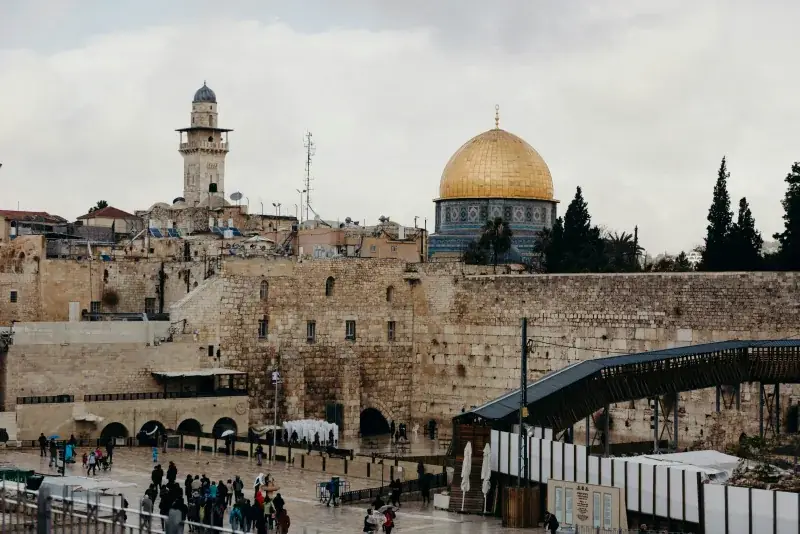
The Old City — a UNESCO World Heritage Site since 1981 — covers barely one square kilometre behind 16th-century walls raised by Suleiman the Magnificent, yet contains four distinct quarters: Muslim, Christian, Jewish and Armenian. Enter through Jaffa Gate beside the Tower of David, a citadel that layers Herodian foundations beneath Crusader and Mamluk stonework, then let the lanes pull you toward the sites pilgrims have sought for millennia. At the Western Wall, the last retaining wall of the Second Temple compound, handwritten prayers are slipped between stones that have stood since Herod's day. Above it, the golden Dome of the Rock crowns the Temple Mount, and the Via Dolorosa traces fourteen stations through the Muslim and Christian quarters to the Church of the Holy Sepulchre, where six Christian denominations share custody of Golgotha and the tomb. Each of these places carries centuries of contested, interwoven history — exactly the kind of story an audio guide brings alive as you look up from the crowd.
Getting lost is part of the charm: the bazaar along David Street, the excavated Roman Cardo and the rooftop viewpoints reward every wrong turn.
Tower of David
Ancient citadel of towers, moats and ramparts layered with four thousand years of conquest and rule.
Western Wall
Ancient retaining wall of stacked, mortar-free stone blocks, sacred site of prayer and pilgrimage.
Dome of the Rock
Gold-domed Islamic shrine of the seventh century, built over a rock sacred to three faiths.
Temple Mount
Sacred hilltop plaza in the old city, home to a golden-domed shrine and a historic mosque revered across three faiths.
Via Dolorosa
Cobbled pilgrimage route through the Old City, its fourteen marked stops tracing the traditional path to Calvary.
Church of the Holy Sepulchre
Ancient basilica built over the traditional sites of the crucifixion and burial of Jesus Christ.
Beyond the gates
Modern Jerusalem is far more than pilgrimage. Climb the Mount of Olives for the classic panorama over the golden Dome and the ancient cemeteries below. In West Jerusalem, Mahane Yehuda Market — locals just call it the shuk — packs more than 250 vendors of spices, halva, cheese and fresh-baked bread by day, then turns into the city's nightlife hub after dark. The Israel Museum keeps the Dead Sea Scrolls in its Shrine of the Book, while Yad Vashem, the World Holocaust Remembrance Center, is among the most moving museum experiences anywhere.
However long you stay, Jerusalem reveals itself in details — a worn threshold, a sealed gate, an inscription in three alphabets — and the surest way to catch them is to walk with the stories in your ears.
Mount of Olives
Sacred ridge of ancient olive groves and a three-thousand-year-old Jewish cemetery overlooking the Old City.
Mahaneh Yehudah Market
Bustling open-air bazaar of produce stalls and spice stands that turns into a lively bar scene after dark.
The Israel Museum, Jerusalem
Encyclopedic museum of archaeology and art, home to the Dead Sea Scrolls in a jar-shaped shrine.
Yad Vashem
Holocaust memorial complex on Jerusalem's Mount of Remembrance, with a museum, archives, and a mirrored children's memorial.