
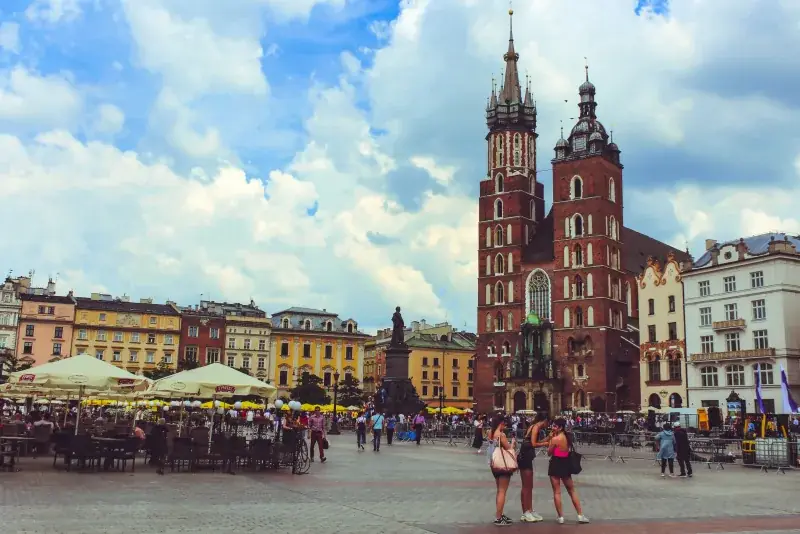

Kraków is the city Warsaw never quite replaced. Capital of Poland until 1596 and the coronation site of its kings long after, it came through the Second World War with its Gothic and Renaissance core almost untouched — which is why its Old Town was among the first twelve sites ever inscribed on the UNESCO World Heritage List, back in 1978. It is a city made for slow discovery: compact, layered, and best explored at your own pace with a self-guided audio tour telling each stone's story as you reach it.
A medieval heart, still beating
Start on Rynek Główny, Europe's largest medieval market square, laid out on a 13th-century grid the city still follows. Every hour a live trumpeter plays the hejnał from the tallest tower of St Mary's Basilica — and stops mid-note, as legend says a watchman did when a Tatar arrow struck him. The Renaissance Cloth Hall still trades in the middle of the square, as it has since it was the medieval world's shopping arcade, and beneath the cobbles the Rynek Underground museum descends through a thousand years of the city's archaeology. Each landmark here has its own audio guide, so the square becomes a walk through stories rather than a checklist.
Rynek Główny
Vast medieval plaza where a bugle call breaks off mid-note from a Gothic tower every hour.
St. Mary's Basilica
Gothic brick basilica with mismatched twin towers, home to a towering carved wooden altarpiece by Veit Stoss.
MNK Sukiennice
Renaissance cloth-hall gallery of the country's largest nineteenth-century painting collection.
Rynek Underground Museum
Archaeological site of medieval streets, market stalls and feared vampire graves below the pavement.
The Royal Route to Wawel
Enter the Old Town as kings did: through the Barbican and St Florian's Gate, then down Floriańska and Grodzka streets to Wawel Hill, where the Royal Castle and Cathedral hold the tombs of monarchs and the great Sigismund bell — and where, below the hill by the Vistula, a fire-breathing statue keeps alive the dragon of Kraków's founding legend.
Kraków Barbican
Circular Gothic fortress of thick brick walls and seven turrets, once linked by a moat to the city's main gate.
St. Florian's Gate
Sole surviving medieval gate tower, crowned by a Baroque dome, marking the start of the old royal coronation route.
Wawel Royal Castle-State Art Collection
Renaissance royal residence and museum holding a legendary tapestry collection that survived a wartime odyssey to Canada.
Wawel Cathedral
Gothic royal cathedral holding a martyred bishop's silver shrine and the tombs of kings.
Dragon Statue
Fire-breathing bronze dragon sculpture with six heads, guarding a legendary den beneath a royal hill.
Kazimierz and the darker chapters
South of the Old Town, Kazimierz — a separate royal town from 1335 and for centuries one of Europe's great centers of Jewish life — has been reborn as the city's most atmospheric quarter, its surviving synagogues now neighbors to cafés and galleries. Across the river, Oskar Schindler's Enamel Factory tells the story of Kraków under Nazi occupation, while day trips lead to the UNESCO-listed Wieliczka Salt Mine and the Auschwitz-Birkenau Memorial — sober, essential extensions of the city's history.
Home to the Jagiellonian University since 1364 — Copernicus studied here — and a UNESCO City of Literature, Kraków rewards ears as much as eyes. Pick a place, press play, and let the city talk.
Kazimierz
Historic former Jewish quarter of cobbled squares, synagogues, and courtyards turned Schindler's List film set.
Oskar Schindler's Enamel Factory
Former enamelware plant turned wartime rescue site, now a museum on Nazi-occupied city life.
Wieliczka Salt Mine
Medieval salt mine of carved underground chapels, chandeliers and altars sculpted entirely from rock salt.
Memorial and Museum Auschwitz-Birkenau
Preserved Nazi death camp of barracks, barbed wire and a starvation cell, now a memorial to over a million victims.