
Bavaria's big-hearted capital
Munich began in 1158 as a settlement "zu den Munchen" — "at the monks" — founded by Henry the Lion to control the salt trade. It grew into the royal seat of Bavaria and, today, Germany's third-largest city, where Wittelsbach palaces and world-class museums sit beside beer gardens, river surfers, and an unhurried Gemütlichkeit that locals still sum up in the affectionate nickname Millionendorf — the village of a million people. It is also a city made for exploring at your own pace, with a self-guided audio tour telling each landmark's story as you stand in front of it.
Marienplatz and the Old Town
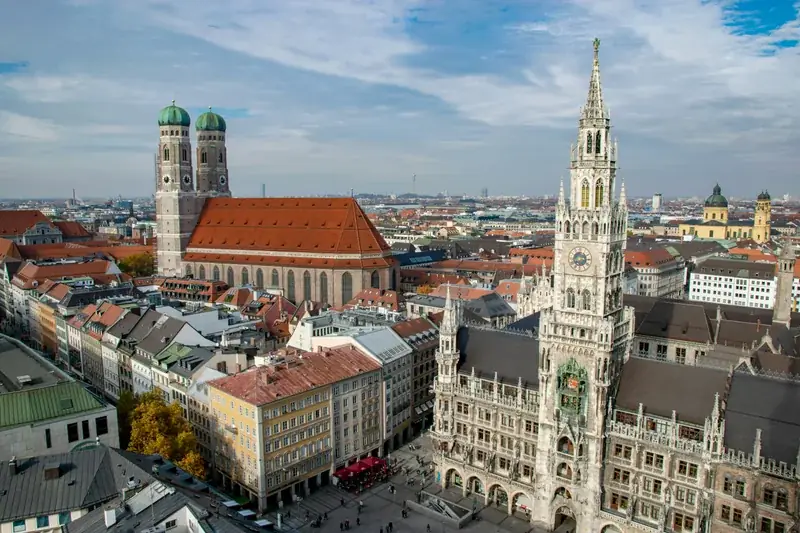
Start on Marienplatz, Munich's central square since the city's founding. At 11 a.m. and noon the tower of the New Town Hall comes alive as the famous Glockenspiel — 43 bells and 32 life-sized figures — re-enacts a 1568 tournament for Duke Wilhelm V and the coopers' Schäfflertanz, danced to coax Munich back outdoors after the plague; the audio guide unpacks the scenes while you watch. A few steps away rise the twin domed towers of the Frauenkirche, the city's silhouette since the 15th century, the food stalls of the Viktualienmarkt, and the Hofbräuhaus, pouring beer under ducal license since 1589.
Marienplatz
Historic square anchored by a golden Marian column and a town hall carillon re-enacting a plague-era dance and a royal joust.
New Town Hall
Neo-Gothic city hall tower whose mechanical carillon reenacts a royal wedding and plague dance.
Rathaus-Glockenspiel
Mechanical carillon of forty-three bells and life-sized figures reenacting a royal wedding joust and a coopers' dance.
Frauenkirche
Twin-towered Gothic brick cathedral with onion domes, home to a legendary devil's footprint at the entrance.
Viktualienmarkt
Open-air food market of flower and produce stalls beside a maypole and comedians' fountains.
Hofbräuhaus München
Historic royal brewhouse and beer hall serving strong Bavarian brews under vaulted, painted ceilings since the sixteenth century.
Palaces and the Wittelsbach legacy
Seven centuries of royal rule left Munich extravagantly endowed. The Munich Residence unfolds room after gilded room in the heart of town, while Nymphenburg Palace, the dynasty's baroque summer residence, stretches a garden front of 632 metres — wider than Versailles — and was the birthplace of "fairy-tale king" Ludwig II. Add the Deutsches Museum, the Pinakothek art galleries, BMW Welt, and the sweeping tent roofs of the 1972 Olympiapark, and you have museum-going for a week.
Munich Residence
Sprawling former royal palace of ten courtyards and over a hundred rooms, rebuilt from ruins after wartime bombing.
Nymphenburg Palace
Baroque summer residence with a gilded hall of portraits of the era's most celebrated beauties.
Deutsches Museum
World's largest science and technology museum, with hands-on exhibits across an island campus.
Alte Pinakothek
Neo-Renaissance palazzo of Old Master paintings, its bomb-scarred facade deliberately left patched with visible rubble brick.
BMW Welt
Swooping glass-and-steel showroom with a double-cone entrance where new car owners collect their vehicles.
Olympiapark München
Sprawling green park of hillside lawns and a lake, built around a landmark tent-shaped roof.
Green Munich
The English Garden, laid out from 1789 by Count Rumford, covers 3.7 square kilometres — larger than New York's Central Park — with 75 km of paths, the 7,000-seat Chinese Tower beer garden, and the Eisbach wave, where surfers ride a standing river wave all year round.
Come for Oktoberfest — held since a royal wedding in 1810 — but Munich rewards a visit in any season: a city of kings and coopers, monks and surfers, best discovered one story at a time.
English Garden
Sprawling city park with a river standing wave famous for urban surfing, plus temples and beer gardens.
Biergarten am Chinesischen Turm
Pagoda-topped beer garden under chestnut trees, site of a dawn dance once banned for indecency.
Eisbachwelle
Man-made standing wave on a park stream, ridden year-round by river surfers since the nineteen seventies.