
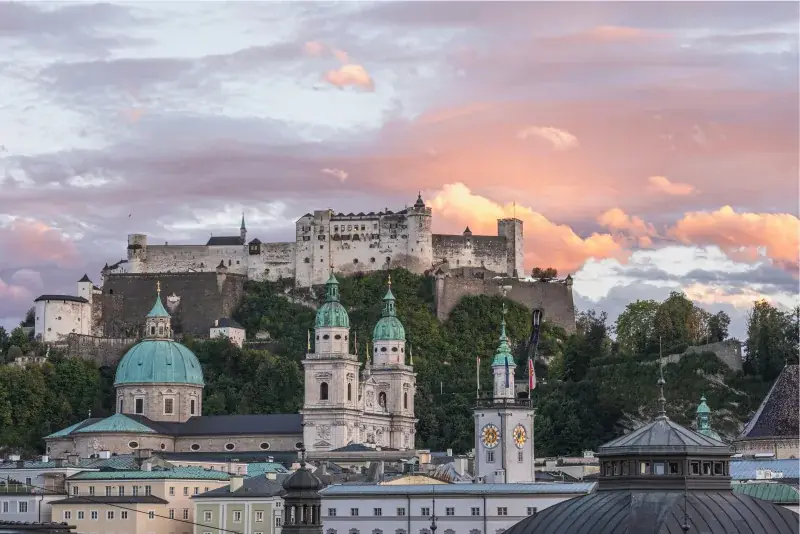
Few cities pack as much beauty into so small a space as Salzburg. Wedged between the Salzach River and the cliffs of the Mönchsberg, at the foot of the Alps near the German border, Austria's fourth-largest city grew rich on the salt trade that gave it its name — literally "salt castle" — and spent that wealth on domes, palaces and squares so perfectly preserved that the entire historic centre was listed as a UNESCO World Heritage Site in 1996. It is also a city made for self-guided audio touring: compact, largely pedestrian, and layered with stories, so you can wander at your own pace while an audio guide unpacks the history behind each façade.
The city the prince-archbishops built
For a thousand years Salzburg was ruled not by kings but by prince-archbishops, and ambitious builders like Wolf Dietrich von Raitenau set about turning a medieval trading town into a Baroque showcase from 1587 onward. Their legacy fills the Altstadt: Salzburg Cathedral, consecrated in 1628 and one of the most important early Baroque churches north of the Alps; Residenzplatz, whose marble Residenzbrunnen of 1661 is the largest Baroque fountain north of the Alps; and the state rooms of the Salzburg Residence, where the archbishops held court. Above it all looms Fortress Hohensalzburg, begun in 1077 and one of Europe's largest fully preserved medieval castles — ride the funicular up or take the footpath, and let the audio guide walk you through nine centuries of sieges never fought. Below, the cliff-cut graves of St. Peter's cemetery, beside Salzburg's oldest abbey, glow with candles in the evening.
Altstadt Salzburg
Pedestrian old-town core of arcaded courtyards, market squares and narrow medieval lanes below a hilltop fortress.
Salzburg Cathedral
Baroque twin-towered cathedral fronted for centuries by a bustling Advent food market.
Residenzplatz
Baroque plaza centered on a towering marble fountain of rearing horses, dolphins and a water-blowing triton.
Salzburg Residence
Baroque state rooms of a prince-archbishop's palace, with gilded halls and frescoed ceilings around an arcaded courtyard.
Fortress Hohensalzburg
Cliffside fortress reached by one of the world's oldest working cable hoists, still climbing its original rock-cut route.
Friedhof St. Peter (Petersfriedhof)
Salzburg's oldest cemetery, arcaded in wrought iron and Baroque family vaults sheltered beneath a cliff.
Mozart's hometown
Wolfgang Amadeus Mozart was born on 27 January 1756 at No. 9 Getreidegasse, the narrow lane famous for its wrought-iron guild signs, and baptized in the cathedral the very next day. He served the archbishop's court as a musician before leaving for Vienna, but Salzburg never let him go: his birthplace is now a beloved museum, concerts sound year-round, and each summer the Salzburg Festival makes the city a world capital of classical music.
Gardens, trick fountains and The Sound of Music
Across the river, the Mirabell Gardens — laid out beneath the marble halls of Mirabell Palace — pair Pegasus Fountain views of the fortress with steps every Sound of Music fan will recognize from "Do-Re-Mi." A short ride south, Hellbrunn Palace (1613–1619) still soaks unsuspecting guests with the trick fountains its playful archbishop devised four centuries ago.
Salzburg rewards the unhurried: climb its hills for the views, then drift lane by lane with an audio tour in your ears, and the Baroque city reveals itself one story at a time.
Mirabell Gardens
Baroque garden of marble balustrades, mythological fountains and a hidden dwarf statue collection.
Mirabell Palace
Bastion garden lined with marble statues of dwarfs who once entertained a baroque court.
Hellbrunn Palace
Water-powered automaton theatre of over a hundred and sixty tiny figures acting out a baroque town, still running on its original mechanism.