
Route≈ 70 m2.1 km
Lisbon, rebuilt
From Carmo through Rossio and Baixa to the river: discover a city shaped by destruction and renewal. A short walk, starting with a descent.

 98 places
Lisbon layers three millennia of history — Moorish Alfama, Manueline Belém and the elegant post-earthquake Baixa — up steep hills above the Tagus, with fado and custard tarts along the way.
From Carmo through Rossio and Baixa to the river: discover a city shaped by destruction and renewal. A short walk, starting with a descent.

From Senhora do Monte through Graça and Alfama to the cathedral and Casa dos Bicos. Viewpoints, the Pantheon and fado, with steps and hills.

From LX Factory and the docks to Belém Tower: industrial heritage, pastries, palaces and maritime history. A long riverside walk with breaks.

From Estrela and Pessoa’s house through Príncipe Real, Chiado and the waterfront to Mouraria and Graça. A half-day walk with gardens, cafés and climbs.
Lisbon has been a city for roughly three thousand years — among Europe's capitals only Athens is older — and it stacks that history in layers up steep hillsides above the River Tagus. Phoenician traders, Roman Olisipo, Moorish alleyways, the gilded wealth of the Age of Discoveries: every era left its mark on these streets, and the most rewarding way to read them is to wander with a story in your ears. Every landmark here comes with a self-guided audio guide, so the city narrates itself as you climb from the riverfront to the castle walls.
On the morning of 1 November 1755, an earthquake — followed by fire and a tsunami — flattened most of Lisbon and killed tens of thousands. Out of the rubble, the Marquês de Pombal drew a startlingly modern grid: the Baixa, an elegant lower town of uniform façades that spills down to Praça do Comércio, the vast riverfront square where kings and cargoes once came ashore. Stand under its triumphal arch with the audio guide playing and the whole drama of destruction and rebirth unfolds around you.
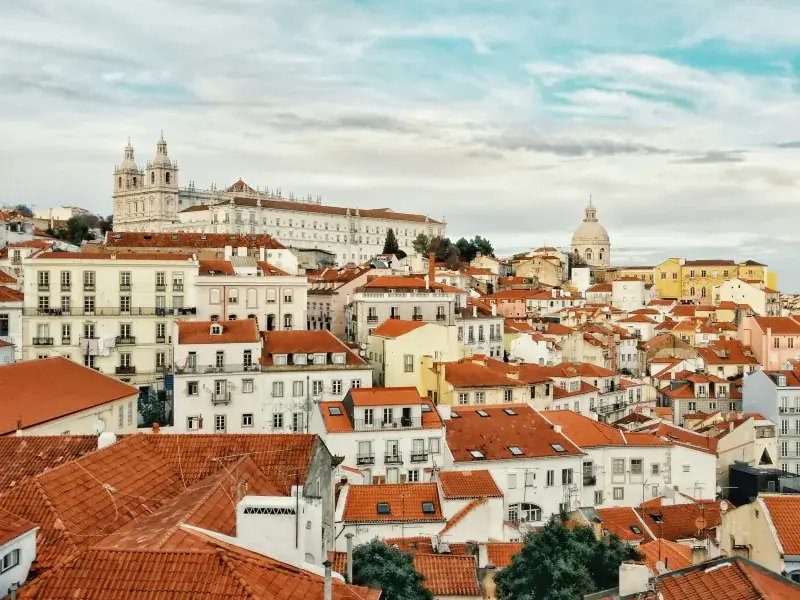
The quarter the earthquake largely spared is Alfama, a Moorish-rooted maze of cobbled becos, stairways and tiny squares tumbling downhill from Castelo de São Jorge, where Portugal's first kings held court and peacocks now patrol the ramparts. This is the cradle of fado, Lisbon's aching, UNESCO-recognized song — you'll hear it drifting from open windows and dedicated fado houses after dark. Pause at the miradouros of Portas do Sol and Santa Luzia, tiled balconies hanging over a jumble of terracotta roofs, and let the guide point out what the postcard views leave out.
Hillside quarter with a labyrinthine Moorish street plan and centuries-old fado tradition.
Moorish-era hilltop fortress with panoramic views and centuries of conquest and royal history.
Hilltop terrace at the Moorish city's eastern gate, overlooking Alfama's red-tiled rooftops.
Downriver in Belém, Portugal's seafaring golden age turns to stone. The Jerónimos Monastery, begun in 1501 and funded by a tax on the spice trade, is the masterpiece of the ornate Manueline style and holds the tomb of Vasco da Gama, who prayed here before sailing for India. Together with the fortress of Belém Tower it has been a UNESCO World Heritage Site since 1983, while the Monument to the Discoveries salutes the navigators from the water's edge. Finish the pilgrimage the local way: warm custard tarts at Pastéis de Belém, baked to a secret monastery recipe since 1837.
Monastery with elaborately carved cloisters and the tombs of Vasco da Gama and King Manuel I.
River fortress with ornate Manueline carvings, once used as a tidal dungeon prison on the Tagus.
Monumental stone prow on the Tagus, flanked by sculpted figures from Portugal's age of exploration.
Lisbon is no museum piece. Bairro Alto swaps daytime quiet for a bar-hopping roar at night, the Time Out Market gathers the city's best kitchens under one roof, and LX Factory fills a former industrial estate with studios, bookshops and rooftop cafés. When the hills wear you out, ride out to the Parque das Nações and drift through the Oceanário, one of Europe's great aquariums. Wherever you surface, press play — there's a story waiting on every corner.
Sixteenth-century hilltop grid of narrow lanes, where press history and bohemian nightlife grew.
Iron market dome split between a traditional fish market and the world's first curated food hall.
Industrial complex reborn as a creative hub, with studios, restaurants, shops, and a Sunday market.
Aquarium in an artificial lagoon, its vast central tank representing all the world's oceans as one.
Legendary pastry shop baking the original pastel de nata since 1837 from a secret monastery recipe.
Football stadium home to Benfica, rebuilt in two thousand and three in the city's Luz district.
Neo-Gothic cast-iron tower linking two street levels, with a sweeping rooftop panorama.
Hilltop park with manicured terraces, a quarry greenhouse, and sweeping city views.
Hilltop shrine with a towering Christ statue, built to honor a wartime vow, overlooking the Tagus.
Historic bohemian quarter of elegant streets, literary cafés, and a dramatic rebirth from fire.
Terrace with azulejo panels depicting the pre-earthquake city, overlooking Alfama and the Tagus.
Romanesque cathedral built over a mosque site, with Gothic cloister and archaeological excavations.
Terraced hilltop garden with sweeping skyline views and a tiled panel naming every visible landmark.
Modern football stadium opened in 2003, flagship of one of Europe's most celebrated clubs.
Cobbled plaza with a royal column, once the stage for Inquisition autos-da-fé and popular revolts.
Baroque viewpoint chapel perched above Alfama, with a stone chair said to ease childbirth.
Contemporary gallery in a walkable ceramic curve on the Tagus, adjacent to a landmark power station.
Modernist park where brutalist buildings and planted rooftops merge with two lakes into one whole.
Roofless Gothic nave kept since 1755 as an earthquake memorial, with archaeology exhibits inside.
Cultural complex with concert halls, a contemporary art museum, and open limestone courtyards.
Art museum built around one oil magnate's collection, spanning ancient Egypt to Art Nouveau.
Sixteenth-century convent housing Portugal's national collection of painted azulejo tile art.
Suspension bridge spanning the Tagus, renamed in 1974 to honor Portugal's democratic revolution.
Leafy city park with a duck pond and bandstand, beside a historic British cemetery.
Maritime museum spanning five centuries of Portuguese seafaring, from astrolabes to royal barges.
Municipal hilltop forest of nearly a thousand hectares, with walking trails and panoramic views.
Hilltop terrace beside a thirteenth-century convent, with panoramic views of the castle and river.
Hilltop garden centered on a giant cedar cypress whose twenty-metre canopy shades the whole square.
Baroque mausoleum sheltering tombs of Portugal's greatest poets, explorers, and singers.
Lush botanical garden carved from a basalt quarry, shaded by wooden slats instead of glass.
Vibrant pink-paved pedestrian strip, once a sailors' red-light district, now a nightlife hub.
Neoclassical royal palace, forever half-built, whose interiors were shaped by a queen from Italy.
Casino built inside the Pavilion of the Future, a landmark from the 1998 World Expo.
Gilded Baroque coaches spanning three centuries of Portuguese royal and diplomatic ceremony.
Cable-stayed road bridge spanning seventeen kilometres of the Tagus estuary, Europe's longest at its opening.
Scientific garden of cycads, colonial palms, and plants gathered from Portuguese territories.
Hands-on science museum in a ship-shaped pavilion built for a World Exposition themed on the oceans.
Medieval convent refectory turned beer hall, lined with allegorical azulejo tile panels.
Contemporary art museum housing a seized private collection of Picasso, Warhol, and Bacon.
State museum housing Portuguese and European art from medieval times through the eighteenth century.
Caravel-shaped tower built for Expo '98, with panoramic Tagus River views from its rooftop bar.
Baroque basilica with a grand dome built by royal vow — the queen who ordered it is buried here.
Jesuit church with a gem-encrusted Baroque chapel built in Rome and shipped piece by piece.
Museum dedicated to fado, with instruments, recordings, and memorabilia from its greatest voices.
Hilltop park honouring Portugal's fado queen, with a fountain lake and a Botero sculpture.
Royal mausoleum and Mannerist church housing Braganza dynasty tombs and azulejo-tiled cloisters.
Hidden hilltop garden with tiered terraces, a mermaid pond, and panoramic views over the Baixa.
Overgrown tropical garden founded as a living showcase of plants from Portugal's former colonial empire.
Twin-columned marble quay on the Tagus, the ceremonial river entrance to the city since the 1700s.
Museum of Asian art documenting Portugal's maritime encounters and exchanges across the Far East.
Funicular climbing steeply to the Bairro Alto viewpoint, in service since eighteen eighty-five.
Baroque church scarred by fire and history, its blackened walls deliberately left as witness.
Eighteenth-century stone aqueduct, its thirty-five pointed arches rising above the Alcântara valley.
Baroque-Rococo church raised over a medieval birthplace, with a venerated crypt beneath.
Underground cistern and neoclassical landmark at the terminus of an eighteenth-century aqueduct.
Baroque palace with Portugal's largest collection of in-situ seventeenth-century azulejo tile panels.
Modernist train station whose steel-and-glass forest canopy transformed an industrial wasteland.
Royal gardens of a former Braganza palace, now freely open to the city.
Working-class hilltop quarter with a medieval Augustinian convent and sweeping river views.
Traditional market hall from 1934 with fresh produce stalls and a food court inside.
Modern art museum with over ten thousand works by Portuguese and international artists.
Palace museum displaying over a thousand historic pieces, including the Portuguese Crown Jewels.
Outdoor flea market trading antiques, azulejo tiles, medals, and coins since the thirteenth century.
Final apartment and literary museum of the poet who invented over seventy distinct identities.
Puppet and mask collection spanning five centuries and five continents, housed in a baroque convent.
Neo-Manueline train terminal with twin horseshoe arches decorated in maritime stonework.
Ornate neo-Moorish palace housing a collective of independent Portuguese designers and artisans.
Riverside park and city district built on a reclaimed industrial wasteland along the Tagus.
Landmark facade of diamond-shaped stones housing a Nobel-winning author's memorial library.
Pink-walled former royal palace on the Tagus, now Portugal's official presidential residence.
Former political prison and torture centre, now a museum of resistance to Salazar's dictatorship.
Ancient Moorish enclave from 1147, birthplace of fado and the legend of Maria Severa.
Cobblestone square flanked by Gothic ruins where Portugal's dictatorship surrendered in 1974.
Palace museum spanning three centuries of Portuguese dress, from court gowns to modern fashion.
Grand tree-lined boulevard, ninety meters wide, Lisbon's ceremonial spine for over a century.
Neoclassical domed church built on the site of a royal assassination attempt, housing Pombal's tomb.
Roman fish-salting ruins with garum tanks, a third-century mosaic, and Visigoth burial under a bank.
Museum dedicated to Portugal's celebrated satirist, housing ceramics, caricatures, and prints.
Public square marking Portugal's restoration of independence, with a tall commemorative obelisk.
City Hall square anchored by a marble pillory, site of the 1910 republican proclamation.
Grand rotunda at the top of a long boulevard, its centerpiece a bronze statesman flanked by a lion.
Jesuit church with Europe's most extravagant Baroque chapel, built in Rome and shipped to Lisbon.
Mannerist monastery with a royal pantheon and cloister of blue-and-white azulejo tile panels.
Parish church rebuilt after 1755, retaining the Manueline portal carved with royal figures in 1534.
Baroque convent church unchanged since the seventeenth century, with rare Dutch azulejo panels.
Cemetery of seven thousand house-shaped mausoleums, including Europe's largest private tomb.
Marina sheltered below a suspension bridge, with restaurants filling converted port warehouses.
Yellow wooden funicular climbing a steep street, the city's oldest, first powered by water.
Funicular railway climbing a steep Bairro Alto hillside, carrying passengers since 1892.
Hilltop viewpoint presided over by a stone sea-giant from Camões' epic, with Tagus River panoramas.