
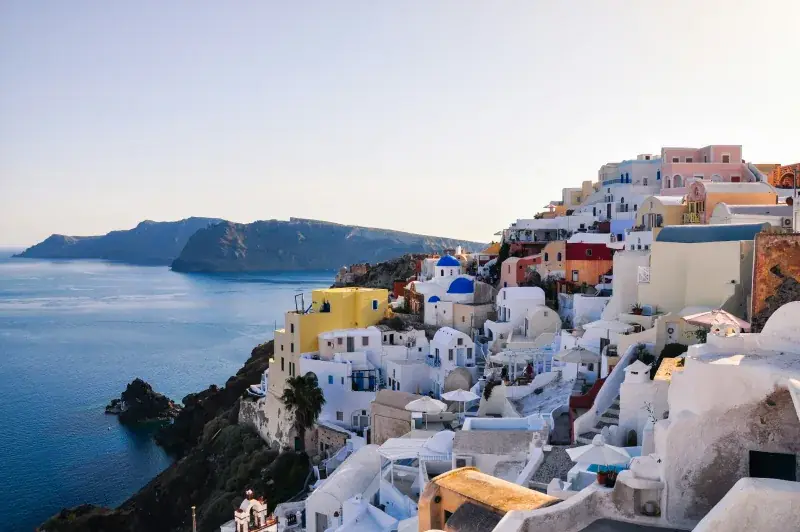

Santorini is what remains of a volcano that blew itself apart. Around the 17th century BC, one of the largest eruptions in recorded history hollowed out the round island the ancients called Strongyli, and the sea rushed in — leaving a crescent of cliffs rising 150 to 350 meters above a drowned caldera, often described as the only inhabited one in the world. Everything that makes the island famous — the whitewashed villages balanced on the rim, the blue-domed churches, the sunsets that stop crowds in their tracks — sits on the lip of that ancient catastrophe. It's a story best absorbed on the spot: wander the caldera edge with a self-guided audio tour playing in your ears, and the postcard views turn into a 3,600-year narrative of eruption, collapse, and stubborn rebuilding.

Villages on the rim
Five settlements cling to the caldera's edge, and each has its own temperament. Fira, the capital, is the island's lively hub of cafés, shops, and cable-car rides down to the old port. Oia, at the northern tip, is the icon — a maze of cave houses, galleries, and the ruined Venetian Castle of Oia, where thousands gather nightly for the most photographed sunset in Greece. Between them, quieter Imerovigli perches at the caldera's highest point, with a footpath out to Skaros Rock, a headland fortress that once sheltered the whole island from pirates. The 10-kilometer clifftop trail from Fira to Oia links them all — arguably the finest walk in the Cyclades, and an ideal route to let audio guides narrate each landmark as it appears around the bend.
Fira
Clifftop capital reached by a cable car climbing two hundred and twenty meters above the old port.
Oia
Cliffside village of whitewashed cave houses and captains' mansions above a volcanic caldera.
Castle of Oia
Clifftop ruins of a Venetian watch fortress, now the island's most crowded sunset perch.
Imerovigli
Clifftop village on the caldera rim, its trail dropping to a ruined pirate-watch fortress on a sea rock.
Skaros Rock
Cliff-top ruins of a six-hundred-year Venetian capital, never conquered yet swallowed by earthquakes.
Fira to Oia Walk
Clifftop caldera-rim trail linking whitewashed villages, passing a ruined medieval fortress along the way.
A Bronze Age Pompeii
On the southern coast, the Akrotiri archaeological site preserves a sophisticated Minoan-era town buried — and protected — by volcanic ash from the great eruption. Multi-story houses, drainage systems, and vivid frescoes survived under the tephra, and the site's eerie completeness helped fuel theories linking Santorini to the legend of Atlantis. High above the east coast, the Hellenistic and Roman ruins of Ancient Thera reward the climb with sweeping Aegean views.
Volcanic to the core
The volcano is not finished. Boat trips cross the caldera to Nea Kameni, the dark lava islet at its center, where fumaroles still steam from craters formed as recently as the 20th century. The same volcanic soil colors the island's beaches — the ochre cliffs of Red Beach, the long black sands of Kamari and Perissa — and gives Santorini's vineyards their edge: crisp, mineral Assyrtiko whites poured at caldera-view wineries like Santo Wines. Volcano, vineyard, village — on Santorini they are one story, and the best way to hear it is to press play and walk.
Nea Kameni
Black volcanic island rising inside a drowned Bronze Age crater, still faintly steaming today.
Red beach
Volcanic cove of blood-red cliffs and black sand, framed by dockside tavernas serving the day's catch.
Santo Wines
Clifftop winery growing ancient volcanic vines coiled into windbreak baskets above the caldera.