
Copenhagen wears its name — København, the "merchants' harbour" — lightly but truthfully. Denmark's capital is still a city organised around water: canals thread past copper spires, harbour buses glide where herring boats once crowded, and locals swim off wooden piers in the middle of town. It is compact, flat and famously unhurried, which makes it ideal to explore at your own rhythm with self-guided audio tours — wander from a royal square to a bohemian commune and let each landmark tell you its story as you reach it.
A capital built by a builder-king
The city began in earnest around 1167, when Bishop Absalon raised a fortress on the islet of Slotsholmen — the same ground where Christiansborg Palace now houses the Danish Parliament. By about 1416 Copenhagen had become the capital of Denmark, and in the 1600s the ambitious Christian IV stamped it with the monuments that still define its skyline: the Renaissance pleasure palace of Rosenborg (1606), where the Crown Jewels glitter in the treasury and a coronation throne of narwhal tusk stands guard; the Round Tower (1642), climbed by a 209-metre spiral ramp instead of stairs; and the Dutch-style canals of Christianshavn, where the twisting golden spire of the Church of Our Saviour dares you up its external staircase. An audio guide at each stop unpacks how one restless king rebuilt a herring port into a Baltic capital.
Christiansborg Palace
Neo-baroque seat of parliament, government and monarchy, its tower crowned by three weathervanes marking two devastating fires.
Rosenborg Castle
Dutch Renaissance summer palace holding crown jewels and a throne of narwhal ivory.
The Round Tower
Spiral cobblestone ramp winding seven and a half times up a seventeenth-century tower to Europe's oldest working observatory.
Church of Our Saviour
Baroque church with a black and gold external spiral spire climbed by four hundred steps.
Fairy tales on the waterfront
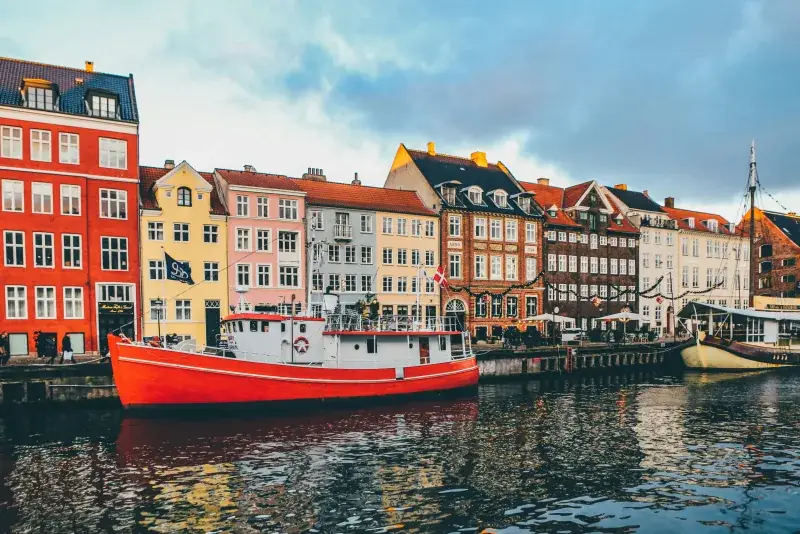
Nyhavn's candy-coloured townhouses line a canal dug in the 1670s — by Swedish prisoners of war, no less — that long served as a rowdy sailors' quarter. Hans Christian Andersen wrote his first fairy tales at No. 20; his most famous heroine, The Little Mermaid, gazes out over the water a short walk north, past the four rococo palaces of Amalienborg, where bearskin-hatted royal guards change at noon each day. At the other end of the centre, Tivoli Gardens (1843) — the pleasure garden Walt Disney openly cited as an inspiration — still lights thousands of lanterns at dusk. Each of these has a story worth hearing on the spot, from shipwrecked sailors to a mermaid who traded her voice for legs.
Nyhavn
Colorful seventeenth-century canal harbor lined with gabled townhouses, old sailing ships, and waterside cafes.
The Little Mermaid
Small bronze harbor statue of a fairy-tale figure, repeatedly beheaded and vandalized yet always restored.
Tivoli Gardens
Pleasure garden of fairy-tale pavilions, fireworks and a century-old wooden roller coaster.
The Copenhagen way of life
Nearly half of Copenhageners commute by bicycle, the mile-long pedestrian street of Strøget was an experiment that reshaped city planning worldwide, and the freewheeling enclave of Freetown Christiania has run on its own rules since 1971. Add world-class art at the Ny Carlsberg Glyptotek and the Louisiana Museum up the coast, smørrebrød lunches and New Nordic kitchens, and harbour water clean enough for a summer swim — and you have a capital best absorbed slowly, one story at a time, with a narrator in your ear.
Strøget
Car-free shopping boulevard born from a controversial nineteen sixty-two traffic experiment.
Freetown Christiania
Self-governing squatter commune since the seventies, with a former Pusher Street now being reclaimed from gang violence.
Ny Carlsberg Glyptotek
Art museum built from a brewer's private sculpture collection, with a palm-filled glass-domed winter garden and Egyptian mummies below.