
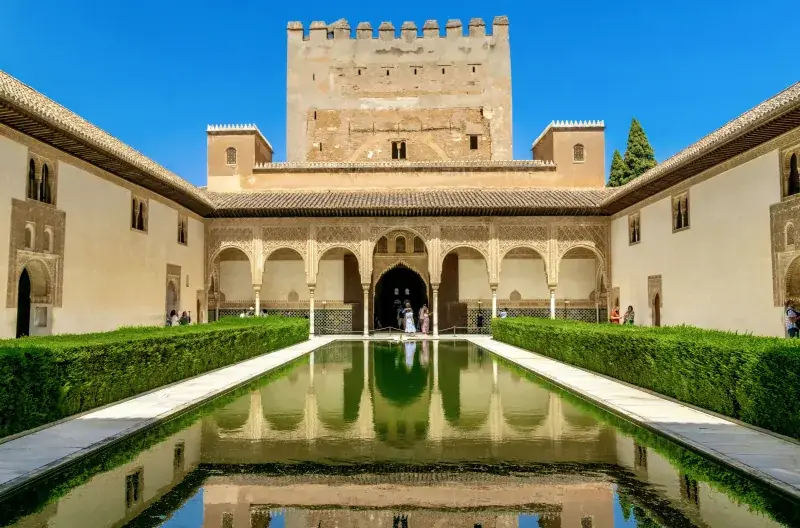

Granada is where Moorish Spain took its final bow. Capital of the Nasrid emirate — the last Muslim dynasty on the Iberian Peninsula — until its surrender to the Catholic Monarchs in 1492, the city layers eight centuries of Islamic art beneath Renaissance domes, all set against the snow line of the Sierra Nevada. It is compact, hilly and made for wandering with a self-guided audio tour in your ears: nearly every lane and courtyard here has a story, and the best ones hide in the details.
The Alhambra: a palace-city on the hill
Crowning its red hill above the rooftops, the Alhambra — "the red one" in Arabic, after its rammed-earth walls — is one of the finest surviving medieval Islamic palace complexes anywhere. Begun in 1238 and elaborated by the sultans Yusuf I and Muhammad V, it unfolds as a sequence of worlds: the Alcazaba watchtower fortress, the honeycomb vaults and filigree stucco of the Nasrid Palaces, the water-cooled terraces of the Generalife summer gardens, and the startling Renaissance rotunda of the Palace of Charles V. An audio guide earns its keep up here — the walls are covered in carved poetry, and the court intrigues behind the Court of the Lions are easy to walk past unheard.
Alhambra
Hilltop Nasrid fortress-palace complex of carved stucco halls, courtyards and towers above the city.
Nasrid Palaces
Ornate royal apartments of carved stucco and honeycombed ceilings, where a dynasty's last council chose surrender over siege.
Generalife Gardens
Cypress-shaded Nasrid summer garden of terraces, water channels and a legendary six-hundred-year-old tree.
Alcazaba
Bare-walled Nasrid military citadel of barracks and watchtowers guarding the palace complex above the city.
Palace of Charles V
Renaissance palace of stone circles and squares, raised over demolished Nasrid royal apartments and left roofless for centuries.
Whitewashed hills and cave-carved flamenco
Across the Darro gorge, the Albaicín keeps its medieval Moorish street plan almost intact — a UNESCO-listed maze of whitewashed lanes and walled carmen gardens that funnels everyone, sooner or later, to the Mirador de San Nicolás and its postcard view of the Alhambra backed by mountain snow. Let the narration walk you along the riverside Carrera del Darro, one of Spain's most atmospheric streets, and on into Sacromonte, where cave houses dug into the hillside still ring with zambra flamenco after dark.
Albaicín
Hillside quarter of narrow lanes, laced beneath by an eleventh-century gravity-fed water network of hidden cisterns.
Mirador de San Nicolás
Hilltop viewpoint packed nightly with vendors, guitarists and tea drinkers watching golden light hit a Moorish fortress across the valley.
Carrera del Darro
Riverside lane of Moorish bathhouses, footbridges and old palaces below the Alhambra's walls.
Sacromonte
Hillside quarter of cave dwellings above a river valley, birthplace of flamenco's zambra tradition.
The city the Catholic Monarchs built
Down in the flat city centre the story flips: Granada's vast Renaissance Cathedral rose over the former mosque, and next door the Royal Chapel guards the marble tombs of Ferdinand and Isabella themselves. Between listening stops, Granada rewards lingering — it is one of the last cities in Spain where a drink still arrives with a free tapa, and a university founded in 1531 keeps the old stones young. Pick a route, press play, and let the city tell you how al-Andalus ended — and what it left behind.