
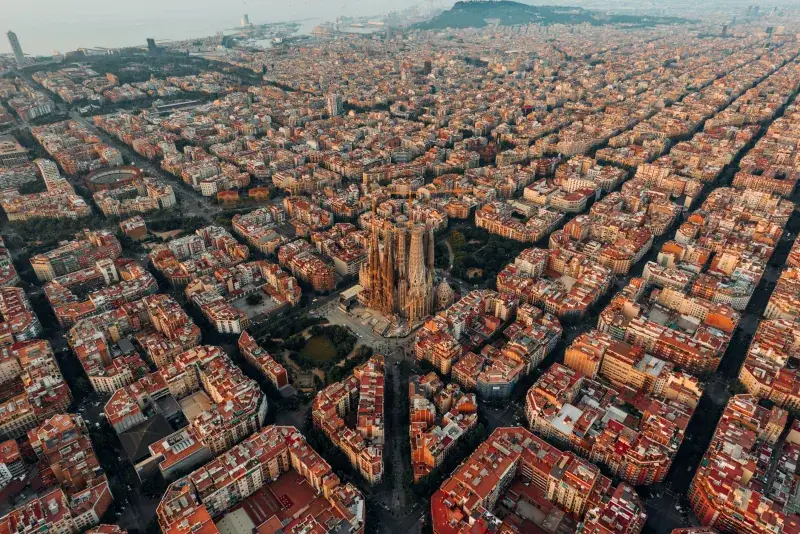
Barcelona, the capital of Catalonia, stretches between the Collserola hills and the Mediterranean — Spain's second-largest city and one of Europe's most rewarding places to wander with an audio guide in your ears. Two thousand years of history are layered into its streets, from the Roman colony of Barcino to the medieval Crown of Aragon and the flamboyant modernisme boom of the late 1800s, and every landmark here has a story worth hearing told well.
The city Gaudí dreamed in stone
No architect defines a city the way Antoni Gaudí defines Barcelona. His unfinished Sagrada Família — begun in 1882 and still rising today, its Nativity façade and crypt listed by UNESCO — is the essential first stop, and a self-guided audio tour lets you take in its forest-like columns and symbol-laden façades at your own pace. Up on the hill in Gràcia, Park Güell began as a failed garden-city venture for industrialist Eusebi Güell; today its trencadís-mosaic salamander and serpentine terrace bench are pure joy, with the whole city spread out below. Down in the Eixample — the visionary grid district laid out by Ildefons Cerdà in the 1850s — the audio stories continue at Casa Batlló and La Pedrera (Casa Milà), two apartment houses that bend stone and iron like living things.
Basilica of the Sagrada Familia
Stone basilica of spiraling spires, the world's tallest church, still under construction.
Park Güell
Hilltop park of fantastical mosaic terraces and columns by Antoni Gaudí, with panoramic city views.
Casa Batlló
Modernist apartment block with a dragon-scale roof and bone-shaped columns, redesigned by Gaudí.
La Pedrera - Casa Milà
Modernista residential building with undulating stone facade, sculptural rooftop chimneys, and no single straight wall.
Gothic lanes and market noise
Older Barcelona hides in the Gothic Quarter, a labyrinth of narrow medieval lanes built over the Roman town, where the Cathedral of Barcelona shelters a cloister famously home to thirteen white geese. A few steps away, La Boqueria market off La Rambla is the city's loudest, most colorful pantry — cured ham, just-squeezed juices, and seafood on ice.
Beyond the old town
There is far more to hear: the Arc de Triomf and the palm-shaded Ciutadella Park, the Magic Fountain below Montjuïc — the hill remade for the 1929 Exposition and again for the 1992 Olympics — and Camp Nou, the temple of FC Barcelona. With each landmark narrated as you stand before it, Barcelona becomes what it has always been: a city that tells its own story, brilliantly.
Arc de Triomf
Red brick triumphal arch built in 1888 as the ceremonial entrance to a Universal Exposition.
Ciutadella Park
Landscaped park laid over a demolished military citadel, centered on a grand cascade fountain shaped by a young Gaudi.
Magic Fountain of Montjuïc
Grand terraced fountain choreographing water, colored light, and music into a nightly free performance below a hilltop palace.
Spotify Camp Nou
Giant football stadium built and rebuilt on members buying bonds, mid-renovation for more seats.