
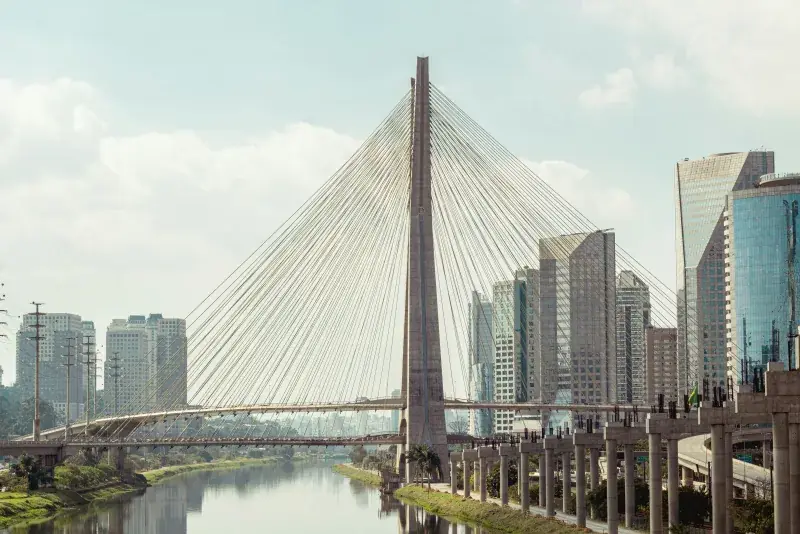
São Paulo is the largest city in the Americas — a restless, endlessly layered megacity that locals call Sampa and, thanks to its famous mist, Terra da Garoa, "Drizzle Land." Founded by Jesuit priests on the Piratininga plateau in 1554, it grew rich on the nineteenth-century coffee boom and then drew immigrants from everywhere: today it holds some of the world's largest Italian, Arab and Japanese communities. There is no single postcard monument here; the city itself is the attraction, and the best way to decode it is street by street, with a self-guided audio tour telling you what each façade, alley and avenue is hiding.
A skyline with stories underneath
Start on Avenida Paulista, the old coffee barons' boulevard turned cultural spine — on Sundays it closes to cars and fills with musicians, skaters and strolling paulistanos. Halfway along it, the Museum of Art of São Paulo (MASP) floats above the sidewalk on four red concrete pillars, Lina Bo Bardi's radical frame for Van Gogh, Rembrandt and Brazil's own masters; its audio guide unpacks why that empty span beneath the museum became the city's favorite public square. Downtown, Oscar Niemeyer's serpentine Copan building and the 1911 Theatro Municipal, modeled on the Paris Opera, tell two very different chapters of the same ambition.
Avenida Paulista
Grand thoroughfare of glass towers lined by a handful of surviving coffee-era mansions.
Museum of Art of São Paulo Assis Chateaubriand
Suspended concrete-and-glass museum built on funds pressed from wealthy donors, with a red free span sheltering a Sunday antiques market.
Copan
Sinuous concrete tower housing thousands across six curved blocks of studios to family flats.
Theatro Municipal de São Paulo
Belle Époque opera house whose curved corner panels and adjustable acoustic shell shift its sound between opera and symphony.
Old São Paulo, loud and quiet
The historic center rewards slow listening. The Sé Metropolitan Cathedral anchors the square where the city measures all its distances, while a few blocks away the Mosteiro de São Bento — a monastery community dating to 1598 — still fills its basilica with Gregorian chant at mass. Nearby, the Mercado Municipal trades under stained glass: come hungry for the legendary mortadella sandwich and codfish pastel, and let the audio guide walk you through a century of market lore between bites.
Sé Metropolitan Cathedral
Neo-Gothic cathedral whose granite capitals hide carved pineapples, coffee branches, and armadillos.
Mosteiro de São Bento
Neo-Romanesque monastery church where Benedictine monks still sing daily Gregorian chant beneath a six-thousand-pipe organ.
Mercado Municipal de São Paulo
Covered nineteen-thirties food hall with stained-glass panels lighting hundreds of market stalls.
Neighborhoods that repaint themselves
São Paulo's character lives in its bairros. Liberdade, heart of the Japanese diaspora, strings red torii-style lanterns over ramen counters and weekend street fairs. In bohemian Vila Madalena, the graffiti-covered Beco do Batman alley changes its murals faster than any museum rotates a show. And when the concrete gets loud, Ibirapuera Park — 158 hectares landscaped around Niemeyer's white pavilions — is where the city goes to breathe.
Give São Paulo a little time and a good pair of headphones, and the "concrete jungle" resolves into one of the most fascinating urban stories on the planet.
Liberdade
Historic square and district where a botched public hanging gave the name Freedom to a Japanese immigrant quarter.
Beco do Batman
Graffiti-covered alley of ever-changing murals, born from one unclaimed Batman drawing decades ago.
Ibirapuera Park
Sprawling green oasis of lakes, lawns and modernist pavilions threaded by tree-lined paths.