
Korea's Seaside Second City
Busan is where South Korea meets the sea — a city of 3.3 million wedged between green mountains and a coastline of beaches, cliffs and one of the world's busiest container ports. It is Seoul's louder, saltier counterpart: fishing boats and film festivals, hillside villages painted every color, and mountain temples above surf-splashed rocks. It is also a city whose best stories hide in plain sight, which is why it rewards exploring with self-guided audio guides — each landmark here has a tale that a quick glance won't give you, from wartime refuge to cinematic renaissance.
A City Shaped by Refuge
During the Korean War, Busan was one of only two cities never captured — it became the provisional capital and absorbed hundreds of thousands of refugees. That history is written into its streets. Gamcheon Culture Village began as a hastily built refugee settlement stacked up a hillside; since 2009, artists and residents have turned its terraced houses into a maze of bright facades, murals and lookouts — an audio guide walks you through how hardship became one of Korea's most photographed neighborhoods. Down by the harbor, Gukje Market grew from the 1945 Dottaegi Market into a labyrinth of more than 1,400 stalls, still humming with the trader spirit of the postwar years.
Temples, Beaches and a Glittering Bridge
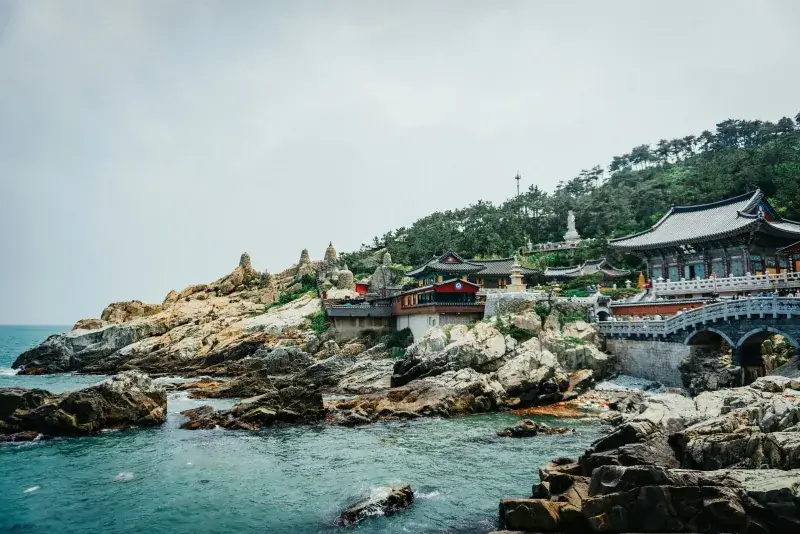
Busan's coastline does the sightseeing for you. Haeundae Beach unrolls 1.5 kilometers of white sand — Korea's most famous stretch of shore — while Gwangalli Beach faces the Gwangan Bridge, spectacular after dark when the span lights up over the bay. To the east, Haedong Yonggungsa Temple, founded in 1376 and rebuilt after the colonial era, clings to seaside rocks at the bottom of 108 lantern-lined steps — one of the country's rare cliffside temples, and a story best heard standing right there. Inland, ancient Beomeosa Temple sits in the folds of Geumjeongsan mountain, and the forested cliffs of Taejongdae drop straight into the strait.
Haeundae Beach
Wide crescent of white sand backed by a high rise skyline, watched over each summer dawn.
Gwangalli Beach
Sandy urban beach lined with cafes and a live-seafood market, framed by a lit-up double-decker bridge.
Gwangan Bridge
Suspension bridge strung with LED lights over the bay, nicknamed for its diamond-like glow.
Haedong Yonggungsa Temple
Clifftop coastal temple reached by one hundred eight lantern-lined steps down to the sea.
Beomeosa Temple
Silla-era mountain temple famed for an optical-illusion one-pillar gate and richly carved main hall.
Taejongdae
Coastal cliff park where duck-billed dinosaur footprints emerged from ancient lake-bed rock.
Markets, Movies and Milmyeon
At Jagalchi Market, Korea's largest fish market, tanks of live seafood fill the ground floor and upstairs restaurants serve it with an ocean view. Nearby BIFF Square celebrates the Busan International Film Festival that helped earn the city its UNESCO City of Film title in 2014. Come hungry: dwaeji gukbap (pork rice soup) and eomuk fishcakes were born here.
Tip: start in the old harbor quarter — Jagalchi, BIFF Square and Yongdusan Park's Busan Tower sit within one easy walk, with an audio story waiting at every stop.
Jagalchi Market
Seven-story seafood hall where the ground floor sells live catch and upper floors turn it into dinner.
BIFF Square
Pedestrian street of bronze handprints where film stars press palms into cement each festival season.
Busan Tower
Panoramic observation tower crowning a dragon-shaped hill once topped by a colonial-era shrine.