
Milan doesn't court visitors the way Venice or Florence do — it rewards the ones who look closer. Italy's capital of fashion, finance and design keeps its treasures behind austere facades and quiet courtyards: Roman ruins, Renaissance genius, a Gothic cathedral bristling with some 3,400 statues. That makes it a city built for exploring with an audio guide in your ears — the stories are exactly what turn Milan's understated elegance into something unforgettable.
A city built in layers
Founded by Celts and Latinized as Mediolanum, Milan served as capital of the Western Roman Empire before the Visconti and Sforza dukes made it one of the great engines of the Renaissance. Leonardo da Vinci spent nearly two decades here in Sforza service — engineering the city's canals and painting The Last Supper on a refectory wall at Santa Maria delle Grazie, where visitors are still admitted for strictly timed viewings. Each landmark's audio guide picks up a different thread of that long story.
Basilica di Santa Maria delle Grazie
Renaissance dining hall holding Leonardo's Last Supper mural, saved by sandbags when wartime bombs destroyed the room around it.
Leonardo's Last Supper Museum
Fragile wall mural of Christ's final meal, painted in an experimental dry technique that began flaking within years.
From marble rooftop to canal-side evenings
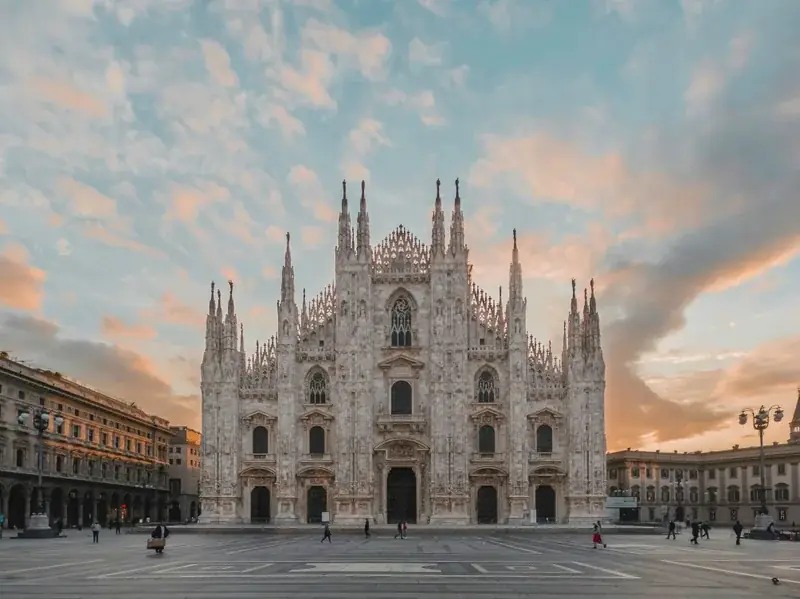
Start at the Duomo di Milano, a cathedral nearly six centuries in the making, clad in pale Candoglia marble — then climb to its walkable rooftop terraces for spires, gargoyles and, on clear days, the Alps. Steps away, the glass-domed Galleria Vittorio Emanuele II leads toward Teatro alla Scala, the opera house that has set the world's standard since 1778 and premiered Verdi and Puccini. At the Sforzesco Castle, the fortress-turned-museum at the edge of leafy Parco Sempione, listen for the story of Michelangelo's final, unfinished Pietà Rondanini.
Then let the city slow down around you:
- Brera — bohemian lanes around the Pinacoteca's Raphaels, Caravaggios and Mantegnas
- Quadrilatero della Moda — the fashion district that crowns Milan's style-capital status
- Navigli — canals that once floated the Duomo's marble into town, now Milan's liveliest stage for evening aperitivo
While much of Italy trades on its past, Milan is Italy's present tense — a working, style-conscious metropolis where football roars at San Siro and vertical forests rise over Porta Nuova.
Give it two or three days, follow the audio guides from landmark to landmark, and Milan's reserve dissolves into one of Europe's richest city stories.
Duomo di Milano
Gothic marble cathedral of soaring spires and thousands of statues, built over nearly six centuries.
Galleria Vittorio Emanuele II
Glass-domed arcade linking a cathedral square to an opera house, floored with symbolic mosaics.
Teatro alla Scala
Historic opera house of gilded boxes and grand chandeliers, site of legendary premieres and infamous flops alike.
Sforzesco Castle
Medieval fortress turned Renaissance ducal court, its towers hiding a whitewashed Leonardo da Vinci ceiling for four centuries.
Pinacoteca di Brera
Grand art gallery of Renaissance and Baroque masterpieces inside a former Jesuit college, founded on Napoleon's orders.
Navigli
Historic canal district of open waterways and portside bars, once Milan's medieval trade highway.