
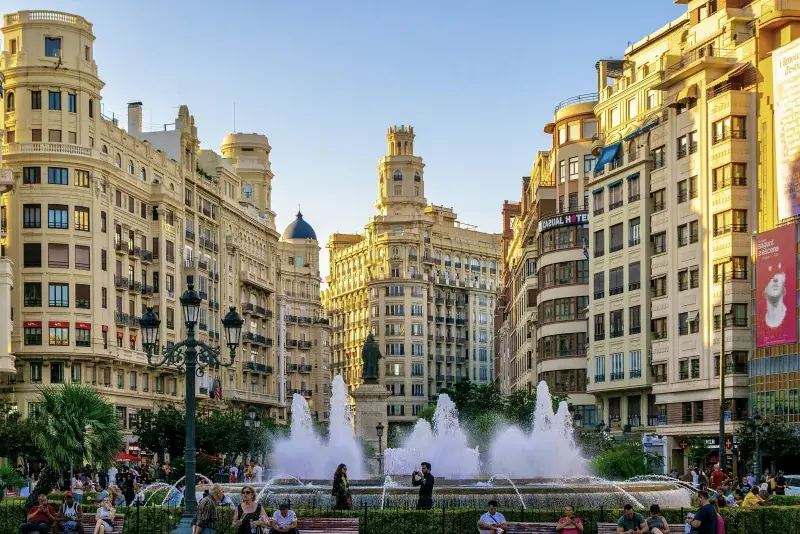
Founded by the Romans in 138 BC and now Spain's third-largest city, Valencia is where medieval Gothic and gleaming futurism share one skyline — with a Mediterranean beach at the end of the tram line. It's a city made for exploring at your own pace: compact, flat and sun-drenched, its stories unfold best with a self-guided audio tour playing as you stand exactly where they happened.
A Golden Age carved in stone
Valencia's 15th-century boom as a Mediterranean silk power studded the old town with masterpieces. At La Lonja de la Seda, the UNESCO-listed silk exchange begun in 1482, twisted columns rise like palm trunks above a trading floor whose carved inscription still preaches honest commerce — the kind of detail an audio guide brings alive while you crane your neck. A few streets away, Valencia Cathedral guards a first-century chalice venerated by many as the Holy Grail; climb the El Micalet bell tower for rooftop views, then linger over café tables on the Plaza de la Virgen, the city's Roman heart.
La Lonja de la Seda de Valencia
Late Gothic silk exchange with helical stone columns rising above a merchants' trading floor.
Valencia Cathedral
Gothic cathedral chapel enshrining an ancient agate cup venerated as the true Holy Grail.
Plaza de la Virgen
Bronze fountain of a river god ringed by eight maidens pouring water for an ancient farmers' court.
The river that became a garden
After a catastrophic flood in 1957, Valencia diverted the Turia River and turned its dry bed into the Jardín del Turia — some nine kilometres of gardens, cycle paths and playgrounds curling through the city beneath 18 bridges. Follow it downstream and the park delivers you to Santiago Calatrava's City of Arts and Sciences, a cluster of white, skeletal structures housing a science museum, a planetarium and the vast Oceanogràfic aquarium. Few walks anywhere carry you from Gothic gargoyles to sci-fi architecture in a single afternoon — and the audio guides along the way explain how one city managed both.
Jardín del Turia
Sunken riverbed park of pine groves and paths where a diverted river once flowed through the city.
Ciudad de las Artes y las Ciencias
Futurist cultural complex of curved white shells clad in ceramic mosaic, spanning a museum, opera house and aquarium.
Oceanogràfic València
Restaurant table set inside an aquarium, surrounded by thousands of fish gliding past floor-to-ceiling glass.
Eat like a Valencian
This is the birthplace of paella — the authentic version made with chicken, rabbit and beans, not seafood. Stock up on saffron and Bomba rice among the 250-plus stalls of the Central Market, an Art Nouveau cathedral of food beneath stained glass and tiled domes, and cool off with horchata, the local tiger-nut drink. When the sun drops, the sand of Malvarrosa beach is only a short tram ride away.
Come in mid-March and the city erupts into Las Fallas, a UNESCO-recognised festival of towering satirical sculptures, fireworks and one spectacular night of ceremonial flames.
From the battlemented Torres de Serranos, once the old town's grandest gate, to the quietest bend of the Turia, every landmark here has an audio guide ready to tell its story — press play and let Valencia narrate itself.
Central Market of Valencia
Modernist iron-and-glass food hall of nearly one thousand stalls, still trading since nineteen twenty-eight.
Platja de la Malvarrosa
Golden urban beach where wealthy families once summered and Sorolla painted children at play in the surf.
Torres de Serranos
Fourteenth-century Gothic gate towers that once sheltered evacuated Prado masterpieces from wartime bombing.