
Casablanca is Morocco's largest city and its economic engine — a sprawling Atlantic metropolis of some 3.7 million people where glass towers, colonial-era boulevards, and a working port set a rhythm quite unlike the imperial cities inland. It doesn't reveal itself in a single postcard view; its stories hide in facades, courtyards, and street corners, which is exactly why it rewards exploring with self-guided audio tours that decode each landmark as you stand in front of it.
A mosque above the ocean
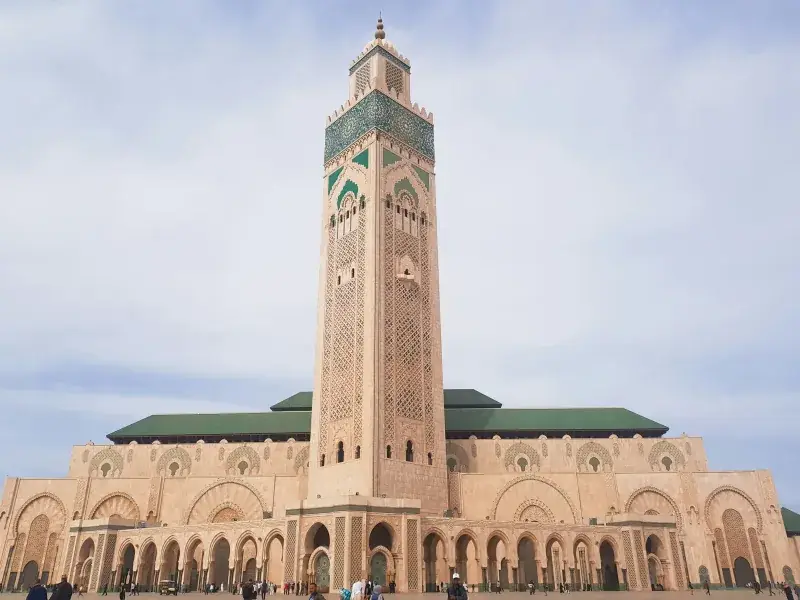
Start at the Hassan II Mosque, completed in 1993 and rising directly over the Atlantic — a setting inspired by the Quranic verse that God's throne was upon the water. Its minaret soars 210 meters, for years the tallest in the world, and the complex can hold around 105,000 worshippers between the prayer hall and its vast esplanade. Cedarwood from the Middle Atlas, marble from Agadir, granite from Tafraoute, and hand-cut zellij mosaics showcase the full range of Moroccan craft, and it is one of the very few mosques in the country that non-Muslims can enter. An audio guide here turns sheer scale into a story of ambition, faith, and artisanship.
The Art Deco capital of Africa
Casablanca boomed under the French Protectorate (1912–1956), and the result is one of the world's finest ensembles of Art Deco and neo-Moorish architecture — a hybrid style blending European modernism with Islamic ornament. Walk from Mohammed V Square along Boulevard Mohammed V and let the narration point out geometric facades, wrought-iron balconies, and gems like the 1930 Cinema Rialto. Nearby stand the white Neo-Gothic Sacred Heart Cathedral (1930) and the Mahkama of Pacha, a 1940s courthouse of carved cedar ceilings and tiled courtyards.
Mohammed V Square
Grand colonial-era plaza ringed by law courts and city hall, centered on a glowing fountain.
Boulevard Mohammed V
Grand two-kilometer thoroughfare of Art Deco and neo-Moorish facades, many now crumbling behind protected walls.
Cinema Rialto
Red and white Art Deco cinema of nineteen thirty with a grand hall and over a thousand seats.
Sacred Heart Cathedral
Deconsecrated Gothic-Art Deco church of poured concrete, now a cultural center hosting exhibitions and performances.
Mahkama of Pacha
Sprawling Art Deco-Mauresque courthouse of carved cedar, zellige tile, and stucco lace around open courtyards.
Medinas old and new
Two very different medinas frame the city's story:
- The Old City, a compact tangle of whitewashed lanes near the port, keeps traces of the Portuguese era — when the town was called Casa Branca, the "white house".
- The Quartier Habous, a 1930s "new medina" designed by the French, fuses orderly streets with traditional Moroccan arcades — the city's most relaxed place to shop for pastries, olives, and crafts.
Ocean air and movie myth
Finish along the Boulevard de la Corniche, the seafront promenade running toward Ain Diab Beach, where locals surf, stroll, and linger in cafés at sunset. And yes — Rick's Café exists: a piano bar in a restored courtyard riad, opened in 2004 to bring the fictional nightclub of the 1942 film to life. With an audio guide in your ears, Casablanca stops being a mere gateway to Morocco and becomes the country's most fascinating modern chapter.
Boulevard de la Corniche
Seafront promenade of beach clubs and terraces stretching past a century-old lighthouse toward a mosque built over the ocean.
Ain Diab Beach
Golden Atlantic beach known for steep surf breaks, strong rip currents, and lively beach clubs.
Rick's Café
Riad-style courtyard restaurant built to recreate the fictional bar from a nineteen forty-two Hollywood classic.