
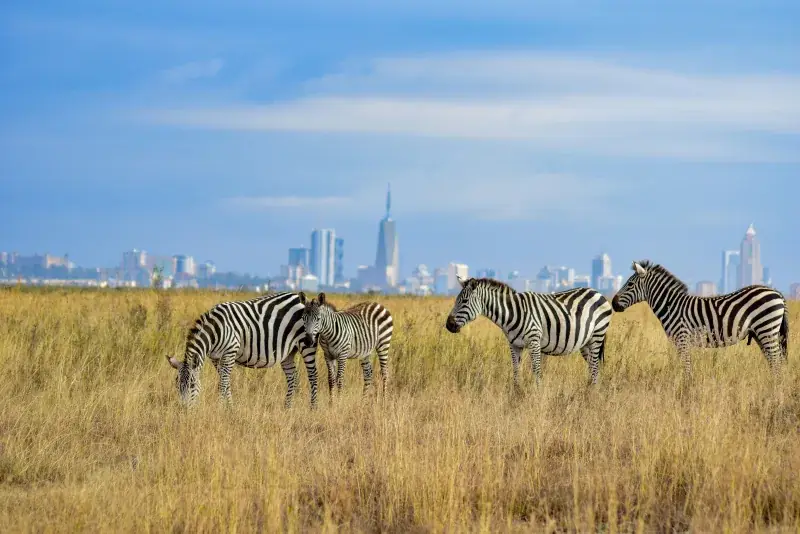
Nairobi is the rare capital where a giraffe can photobomb a skyline. Founded in 1899 as a supply depot on the Uganda Railway — its name drawn from the Maasai Enkare Nyirobi, "the place of cool waters" — it grew from a swampy railhead into the capital of British East Africa by 1907 and of independent Kenya in 1963. Today the "Green City in the Sun" is East Africa's financial and diplomatic engine, a mile-high metropolis of more than five million people that hosts the UN's environment programme and a famously inventive tech scene. It is a city of layered stories — Maasai, railway, colonial, safari, startup — and the easiest way to hear them is with a self-guided audio tour, moving at your own pace while each landmark tells its own tale.
Wilderness on the doorstep
No other world capital keeps a national park inside its city limits. Nairobi National Park, opened in 1946 as Kenya's first, begins barely seven kilometres from downtown: lions, black rhinos and giraffes graze against a backdrop of high-rises. On the park's edge, the Sheldrick Wildlife Trust's famous nursery raises orphaned elephant calves, while in leafy Lang'ata the Giraffe Centre — breeding endangered Rothschild's giraffes since 1979 — lets you meet its long-necked residents eye to eye from a raised platform. An audio guide at each stop turns a photo op into a conservation story worth remembering.
Nairobi National Park
Fenced savanna reserve on a capital city's edge where lions, rhinos and giraffes roam beneath a skyline of skyscrapers.
Sheldrick Wildlife Trust Nursery
Elephant nursery where orphaned calves are hand-reared on a pioneering coconut-oil milk formula before release to the wild.
Giraffe Centre
Raised wooden platform where visitors hand-feed rescued Rothschild's giraffes at eye level.
From railhead to republic
"I had a farm in Africa, at the foot of the Ngong Hills…"
Karen Blixen's opening line still hangs over the suburb that bears her name, where her preserved farmhouse — now the Karen Blixen Museum — recalls the Out of Africa era. In the centre, the National Museum of Kenya traces the human story back to the fossil beds of the Rift Valley, and the 28-storey Kenyatta International Convention Centre crowns the skyline with a rooftop panorama stretching to the Ngong Hills. Listen as you go, and the colonial verandas, independence monuments and matatu-painted streets snap into a single narrative.
Karen Blixen Museum
Colonial-era farmhouse and coffee estate turned museum, filled with the original owner's furniture and photographs.
National Museum of Kenya
State collection holding fossil evidence that early human relatives butchered and ate one another over a million years ago.
Kenyatta International Convention Centre
Cone-topped tower with a helipad and hut-shaped amphitheatre, born from a chief architect's scandal.
Green lungs and living culture
When the traffic hums too loud, Nairobians escape to Karura Forest's waterfall trails or hike the whale-backed ridge of the Ngong Hills. Back in town, the Maasai Market spreads out its beadwork and carvings, and Bomas of Kenya stages the dances and homesteads of the country's many peoples. Nairobi rewards the curious: press play, step out, and let the city of cool waters tell you how it became the safari capital of the world.
Karura Forest
Sprawling urban forest of trails and waterfalls, with a volcanic cave layered with human history.
Ngong Hills Forest Reserve
Rift-edge ridge of four peaks likened to a giant's knuckles in Maasai legend and film.
Maasai Market
Sprawling open-air stalls of hand-strung Maasai beadwork, carvings, and textiles that rotate across the city by the day.
Bomas Of Kenya
Open-air village of reconstructed traditional homesteads from over twenty Kenyan ethnic communities.