
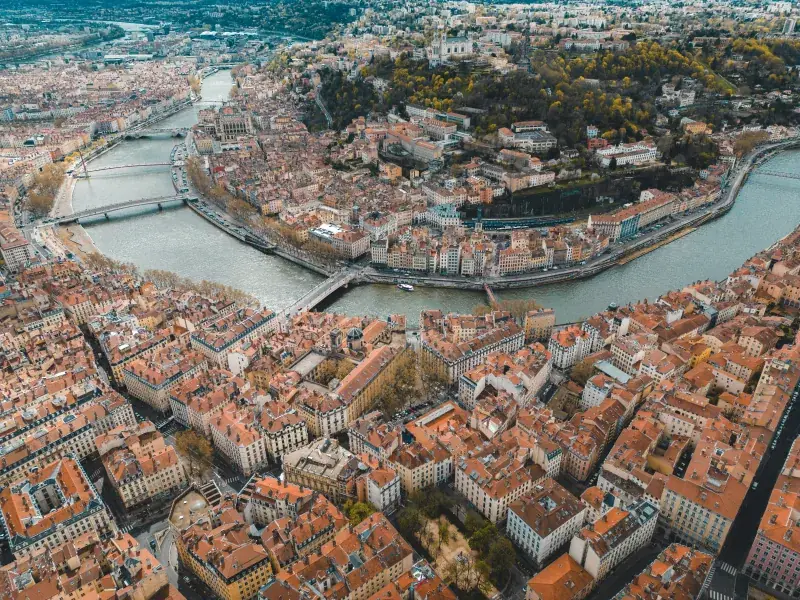
Lyon wears its two thousand years lightly. Founded as Roman Lugdunum, the capital of Gaul, it grew into Europe's silk metropolis and later into what the French themselves call the capital of gastronomy — and in 1998 UNESCO listed some 500 hectares of it as a World Heritage Site, covering four districts: Fourvière hill, Vieux Lyon, the Presqu'île and the slopes of the Croix-Rousse. Squeezed between two rivers and two hills, it is a city built for unhurried exploring with a self-guided audio tour in your ears, each landmark's guide peeling back another layer — Roman stone, Renaissance courtyard, silk-weaver's loft.
From Roman Hill to Renaissance Maze
Everything began on Fourvière, where a Gallo-Roman theatre is still carved into the hillside and the white Basilica of Notre-Dame de Fourvière crowns the skyline like a lighthouse over the city. At the foot of the hill, Vieux Lyon is one of Europe's largest surviving Renaissance quarters — so precious that in 1962 it became France's very first protected heritage sector. Its ochre facades hide the Cathédrale Saint-Jean-Baptiste, whose astronomical clock has been counting the hours since 1379, and the famous traboules: around 500 covered passages thread through the city's buildings, of which roughly 80 stay open to quiet visitors. Slipping through a nondescript door into a galleried courtyard is Lyon's signature thrill, and an audio guide is the ideal companion for decoding what you find on the other side.
Théâtre Gallo Romain
Roman theater terraced into a hillside, built for five thousand spectators and later doubled to ten thousand.
Basilica of Notre Dame of Fourvière
Byzantine-Romanesque hilltop church of marble and mosaic, its facade carved over decades by hand.
Vieux Lyon
Renaissance quarter of narrow stone lanes once home to Europe's richest banking families.
Cathédrale Saint-Jean-Baptiste
Gothic portal of decapitated saints, scarred by a sixteenth-century religious riot never repaired.
Silk, Rebellion and the Croix-Rousse
Climb the "hill that works" and the architecture changes: the tall-windowed workshops of the canuts, the silk weavers whose looms clattered here through the nineteenth century — and whose revolts helped shape modern labor rights. Their story lives on in the slope's own traboules and in the Mur des Canuts, a giant trompe-l'œil mural that repaints the neighborhood onto a blank wall.
The Stomach of France
Lyon's beloved bouchons were born to feed those silk workers, run by the legendary mères lyonnaises — the "mothers" whose kitchens trained chefs like Paul Bocuse. His name now graces Les Halles de Lyon Paul Bocuse, a covered market of 58 stalls piled with quenelles, Saint-Marcellin cheese and cervelle de canut. Come hungry; leave converted.
Between the Rivers
The Presqu'île, the long peninsula between the Rhône and the Saône, strings together vast Place Bellecour, fountain-fronted Place des Terreaux and the Museum of Fine Arts, while at the rivers' meeting point the crystalline Musée des Confluences points the city toward the future. When you need green, the Parc de la Tête d'Or spreads lakes and rose gardens along the Rhône. Every stop has a story — and in Lyon, the stories are the point.
Place Bellecour
Equestrian bronze king riding bareback, replacing a statue melted for cannons in the Revolution.
Place des Terreaux
Central square where a checkerboard pavement and a monumental horse-drawn fountain face the historic city hall.
Museum of Fine Arts of Lyon
Former abbey staircase crowned by a sweeping mural of muses and allegorical figures of the arts.
Musée des Confluences
Deconstructed glass-and-steel cloud rising over docks that once stored sugar, salt, and wine.
Parc de la Tête d'Or
Sprawling landscaped park built over a drained swamp, centered on a sixteen-hectare artificial lake and free zoo.