
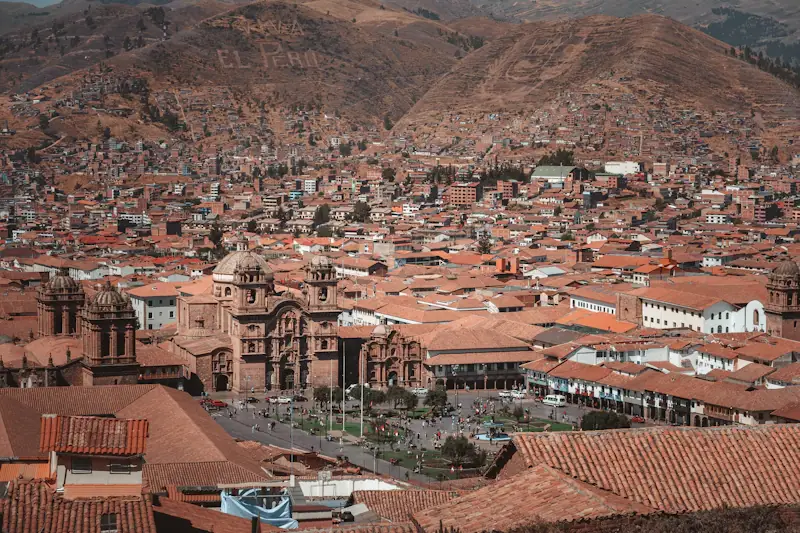

Cusco was the navel of the Inca world — Qosqo in Quechua — and at 3,400 metres in the Peruvian Andes it still feels like the centre of something. For three centuries it was the capital of the largest empire the Americas ever saw, laid out (many scholars believe) in the shape of a puma. Then Francisco Pizarro rode in on 15 November 1533, and the Spanish built their churches and mansions straight onto the Inca walls. Earthquakes in 1650 and 1950 shook down the colonial layers and left the mortarless Inca stonework standing underneath, which is why UNESCO inscribed the whole city in 1983 as one of the most complete fusions of Indigenous and colonial cultures anywhere.
That layering is what makes Cusco such a good city to explore with a self-guided audio guide. Almost every wall you walk past has two stories — the one the Incas built and the one the Spanish told on top of it — and the audio guides for each landmark let you hear both while you stand in front of the stone. Cusco is also the base for the Sacred Valley and Machu Picchu, so most visitors give it two or three days before heading out; this is a city that rewards slowing down.

Start on the Plaza de Armas
The Plaza de Armas was Huacaypata, the ceremonial square of the Inca capital, and it is still where everything begins. Two great churches close in its eastern side. Cusco Cathedral, begun in the 1550s on the foundations of an Inca palace, holds an astonishing collection of colonial paintings, including a Last Supper in which Christ and the apostles share a roast guinea pig. A few steps along, the Jesuit Church of the Society of Jesus was built deliberately grand enough to rival the cathedral — a rivalry that ended up in Rome. Their audio guides pick apart the politics behind the baroque façades; then sit on a bench, watch the light change on the arcades, and let the altitude catch up with you.
Qorikancha and the walls of the Inca city
Walk downhill from the plaza and the city's most extraordinary building appears: Qorikancha, the "golden enclosure" and the holiest temple of the empire. Its walls were sheathed in gold until the Spanish stripped them for Atahualpa's ransom in 1533, and the Dominicans then raised the Church of Santo Domingo on top. The 1650 earthquake destroyed the first convent but not a single Inca block moved, and the curved parabolic wall at the temple's base is still one of the finest pieces of masonry in Peru. Back uphill, the alleys of Calle Loreto and Hatun Rumiyoc are lined by original Inca walls, and the famous Twelve Angled Stone shows how the builders fitted enormous polygonal blocks together without mortar — fitted, as the Spanish chroniclers said, so tightly that a coin cannot slip between them.
Qorikancha
Inca sun temple whose gold-plated walls were plundered, its foundations now underpinning a colonial church.
Twelve Angled Stone
Twelve-sided green diorite block, millimeter-fitted without mortar into an Inca palace wall now framing a colonial doorway.
Calle Loreto
Inca stone lane where fractured corner blocks preserve a five-hundred-year seismic record still studied by geologists.
Up to Sacsayhuamán and the ruins above town
A steep half-hour climb (or a short taxi) brings you to Saqsaywaman, the citadel on the ridge above Cusco at 3,700 metres. Three zigzag terrace walls of limestone blocks, the largest weighing between 128 and 200 tonnes and hauled some 35 km from Rumicolca, were raised under Pachacuti and his successors in the fifteenth century. The Spanish quarried much of it for their own churches, yet what remains is still overwhelming, and every 24 June the Inti Raymi sun festival is staged here for the winter solstice. The same ticket covers a string of smaller sites along the road out of town: the carved rock shrine of Q'enco Archaeological Complex, the red-stone outpost of Puka Pukara, and Tambomachay, about 8 km from the city, where Inca fountains still run through a system of stone channels. The audio guides for these are best heard on site, where the landscape explains what the ruins were for.
Saqsaywaman
Zigzag megalithic fortress walls of house-sized stones, site of a bloody sixteenth-century siege above Cusco.
Q'enco Archaeological Complex
Ceremonial complex carved directly into a limestone outcrop, with zigzag ritual channels and an underground altar chamber.
Puka Pukara Archaeological Complex
Reddish stone lookout and rest post on a high ridge, linked by water channels to a nearby Inca bathing shrine.
Tambomachay
Rock-cut Inca fountain with twin stone channels delivering a steady, unexplained flow year-round.
San Blas and the markets
Above the plaza on the hillside, Barrio San Blas is Cusco's artists' quarter: steep whitewashed lanes, blue doors, silversmiths and weavers working in their doorways, and cafés with balconies over the red-tiled roofs. Its small church, Templo del San Blas, is worth the entrance fee for one object alone, a pulpit carved from a single trunk of cedar that is often called the finest woodcarving in the Americas. Down on the other side of the centre, Mercado Central de San Pedro is where Cusco actually shops — stalls of cheeses, fruit juices, herbal remedies, alpaca textiles and whole roasted pigs. Go hungry.
Barrio san blas
Hillside artisan quarter of steep cobbled lanes, once prized for a salt spring and sweeping valley views.
Templo del San Blas
Colonial church famed for a single cedar-trunk pulpit carved with more than eighty tumbling figures.
Mercado Central de San Pedro
Iron-columned 1920s produce market where engineer and popular legend still argue over who designed the roof.
Into the Sacred Valley
The Urubamba valley, the Incas' Sacred Valley, unfolds northwest of the city and is where Cusco's real day trips lie. Parque Arqueológico Pisac, 33 km out, is one of the largest complexes in the old empire, with terraces staircasing down a whole mountainside above a famous artisan market. Ollantaytambo Archeological Site, 60 km on, is the only Inca town still inhabited on its original grid, guarded by a temple-fortress where Manco Inca beat back the Spanish in 1536; it is also the railhead for Machu Picchu. Between them, the high plain around Chinchero hides two of the strangest sites in Peru: the concentric terraces of Zona Arqueologica Moray, an Inca agricultural laboratory with a 5°C temperature difference between top and bottom, and the Salt Mine of Maras, where more than 4,500 pans fed by a single saline spring have been harvested since Wari times, over a thousand years ago. Arqueológico de Chinchero Park itself, at 3,700 metres, pairs Inca walls with a colonial church and the region's best weaving workshops.
Parque Arqueológico Pisac
Sun temple carved from living bedrock, its granite walls dressed with mortar-free precision around a solar marker.
Ollantaytambo Archeological Site
Terraced stone fortress with cliffside granaries once used to outlast a siege that stone walls alone could not win.
Zona Arqueologica Moray
Nested circular terraces once believed to be an Inca crop laboratory, ringed by dramatic elevation drops.
Salt Mine of Maras
Terraced hillside of thousands of hand-worked salt pools fed by an ancient mineral spring.
Arqueológico de Chinchero Park
Terraced royal estate whose excavated stone channels and heat-storing walls reveal Inca farming engineering.
Rainbow Mountain and Humantay Lake
Two longer excursions have become Cusco classics. Vinicunca Rainbow Mountain is a three-hour drive and then a 4–5 km hike each way to a 5,000-metre ridge striped in ochre, turquoise and rust by mineral layers — hard on the lungs, unforgettable at the top. Humantay Lake, below the glaciers of the Salkantay massif, is a turquoise tarn reached by a shorter but equally steep climb. Do either only once you are properly acclimatised.
Altitude, timing and getting around
Cusco is higher than Machu Picchu, so the first day matters: walk slowly, drink coca tea, skip the big climb until day two. The historic centre is compact and best covered on foot, with the audio guides on your phone as you go; taxis are cheap for Sacsayhuamán and the airport, and Sacred Valley trips run by colectivo, tour van or the train from Ollantaytambo. The dry season, May to September, brings the clearest skies and the biggest crowds, peaking around Inti Raymi in late June; the shoulder months of April and October are quieter and still mostly dry. Most archaeological sites around the city are covered by the Boleto Turístico, a combined ticket sold at the sites and in the centre.