
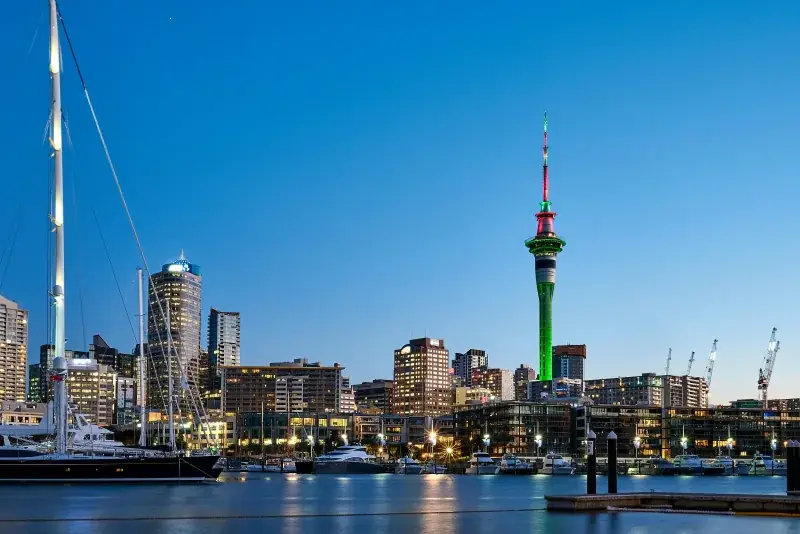
Auckland — Tāmaki Makaurau, "the place desired by many" — is New Zealand's largest city, draped across a narrow volcanic isthmus between two harbours: the Waitematā opening east to the Pacific, the Manukau west to the Tasman Sea. Locals call it the City of Sails, and one glance at the yacht-crowded Waitematā explains why. It is a city best understood by wandering it — and with self-guided audio tours, every crater rim, ferry wharf and gallery hall comes with its story told in your ear, at your own pace.
A city built on volcanoes
Auckland sits on a field of roughly 53 volcanic cones, and the best viewpoints in town are their summits. Climb Maungawhau / Mount Eden, the city's highest cone, and peer into a perfectly grassy crater with the skyline beyond; at Maungakiekie / One Tree Hill, rising from the sheep-grazed lawns of Cornwall Park, the terraced slopes of a great Māori pā are still visible underfoot. An audio guide turns each summit walk into a layered history — geology, ancestral settlement, and the modern city below.
Maungawhau / Mount Eden
Dormant scoria volcano with a deep crater once a fortified Māori hilltop stronghold.
Maungakiekie / One Tree Hill
Volcanic summit crowned by an obelisk, site of a former Maori pa and a famous chainsaw protest.
Cornwall Park
Sloped volcanic-cone park with a working farm, ancient Maori terraces, and sweeping city views.
Harbour life and island escapes
Downtown, the Viaduct Harbour waterfront buzzes with superyachts and seafood restaurants beneath the 328-metre Sky Tower, the tallest structure in the Southern Hemisphere's yachting capital. Ferries fan out across the Hauraki Gulf: a short hop to Devonport's Victorian villas, about 40 minutes to Waiheke Island's vineyards and beaches, or across to Rangitoto Island — a symmetrical volcano that erupted only around 600 years ago and now carries the world's largest pōhutukawa forest.
Viaduct Harbour
Historic fishing basin turned marina precinct of waterfront bars, restaurants, and superyachts.
Sky Tower
Concrete telecommunications spire engineered to sway a metre in the wind, with glass-floor observation decks and a wire-guided plunge off the side.
Devonport
Volcanic headland laced with prisoner-dug tunnels built to repel an invasion that never came.
Waiheke Island
Vineyard-dotted island laced with beaches, art studios, and a hidden wartime gun fortress.
Rangitoto Island
Black scoria volcanic cone cloaked in the world's largest pohutukawa forest, risen from the sea barely six centuries ago.
Pacific culture and wild coasts
Auckland holds the largest Polynesian population of any city in the world, and its museums show it: the 1920s Greco-Roman Auckland War Memorial Museum houses an extraordinary collection of Māori taonga, including a carved meeting house, while the Auckland Art Gallery Toi o Tāmaki holds more than 16,000 works. Then swap the city for the west coast, where black-sand Piha Beach thunders with surf beneath Lion Rock.
Few cities pack volcanoes, islands, beaches and a living Pacific capital into one place. Pick a landmark, press play, and let Auckland tell you its story.
Auckland Museum
War memorial museum atop a dormant volcano, home to a carved Maori war canoe over eighty feet long.
Auckland Art Gallery
Landmark gallery of eighteen thousand artworks beneath a timber canopy shaped like a kauri forest.
Piha Beach
Wild black-iron-sand surf beach split by a volcanic rock outcrop, ringed by rainforest ranges.