
Mexico City is two cities stacked on top of each other. In 1325 the Mexica founded Tenochtitlan on an island in Lake Texcoco — a capital of canals and causeways with more than 200,000 inhabitants; two centuries later the Spanish tore it down and built their colonial city straight onto the ruins, recycling Aztec temple stones into the Metropolitan Cathedral. Today a metropolis of nearly 22 million sits at 2,240 meters on the drained lakebed, still slowly sinking into it, while the pre-Hispanic past keeps breaking through the Baroque surface. That layering is exactly what a self-guided audio tour was made for: stand in one plaza and hear five centuries talking over each other.
One square, five centuries
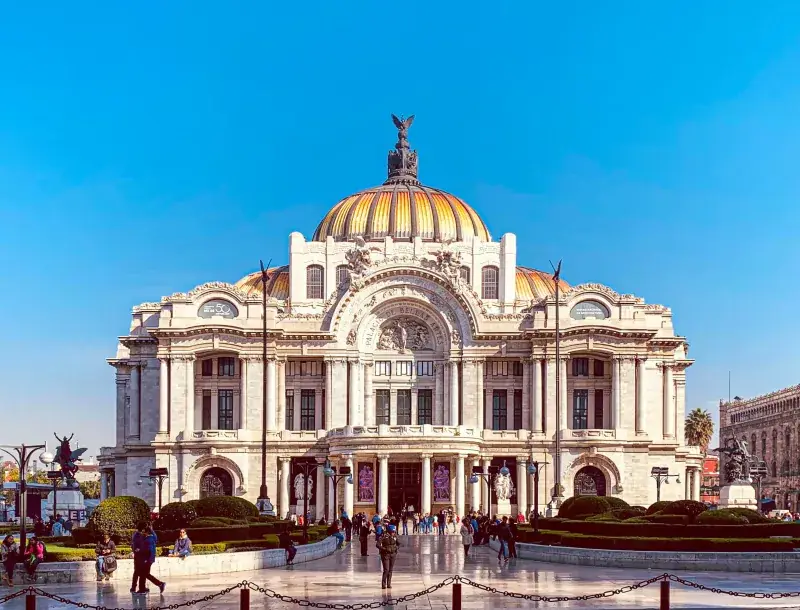
Start at Constitution Plaza — the Zócalo — one of the largest public squares in the world. On one side rises the cathedral that took over two hundred years to build, the largest in Latin America; just behind it lie the excavated platforms of the Templo Mayor, the ceremonial heart of Tenochtitlan rediscovered beneath a city street in 1978. A short walk west, the Palacio de Bellas Artes pairs a white-marble exterior with murals by Mexico's great modernists, beside the leafy Alameda Central, the city's oldest park. Each landmark's audio guide untangles which era you are actually looking at — Aztec foundation, colonial facade, or revolutionary mural.
Constitution Plaza
Vast paved square built over an Aztec ceremonial center, with a giant flag raised and lowered daily by soldiers.
Mexico City Metropolitan Cathedral
Baroque cathedral raised on a drained lakebed, engineered back level after decades of sinking unevenly.
Templo Mayor Museum
Excavated ruins of a holy Aztec pyramid, paired with a museum of monoliths and relics.
Palacio de Bellas Artes
Marble-clad theatre that sank four meters into an old lakebed during forty years of stalled construction.
Alameda Central
Historic downtown park with tree-lined paths, fountains, and a shaded plaza dating to the sixteenth century.
Chapultepec and the grand avenues
West of the center spreads the Bosque de Chapultepec, the city's enormous urban forest. On its hill stands Chapultepec Castle, once home to viceroys and an emperor and now the National History Museum; below it, the Museo Nacional de Antropología — purpose-built in the 1960s — holds the largest collection of Mexican artifacts in the world, including the famous Sun Stone. Follow Paseo de la Reforma past the golden Angel of Independence, then drift into La Condesa for Art Deco streets, tree-shaded cafés, and some of the best casual food on the continent.
Bosque de Chapultepec
Sprawling ancient forest of sacred springs, cypress groves, lakes, museums and a hilltop castle.
Chapultepec Castle
Hilltop palace built over sacred Aztec springs, once home to an emperor and six young cadets.
Museo Nacional de Antropología
Concrete umbrella-roofed courtyard leading into vast halls of Mesoamerican art and monoliths.
Avenida Paseo de la Reforma
Grand nineteenth-century boulevard that shuts to cars every Sunday for cyclists and skaters.
The Angel of Independence
Golden winged victory column on a busy traffic circle, rebuilt after toppling in an earthquake.
La Condesa
Oval-curved streets tracing a vanished horse racetrack, lined with art deco apartment blocks and shaded parks.
Pilgrims, markets, and canals
At Tepeyac Hill in the north, the Basilica of Our Lady of Guadalupe draws some twenty million pilgrims a year — one of the most visited shrines in the Catholic world. For an earthier kind of ritual, browse the herbs and folk-magic stalls of Mercado Sonora; for a glimpse of the vanished lake, ride a painted trajinera through the canals of Xochimilco, a surviving fragment of the Aztec floating gardens.
At 2,240 meters the air is thin and the sun is strong — take your first day slowly, the way the locals do.
With an audio guide in your ears, Mexico City stops being overwhelming and becomes legible: a lake, an empire, a colony, and a modern megacity, all speaking from the same street corner.
Basilica of Our Lady of Guadalupe
Circular, column-free basilica roofed in oxidized copper, replacing one that sank into lakebed clay.
Mercado Sonora
Sprawling market of herbalists and healers selling remedies, charms, and cures for body and luck.
Embarcadero Nuevo Nativitas Xochimilco
Boat launch onto ancient canals where floating gardens drift past a fading habitat of a rare salamander.