
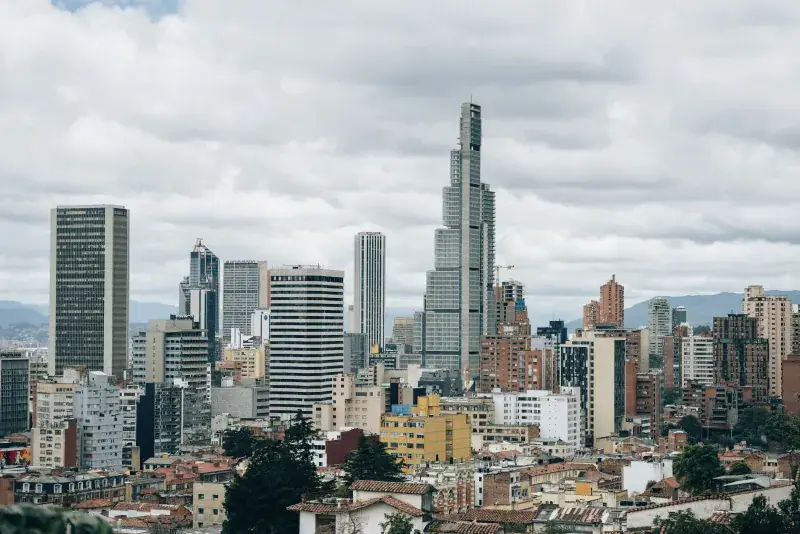
Bogotá sits 2,640 metres up in the Andes — a capital of roughly eight million people spread across a high green plateau and pressed against a wall of eastern mountains. Founded in 1538 by the conquistador Gonzalo Jiménez de Quesada on lands of the Muisca people, it grew into the city long nicknamed the Athens of South America for its universities, libraries and theatres. Today it is a place of sharp, likeable contrasts: colonial bell towers and graffiti-covered lanes, high-altitude fruit markets and third-wave coffee bars. It rewards unhurried wandering, and with self-guided audio guides you can take it street by street at your own pace, with each landmark's story in your ears as you reach it.
The colonial heart
Start in La Candelaria, the historic quarter of cobblestones, thick-walled colonial houses and some of the boldest street art on the continent. An audio guide walks you from the student cafés of Chorro de Quevedo — the little plaza where the city is said to have been founded — down to the vast Plaza de Bolívar, where the Catedral Primada, the Capitol and the Palace of Justice frame two centuries of Colombian history in a single square.
La Candelaria
Cobblestoned colonial quarter of pastel houses, churches and plazas where the capital's history unfolded.
Chorro de quevedo
Cobblestone square built around a public fountain whose water once flowed for over sixty years straight.
Plaza de Bolívar
Colonial plaza where a merchant's refused vase sparked a nation's independence uprising in eighteen ten.
Gold, art and altitude
A few blocks away, the Gold Museum holds the world's greatest collection of pre-Hispanic goldwork — some 55,000 pieces, crowned by the Muisca raft that gave rise to the legend of El Dorado. Pair it with the Botero Museum's cheerfully oversized figures, then ride the funicular or cable car up Monserrate, the white-churched peak above the city, for a panorama that finally makes Bogotá's scale make sense.
Gold Museum
Pre-Columbian gold votive raft depicting a chief's sacred lake offering ritual behind the El Dorado legend.
Botero Museum
Colonial mansion museum of voluptuous, oversized figures and still lifes donated whole by the artist himself.
Monserrate
Sacred peak above the capital, reached by funicular and cable car for sweeping city views.
Beyond the centre
The city keeps unfolding northward: Usaquén's colonial plaza and Sunday flea market, the perfume of exotic fruit at Paloquemao Market, and the lawns and lakes of Parque Simón Bolívar, where bogotanos spend their weekends — many of them arriving by bicycle on the city's famous ciclovía routes. With a little more time, head 49 kilometres north to the Zipaquirá Salt Cathedral, an astonishing church carved 200 metres underground in a working salt mine.
Cool, creative and unmistakably Andean, Bogotá is a capital best understood slowly — one plaza, one museum and one audio story at a time.
Usaquén
Cobblestone plaza and colonial parish church anchoring a Sunday flea market on former Muisca ground.
Paloquemao Fruit Market
Sprawling produce hall trading fresh flowers, fruit and spices since the nineteen forties.
Zipaquirá Salt Cathedral
Underground church carved from an active salt mine, rebuilt deeper after its original sanctuary was closed as unsafe.