
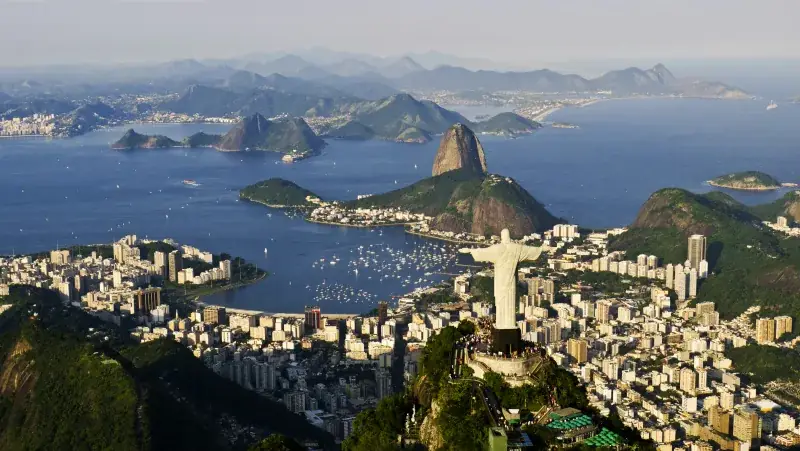

Rio de Janeiro is the city Brazilians call the Cidade Maravilhosa — the Marvelous City — and for once a nickname undersells the reality. Granite peaks rise straight out of the Atlantic, rainforest tumbles down to world-famous beaches, and samba spills from doorways in between. Founded in 1565 and Brazil's capital until 1960, Rio wears its history lightly; in 2012 UNESCO inscribed its "Carioca Landscapes between the Mountain and the Sea" as a World Heritage site. It is a city best explored at your own rhythm — which is exactly what self-guided audio tours are for: wander from beach to viewpoint with a narrator in your ear, unpacking each landmark's story as you reach it.
Between the mountain and the sea
Two summits define the skyline, and each has a tale worth hearing. Christ the Redeemer, the 30-metre Art Deco statue completed in 1931 to designs by sculptor Paul Landowski, opens its arms atop 700-metre Corcovado inside Tijuca National Park — voted one of the New Seven Wonders of the World in 2007. Across the water, the cable car up Sugarloaf Mountain rises from Urca, the very spot where the city was founded. Wrapped around both is Tijuca, the vast rainforest-within-a-city (a national park since 1961), threaded with trails, waterfalls and lookouts — audio guide queued, you can hike its story as you go.
Christ the Redeemer
Soaring Art Deco statue crowning a rainforest peak, arms spread over a sweeping bay panorama.
Sugarloaf Mountain
Granite peak reached by a century-old cable car, with a sweeping panorama over the bay and city.
Tijuca National Park
Rainforest peak reached by a stone staircase and chain rail carved for a king who refused to use it.
Beach culture, Carioca style
The beaches are Rio's living rooms. Copacabana's wave-patterned promenade hums from dawn until long after dark, Ipanema sets the standard for effortless cool, and at the Arpoador rock crowds gather every single evening to applaud the sunset behind the Dois Irmãos peaks. Follow the shore on to Leblon for a quieter, more local stretch of sand.
Copacabana Beach
Sweeping stretch of sand backed by a hand-cut, wave-pattern stone promenade from a modernist master.
Ipanema Beach
Crescent of white sand backed by a hand-laid mosaic promenade and borrowed lifeguard numbers.
Pedra do Arpoador
Rocky outcrop where crowds gather nightly to applaud a rare westward sunset over the Atlantic.
Samba, steps and the city of tomorrow
Downtown and bohemian Santa Teresa reward slow exploring. The Escadaria Selarón — 215 steps that Chilean artist Jorge Selarón covered in tiles from more than 60 countries — climbs out of nightlife-filled Lapa, close to the sweeping arches of the old Carioca Aqueduct. On the reborn waterfront, Santiago Calatrava's Museu do Amanhã (Museum of Tomorrow) points like a spaceship across Guanabara Bay, while the Botanical Garden, founded in 1808, shelters avenues of imperial palms, orchids and free-flying toucans. And no visit is complete without the Maracanã, the temple of Brazilian football that packed in some 170,000 fans for the 1950 World Cup final.
Carnival may last a week, but Rio's soundtrack — samba, bossa nova, the thump of a beach kickabout — plays all year.
Press play, pick a neighbourhood, and let the city tell you its own story, between the mountain and the sea.
Escadaria Selarón
Mosaic staircase of colorful tiles from sixty countries, built solo across two decades.
Arcos da Lapa
Colonial stone aqueduct turned tram viaduct, its forty-two arches shading Rio's bohemian quarter.
Museu do Amanhã
Sun-tracking solar wings and bay-water cooling built into a cantilevered science museum on the pier.
Botanical Garden of Rio de Janeiro
Formal palm avenue and lakes where a single ancestral tree shaped a nation's landscape.
Estádio Jornalista Mário Filho
Iconic football arena rebuilt for a World Cup amid a construction bribery scandal that jailed a state governor.