

Where California Began
San Diego is where California's story starts. Juan Rodríguez Cabrillo stepped ashore at Point Loma in 1542 as the first European to land on the West Coast, and the first of California's 21 missions — Mission Basilica San Diego de Alcalá — rose here two centuries later. Yet the city wears all that history lightly: this is a sun-soaked Pacific port of surf breaks and sailboats, craft-beer patios and Navy gray on the bay. Its landmarks are scattered from clifftop to harbor, which makes San Diego a natural city to explore with self-guided audio guides — press play at each stop and hear the story behind what you're looking at, at your own pace.
From Conquistadors to Gaslamps
Start where the timeline does. At Cabrillo National Monument, high on Point Loma beside the 19th-century Old Point Loma Lighthouse, the whole sweep of bay, city and ocean opens below you. Down in Old Town San Diego State Historic Park — the "birthplace of California" — adobe homes and some 17 museums and historic sites recreate the Mexican and early American pueblo of the 1800s. Downtown, the Gaslamp Quarter packs 16 blocks of restored Victorians — from the 1882 Yuma Building to the ornate Louis Bank of Commerce — into a National Register district that once ran on gambling dens and now runs on restaurants, theaters and rooftop bars. Each has an audio guide that peels back its rowdy, layered past.
Cabrillo National Monument
Clifftop Fresnel-lens beacon lit in eighteen fifty-five, later dimmed by the fog it was meant to pierce.
Old Town San Diego State Historic Park
Restored nineteenth-century adobe hacienda once mythologized as a fictional novel's wedding chapel.
Gaslamp Quarter
Victorian-era saloon district named for the sting of bay rays, now lined with bars and restaurants.
A Park Like No Other
Balboa Park is San Diego's cultural heart: a vast spread of Spanish Colonial Revival pavilions built for the 1915 Panama-California Exposition, now home to more than a dozen museums, the Botanical Building, the Spreckels Organ Pavilion — the world's largest outdoor pipe organ — and the world-famous San Diego Zoo. You could spend a full day here and still leave gardens unexplored.
Balboa Park
Sprawling urban park of gardens, museums and Spanish Colonial architecture around a free outdoor pipe organ.
San Diego Zoo
Sprawling wildlife park of naturalistic habitats set in canyon terrain, home to giant pandas and rare species from six continents.
Spreckels Organ Pavilion
Open-air Italian Renaissance pavilion housing one of the world's largest unamplified pipe organs.
Bay, Beaches and Big Ships
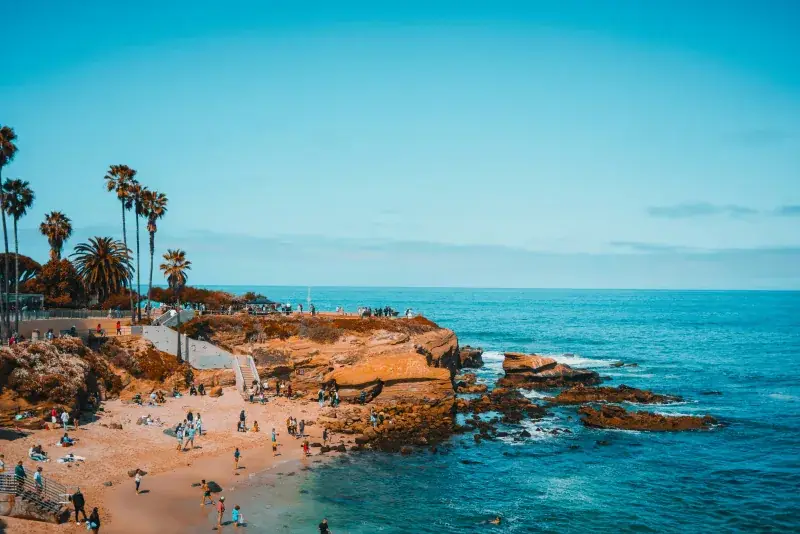
On the Embarcadero, walk the flight deck of the USS Midway, a real aircraft carrier turned museum. Ferry across the bay to Coronado, where the red-turreted Hotel del Coronado has anchored the beach since 1888. North along the coast, sea lions haul out at La Jolla Cove, rare pines cling to the sandstone bluffs of Torrey Pines, and locals gather at Sunset Cliffs for the day's last light.
Tip: San Diego's climate is famously mild year-round — mornings for tidepools and trails, evenings for the Gaslamp, and an audio guide in your pocket for everything in between.
USS Midway Museum
Decommissioned aircraft carrier turned floating museum, deck once cleared for a refugee family's desperate landing.
Coronado
Seaside resort town famed for a grand Victorian beach hotel and an unsolved nineteenth-century death that still haunts it.
Hotel del Coronado
Grand Victorian wooden beach resort with a knothole-free pine Crown Room ceiling built without a single nail.
La Jolla Cove
Rocky cliff-ringed inlet where hundreds of wild sea lions haul out beside a protected marine reserve.
Torrey Pines State Natural Reserve
Coastal bluff-top launch site where pilots have soared engineless off three-hundred-fifty-foot sandstone cliffs since the nineteen twenties.
Sunset Cliffs Natural Park
Wave-carved sandstone bluffs and sea caves along the Pacific, laced with cliffside trails.