

Chicago rose twice: first as a trading post on the southwestern shore of Lake Michigan, then again from the ashes of the Great Fire of 1871 — rebuilding so boldly that by 1885 it had raised the world's first steel-framed skyscraper. Today the third-largest city in the United States wears that history on every block, and the easiest way to hear it is with a self-guided audio tour: stand in front of a landmark, press play, and let the city tell its own story at your own pace.
The city that invented the skyscraper
Architecture is Chicago's signature art form. In the Loop, nineteenth-century pioneers share sidewalks with gleaming supertalls, and the Chicago Riverwalk threads between them at water level — an unbeatable stage for an audio-guided stroll through a century of skylines. Ride up Willis Tower to the Skydeck on the 103rd floor, 1,353 feet above the street, where the glass boxes of The Ledge jut out from the facade and four states stretch to the horizon on a clear day. The wider region holds the world's highest concentration of Frank Lloyd Wright buildings, from The Rookery's luminous lobby to the UNESCO-listed Robie House — each with a story an audio guide can unpack while you stand right where it happened.
Chicago Riverwalk
Riverside promenade of stone terraces and cafes beneath the bascule bridges of a working downtown waterway.
Willis Tower
Bundled-tube steel skyscraper with glass balconies suspended over open air on its observation floor.
The Rookery Building
Fireproof iron-and-masonry landmark built on the ashes of the Great Fire, with a glass-roofed light court remade by Frank Lloyd Wright.
Frederick C. Robie House
Horizontal Prairie masterwork of cantilevered roofs, Roman brick and long bands of art glass.
A front yard on the lake
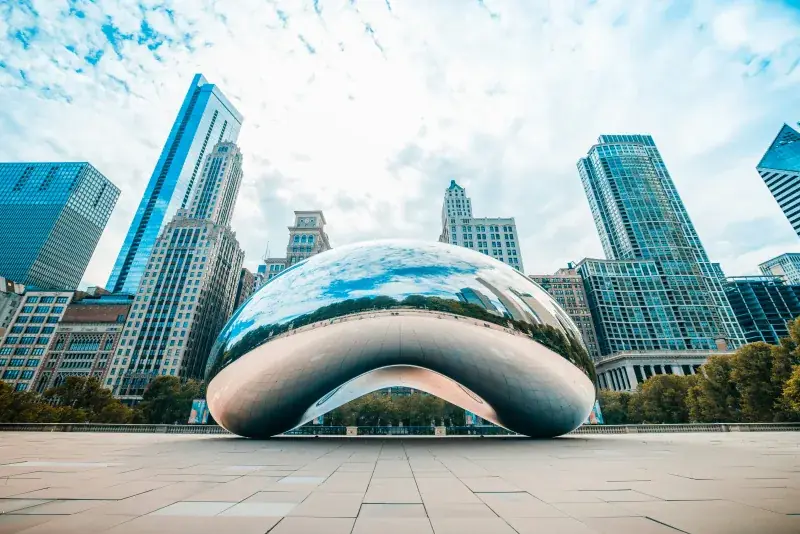
Between the towers and the water lies a lakefront few cities can match. In Millennium Park, crowds circle Cloud Gate — "The Bean" — to catch the skyline curved across its mirrored skin, while free concerts fill Frank Gehry's Jay Pritzker Pavilion on summer evenings. Steps away, the Art Institute of Chicago ranks among the world's great museums, and the Museum Campus pairs the Field Museum's dinosaurs with the Shedd Aquarium's aquatic life. Navy Pier stretches out into Lake Michigan with its Ferris wheel, and the Magnificent Mile funnels shoppers up North Michigan Avenue past Gothic Revival and Jazz Age towers.
Millennium Park
Downtown park of reflective public art and open-air pavilions, built largely with private donations.
Cloud Gate
Seamless stainless-steel sculpture with a mirror-polished, bean-shaped curve reflecting the skyline overhead.
The Art Institute of Chicago
Beaux-Arts palace of galleries built at speed for a World's Fair deadline, its stone-look walls actually brick.
Field Museum
Largest, most complete Tyrannosaurus rex skeleton ever found, once seized as evidence in a federal criminal case.
Shedd Aquarium
Octagonal marble hall on Lake Michigan holding one of the world's oldest saltwater collections, its first seawater hauled inland by train.
Navy Pier
Historic lakefront pier of dining pavilions and picnic groves turned mile-long food hall and entertainment strip.
Big shoulders, blues and deep-dish
"City of the Big Shoulders" — Carl Sandburg's nickname still fits.
Chicago helped shape modern blues, jazz, house music and improv comedy, and its neighborhoods keep that working-city swagger: catch an afternoon game at century-old Wrigley Field, argue about the best deep-dish pizza, or hop the elevated "L" as it rattles around the Loop. Wherever you wander, the audio guides travel with you — no group, no schedule, just Chicago telling its story one landmark at a time.