
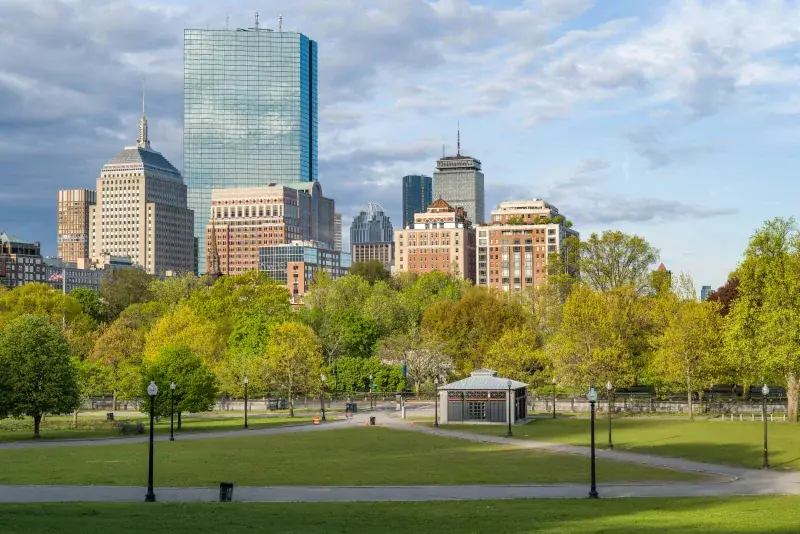

Boston is where the United States began arguing itself into existence. Founded in 1630 between the Charles River and the harbor, the capital of Massachusetts packs nearly four centuries of history into a compact, famously walkable core — which makes it a natural city to explore with self-guided audio guides, wandering from cobblestones to waterfront at your own pace while the stories play in your ears.
Follow the red line
The city's signature walk is the Freedom Trail, a 2.5-mile red line laid through the streets in 1951 that links 16 revolutionary sites and draws more than four million visitors a year. It begins on Boston Common — America's oldest public park — climbs past the gold-domed Massachusetts State House, and threads downtown to Faneuil Hall, the "Cradle of Liberty" where colonists rehearsed rebellion. In the North End, Boston's Italian quarter, the steeple of Old North Church still recalls the two lanterns of Paul Revere's midnight ride; across the water in Charlestown, the trail ends at USS Constitution. Each stop along the way has its own audio guide, so the red line becomes a chain of stories rather than a checklist.
Freedom Trail
Painted-red walking route linking sixteen Revolutionary-era landmarks through the old city center.
Boston Common
Colonial green once used for grazing and public hangings, now a leafy park crossed by walking paths.
Massachusetts State House
Gilded dome landmark whose House chamber guards a carved wooden codfish once stolen by campus pranksters.
Faneuil Hall
Colonial market hall and revolutionary meeting space, funded by profits from the slave trade.
Old North Church
Colonial steeple where two lanterns once flashed a coded warning that ignited a revolution.
USS Constitution
Wooden War of 1812 frigate whose thick oak hull turned cannonballs to scrap, earning her the name Old Ironsides.
Brownstones and swan boats
Step off the trail and Boston softens. Beacon Hill's gaslit lanes and brick rowhouses are the city's most photographed corner, and beside the Common lies the Public Garden — created in the 1830s as the first public botanical garden in the United States, where pedal-powered Swan Boats have circled the lagoon since 1877.
Beacon Hill
Row of nineteenth-century brick townhouses, a few still glazed with rare violet-tinted glass panes.
Public Garden
Historic urban park with a formal lagoon, swan boats, and an ornamental nineteenth-century footbridge.
Swan Boats
Pedal-powered lagoon boats hidden inside copper swans, unchanged since a shipbuilder's opera-inspired debut.
Beyond the colonial core
Boston is more than its revolution. Fenway Park, home of the Red Sox since 1912, is the oldest active ballpark in the major leagues, its 37-foot "Green Monster" wall a shrine of American sport. The Museum of Fine Arts holds one of the country's great collections, the New England Aquarium anchors a reborn harbor, and across the river Harvard University has been shaping minds since 1636. Pick a neighborhood, press play, and let the city talk.
Fenway Park
Historic ballpark home to a hand-operated scoreboard and a towering left field wall known as the Green Monster.
Museum of Fine Arts, Boston
Encyclopedic art collection spanning centuries, including a Rembrandt once stolen at gunpoint and later ransomed back.
New England Aquarium
Cylindrical coral-reef tank home to a beloved, decades-old green sea turtle and rescued marine life.
Harvard University
Ivy League campus where a maid taught herself to read starlight and discovered the Horsehead Nebula.