
The city the sea made rich
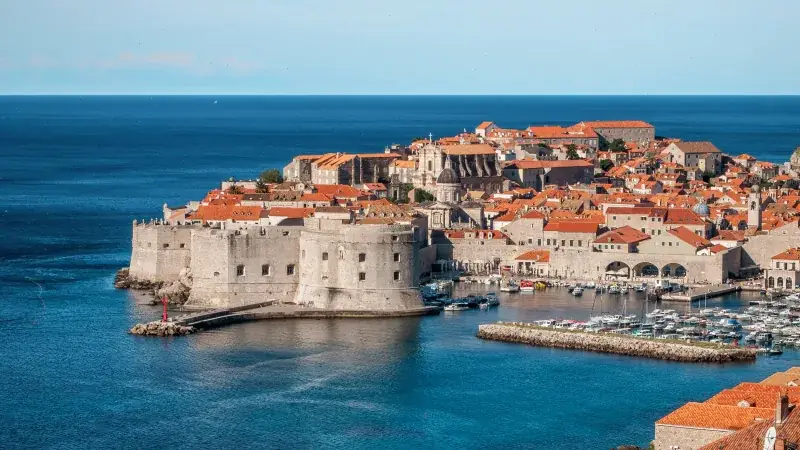
Dubrovnik is a walled miracle on Croatia's Dalmatian coast — a compact old city of polished limestone, terracotta roofs and Baroque bell towers wedged between mountain and Adriatic. For 450 years it was the capital of the Republic of Ragusa (1358–1808), a tiny merchant state that out-negotiated empires, wrote the world's first quarantine law in 1377 and abolished the slave trade in 1416 — centuries ahead of most of Europe. The best way to unpack that improbable story is with a self-guided audio tour, moving stone by stone through streets where almost every façade hides a plot twist.
Walk the walls, then walk the story
Begin where everyone does: at Pile Gate, then up onto the City Walls — roughly two kilometres of ramparts rising up to 25 metres, never breached while the republic stood. The full circuit takes about an hour, with terracotta rooftops on one side and open sea on the other. Below gleams the Stradun, the limestone promenade rebuilt in harmonious Baroque style after the catastrophic 1667 earthquake; an audio guide along it connects Onofrio's Fountain, piping clean drinking water since the early 1400s, to the 14th-century pharmacy still operating inside the Franciscan Monastery — one of the oldest in Europe.
Pile Gate
Renaissance fortress gate with a stone bridge, dry moat, and two carved guardian saints centuries apart.
Dubrovnik City Walls
Nearly two-kilometer stone fortification with towers and bastions ringing a medieval old town.
Stradun
Limestone-paved main street of shops rebuilt to a single uniform plan after a catastrophic earthquake.
Onofrio's Large Fountain
Sixteen-sided public fountain with carved masked spouts, fed by a gravity aqueduct across twelve kilometers.
Franciscan Church and Monastery
Working medieval pharmacy compounding remedies from centuries-old Franciscan recipes.
Palaces of a one-month president
Government here was designed against ambition. In the Gothic-Renaissance Rector's Palace, the republic's head of state served a single month and could not leave the building without the Senate's permission — a story the palace's audio guide tells room by room. Nearby stand Sponza Palace, the elegant former customs house that survived the great earthquake, and the church of St Blaise, dedicated to the protector whose image watches from the city gates.
Rector's Palace
Gothic-Renaissance seat of government rebuilt after two gunpowder blasts and a great earthquake.
Sponza Palace
Arcaded Renaissance customs house whose courtyard now hosts open-air summer concerts.
Saint Blaise’s Church, Dubrovnik
Baroque harbor church rebuilt after a fire, its altar cradling the statue that survived it.
Beyond the gates
Ride the cable car up Mount Srđ for the postcard panorama of the old town against the Adriatic, or take the short ferry to Lokrum, a green island of monastery ruins and quiet swimming coves. Cliff-top Lovrjenac Fortress guards the western approach — theatre stage in summer, film set the rest of the year. Shelled in the 1990s and meticulously restored, Dubrovnik — a UNESCO World Heritage Site since 1979 — wears its scars lightly; let the audio guides fill in what the flawless stone won't tell you.
Dubrovnik Cable Car
Two-cabin ropeway climbing a sheer karst mountain in under four minutes to sweeping coastal views.
Lokrum
Wooded island retreat with a ruined monastery, a former archduke's fortress tower, and a saltwater lake.
Tvrđava Lovrjenac / Lovrjenac Fortress
Triangular clifftop fortress with sea walls twelve meters thick and city-facing walls barely sixty centimeters.