
Seville wears its history in the open air. Orange trees line streets that Romans, Moors and Castilian kings all called home; flamenco drifts across the river from Triana; and the Guadalquivir — the waterway that once carried the wealth of the Americas into Europe — still glides past the golden Torre del Oro. The capital of Andalusia is a city best understood slowly and on foot, and with a self-guided audio guide in your ears each patio, tower and tiled façade starts telling its own story, at your own pace.

Three monuments, seven centuries
The heart of the old city is a UNESCO World Heritage ensemble inscribed in 1987. The Catedral de Sevilla, raised over the Almohad great mosque, is the largest Gothic church in Europe and holds the tomb of Christopher Columbus; its bell tower, La Giralda, began life as a 12th-century minaret and is still counted the masterpiece of Almohad architecture. Steps away, the Royal Alcázar — the oldest royal palace in Europe still in use — layers Moorish fortress walls, Pedro I's dazzling Mudéjar palace and lush Renaissance gardens into one hypnotic complex, while the neighboring Archivo de Indias keeps some 40,000 documents charting three centuries of voyages to the New World. Each has an audio guide that unpacks what the tilework can't say on its own — who built what, and why the styles blend so seamlessly.
Catedral de Sevilla
Gothic cathedral of soaring vaults and a gold altarpiece funded by transatlantic trade wealth.
La Giralda
Bronze weathervane of Faith Triumphant crowning a former mosque minaret turned Renaissance bell tower.
Royal Alcázar of Seville
Fourteenth-century royal palace of carved plaster, cedar ceilings, and tilework by Muslim craftsmen for a Christian king.
Archivo de Indias
Renaissance merchants' hall turned imperial archive, holding eighty million pages on the Spanish Americas.
Two banks of the Guadalquivir
On the west bank, Triana was traditionally the quarter of Seville's sailors, potters and flamenco families, and it still feels like a town of its own: ceramics workshops, tapas bars and the iron arc of the Triana Bridge. Back across the river, the whitewashed lanes of Santa Cruz, the old Jewish quarter, knot themselves around orange-scented patios — a maze made for wandering with a narrator recounting the legends behind its named alleys.
Triana
Riverside quarter of flamenco, ceramics, and a legendary crucifix carving born from tragedy.
Triana Bridge
Nineteenth-century iron arch bridge that ended seven centuries of paying to cross the river.
Santa Cruz, Seville
Rose-filled square of orange trees marking the vanished parish church where a great baroque painter was laid to rest.
From 1929 to a rooftop in the sky
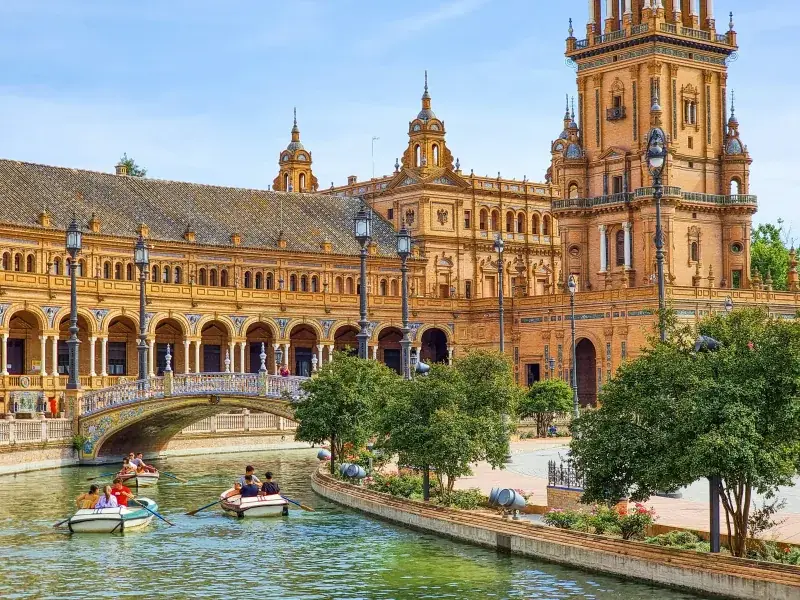
Seville's grandest set piece is surprisingly modern: the sweeping, tile-clad Plaza de España, built by architect Aníbal González for the 1929 Ibero-American Exposition, anchors the shaded walks of Parque de María Luisa. A stroll north, the Setas de Sevilla hovers over Plaza de la Encarnación — billed as the largest wooden structure in the world, with a rooftop walkway that turns the whole city into a panorama.
Come for the monuments; stay for the rhythm — evening paseos, tapas crawls, and the spring one-two of Semana Santa processions and the Feria de Abril.
However you route your day, Seville rewards ears as much as eyes: press play, start walking, and let the city narrate itself.
Plaza de España
Half-moon Regionalismo plaza of brick and tile, its canal edge lined with alcoves for every Spanish province.
Parque de María Luisa
Landscaped nineteenth-century garden of ponds and pavilions that became the stage for a world's fair in nineteen twenty-nine.
Setas de Sevilla
Timber canopy shading a market square, built over Roman ruins found while digging for parking.