
Moscow is a city of magnificent contradictions — golden onion domes beside Stalinist skyscrapers, tsarist estates ringed by a metro built as a "palace for the people", and a medieval fortress that still runs a country of eleven time zones. It is dense with stories, and the best way to unlock them is at your own pace, with a self-guided audio tour narrating each landmark as you stand in front of it.
The heart: Red Square and the Kremlin
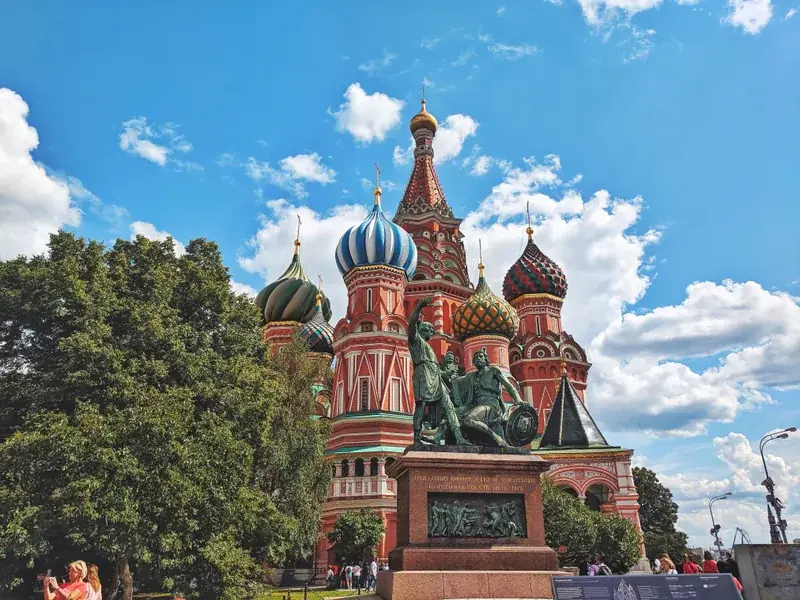
Every visit begins on Red Square — and despite appearances, the name has nothing to do with brick or revolution: the old Russian word krasnaya meant "beautiful". Inscribed on the UNESCO World Heritage list in 1990 together with the Moscow Kremlin, the cobblestone expanse gathers half of Russian history in one sweep: the swirling domes of St Basil's Cathedral, raised in 1555–1561 by Ivan the Terrible to mark the conquest of Kazan; Lenin's Mausoleum; the neo-Russian State Historical Museum; and the glass-roofed arcades of GUM, stretching 242 metres along the square's eastern side. Behind the red walls, the Kremlin's Cathedral Square and Armoury Chamber hold coronation churches and imperial treasures — each with an audio guide that tells you exactly what you are looking at, and why it mattered.
Red Square
Vast paved plaza beside the Kremlin walls, ringed by onion-domed cathedrals and a landmark department store.
The Moscow Kremlin
Fortified medieval citadel of red-brick walls, golden-domed cathedrals, and towers overlooking the river.
St. Basil's Cathedral
Riot of painted onion domes built to mark a tsar's military conquest, named for a barefoot holy fool.
State Historical Museum
Red-brick neo-Russian museum tracing the nation's story from prehistory to the twentieth century.
GUM
Grand glass-roofed nineteenth-century trading arcade of three galleries lined with shops around Red Square.
Armoury Chamber
Treasury museum of royal regalia, coronation robes, jeweled thrones and Faberge eggs.
A green, modern capital
Step off the square into Zaryadye Park, opened in 2017 on the site of the vast Rossiya Hotel. Its landscaped slopes compress four Russian climate zones — taiga, steppe, tundra and floodplain — into thirteen hectares, and its V-shaped "floating bridge" cantilevers out over the Moskva River for the city's best free panorama of the Kremlin. Across the river, Gorky Park, the model Soviet park of 1928, has been reborn as Moscow's favourite riverside playground, while the royal estates of Kolomenskoye — with its UNESCO-listed Church of the Ascension of 1532 — and Tsaritsyno trade city noise for orchards and palace follies.
Zaryadye Park
Riverside urban park of wild grasses and glass domes, with a boomerang bridge cantilevered over the water.
Gorky Central Park of Culture and Leisure
Riverside park with landscaped lawns, an open-air ice rink, and a vanished Soviet parachute tower.
Kolomenskoye
Riverside royal estate with a UNESCO tent-roofed church and a rebuilt tsarist wooden palace.
Tsaritsyno Museum-Reserve
Grand imperial estate of red-brick Gothic palaces, abandoned unfinished for two centuries before its recent restoration.
Art underground and above
Give an afternoon to the State Tretyakov Gallery, begun in 1856 as one merchant's private collection and now the definitive home of Russian art, from medieval icons to the avant-garde. Then remember that Moscow's most visited museum is its Metro: since 1935 its stations have gleamed with chandeliers, mosaics and stained glass. Ride it out to the fountains of VDNKh or up to Sparrow Hills for the classic skyline view — audio guide in your ears, the whole city underfoot.
Give Moscow unhurried time: its stories run deep, and each landmark's audio guide is another chapter.
The State Tretyakov Gallery
Grand art museum holding the world's largest collection of Russian painting and icons.
All-Russian Exhibition Center
Sprawling Soviet-era exhibition park of gilded pavilions, grand fountains, and triumphal arches.
Vorob'yevy gory
Riverside hill and viewpoint crowned by a soaring Stalin-era university tower and a teenage revolutionary's oath.