
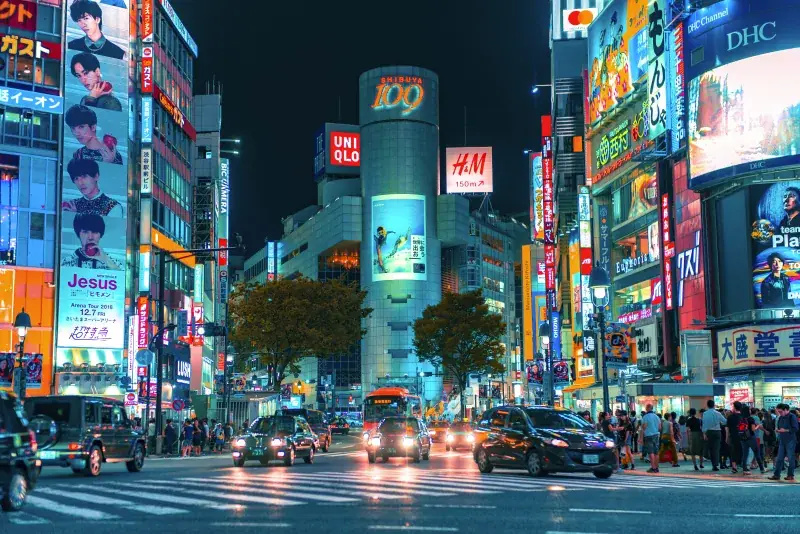

Tokyo: Edo's Old Soul in a Neon Future
Tokyo began as Edo, a fishing village that became the shogun's capital in 1590 and was renamed the "eastern capital" when the emperor moved here in 1868. Today it anchors the largest metropolitan area on Earth — some 41 million people — yet it rarely feels overwhelming, because Tokyo is really a constellation of villages: lantern-lit temple quarters, neon canyons, hushed shrine forests. It is a city built for wandering, and with a self-guided audio tour in your ears, every crossing and courtyard starts telling its story — at your own pace, on your own route.
Where the Old City Still Breathes
Start in Asakusa, where Sensō-ji — Tokyo's oldest temple, founded in the 7th century — pulls you through the great Kaminarimon gate and the souvenir stalls of Nakamise street; its audio guide unpacks how this merchant quarter survived fire, earthquake and war. Across town, a giant torii gate marks Meiji Jingu, a shrine wrapped in a forest of roughly 100,000 trees donated from every region of Japan — an almost silent world just steps from Harajuku's candy-colored Takeshita Street. Few cities switch moods so fast, and the guides catch each shift: imperial memory on one side of the tracks, teenage fashion rebellion on the other.
Sensō-ji
Ancient Buddhist temple complex behind a giant red lantern gate, rebuilt after repeated fires and wartime bombing.
Meiji Jingu
Vast Shinto shrine forest engineered from thousands of donated trees to look ancient within a century.
Takeshita Street
Narrow pedestrian shopping lane packed with youth fashion boutiques, crepe stands, and secondhand clothing stalls.
Skylines, Sushi and Sensory Overload
For the view, choose your era: Tokyo Tower, the beloved red-and-white icon of 1958, or Tokyo Skytree, the world's tallest tower. Between them lie the knife shops and tamagoyaki stands of the Tsukiji Outer Market — fitting for a city with more Michelin-starred restaurants than any other — the electric arcades of Akihabara, digital art at teamLab Planets, and the manicured calm of Shinjuku Gyoen. Each has an audio story of its own, from post-war rebirth to the roots of otaku culture.
Tokyo rewards the curious: turn one corner past a glass tower and you find a pocket shrine, a jazz café, an alley of red lanterns. Press play, start walking, and let the city explain itself.
Tokyo Tower
Postwar lattice tower of steel partly reforged from wrecked wartime tanks, painted orange and white by aviation law.
Tokyo Skytree
Broadcasting tower over six hundred meters tall with two observation decks offering sweeping city views.
Fish Market Tsukiji Outer Market
Maze-like lanes of century-old shops selling fresh-sliced tuna, sushi knives, and street food.
Akihabara Electric Town
Bustling electronics and anime shopping district born from a postwar radio black market.
teamLab Planets TOKYO DMM
Barefoot digital art museum where visitors wade through water and a floor that sinks underfoot.
Shinjuku Gyoen National Garden
Sprawling Meiji-era garden blending Japanese, French and English styles around a tranquil pond.