
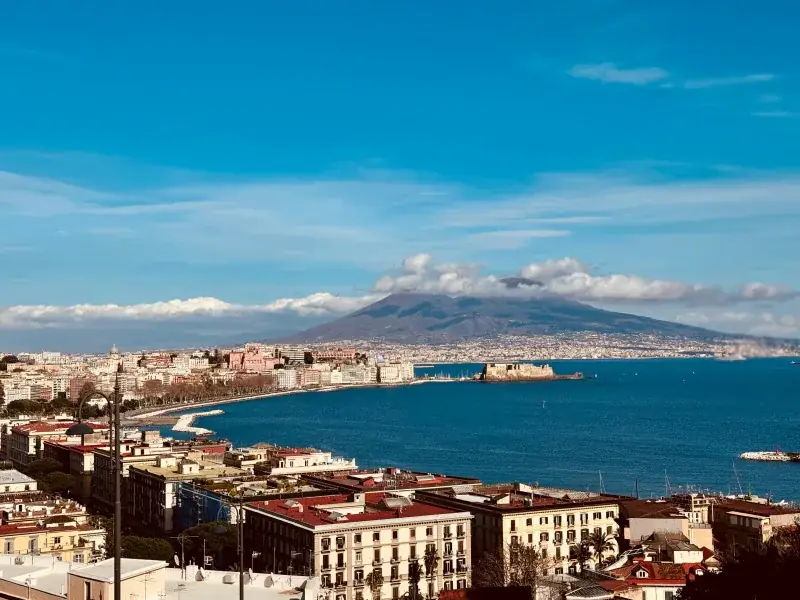

Italy's most alive city
Founded by Greek settlers as Neapolis in the sixth century BC, Naples has been lived in continuously for some 2,700 years — and it wears every one of them on its sleeve. Italy's third-largest city curls around its bay with Mount Vesuvius on the horizon, and its UNESCO-listed historic centre still follows the street grid the Greeks laid down. It is a city made for exploring at street level with an audio guide in your ears: laundry-strung alleys, baroque churches and roaring scooters all at once, each landmark carrying a story that runs far deeper than any plaque.
Layers of a 2,700-year-old city
Start where the city splits in two. Spaccanapoli, the arrow-straight street tracing an ancient Roman decumanus, slices through the old town past artisan workshops, tiny chapels and the nativity-scene carvers of Via dei Presepi. A few steps off it, the Sansevero Chapel hides the Veiled Christ — Giuseppe Sanmartino's marble Christ beneath a shroud carved from the very same block, a sculpture that has stunned visitors since the eighteenth century. Nearby, the cloister of Santa Chiara glows with hand-painted majolica tiles, while the Duomo guards the relics of San Gennaro, the patron saint whose blood Neapolitans still gather to watch liquefy. Each stop has its own audio story, so the miracle, the alchemist's legends and the street's gossip come with you as you walk.
Naples goes down as well as back. Beneath the pavement, Underground Naples opens Greek-cut tuff quarries and aqueduct tunnels that sheltered thousands of residents during the bombing raids of the Second World War — an eerie, unforgettable descent.
Sansevero Chapel Museum
Baroque chapel with a veiled marble Christ and wax-wired anatomical skeletons below.
Complesso Monumentale di Santa Chiara
Gothic monastery cloister of hand-painted majolica tiles, once home to a cloistered order of nuns.
Duomo di Napoli
Gothic cathedral built over a saint's bones, where a martyr's dried blood is watched three times a year for a sign.
Via dei Presepi
Narrow pedestrian lane crowded with workshops molding terracotta nativity figures by hand.
Underground Naples
Ancient Greek quarries and Roman aqueduct tunnels forty meters underground, once a wartime bomb shelter.
Castles, palaces and the sea
Down at the waterfront the mood widens. The colonnaded sweep of Piazza del Plebiscito faces the Royal Palace of Naples, seat of Spanish viceroys and Bourbon kings; Castel Nuovo raises its white triumphal arch over the port; and the medieval Castel dell'Ovo sits on the islet of Megaride, the very spot where the city's first Greek colonists landed. Inland, the National Archaeological Museum holds the finest treasures excavated from Pompeii and Herculaneum — the perfect prologue to a day trip up Vesuvius itself, or out to the buried cities beneath it.
Piazza del Plebiscito
Grand semicircular square framed by a colonnaded basilica and twin bronze equestrian statues.
Royal Palace of Naples
Baroque royal residence with eight statue-lined niches of Naples's kings facing the sea.
Castel Nuovo
Medieval fortress with five sea-facing towers around a moat, home to a stuffed Nile crocodile legend.
Castel dell'Ovo
Seafront fortress on a former island, linked to the mainland by a slender stone causeway.
Museo Archeologico Nazionale di Napoli
Grand royal collection of Greek and Roman antiquities from Pompeii, Herculaneum and the Farnese family.
Mount Vesuvius
Dormant volcanic cone looming over a bay, whose ash buried entire Roman cities in an instant.
Why go
Because Naples is where pizza was born and is still baked best, in wood-fired ovens a few steps from Greek walls. Because it is loud, warm, superstitious, devout and theatrical — often on the same street corner. Let the audio guides peel back the layers while the city carries on around you, exactly as it has for twenty-seven centuries.
"Vedi Napoli e poi muori" — see Naples and then die, the old saying goes. Better: see Naples slowly, one story at a time.