
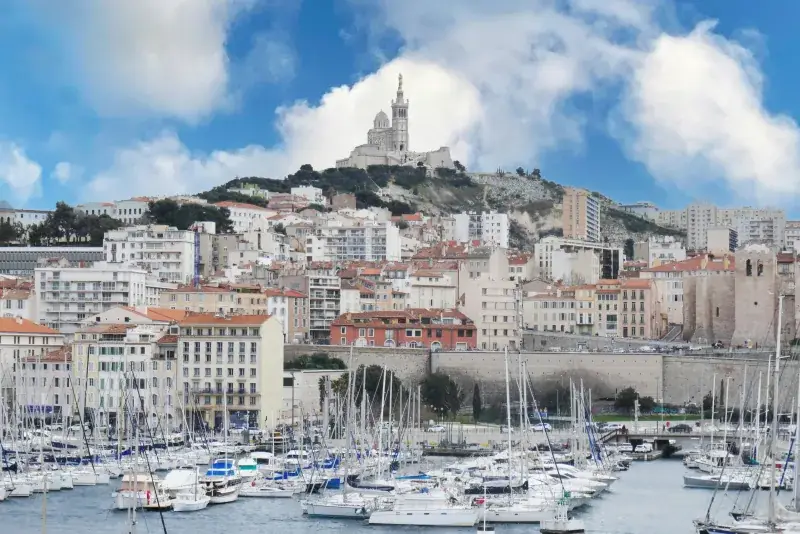

France's Oldest City, Facing the Sea
Marseille began around 600 BC, when Greek sailors from Phocaea moored in a sheltered inlet and founded Massalia. Twenty-six centuries later that inlet is still the city's beating heart — the Old Port, where fishermen sell the morning catch on the Quai des Belges and café terraces face a forest of masts. This is a city best understood story by story: wander with a self-guided audio tour in your ears and the loud, sun-bleached streets resolve into 2,600 years of arrivals — Greeks, Romans, Corsicans, Armenians, North Africans — each wave leaving its trace.
Marseille is France's second-largest city, yet it feels nothing like Paris or the polished Riviera. It is plural, unvarnished and proudly Mediterranean — a working port that happens to be a magnificent place to get lost in, and the natural gateway to Provence.
What to Listen For
Every landmark here has a tale worth hearing. High above the rooftops, the striped Neo-Byzantine basilica of Notre-Dame de la Garde — la Bonne Mère to locals — watches over sailors and rewards the climb with a panorama stretching from the islands to the Calanques. At the harbour mouth, Fort Saint-Jean links by footbridge to the MuCEM, the Museum of European and Mediterranean Civilisations, whose concrete lacework shades galleries devoted to the sea that made the city. Behind the port, the lanes of Le Panier — the oldest quarter — climb past street art, artisan workshops and washing strung between shutters, with an audio guide turning every corner into a chapter.
Listening also unlocks the harder-to-read layers: the fortress-like medieval abbey of Saint-Victor above the south quay, la Canebière — the grand avenue that once announced the city to the world — and the Palais Longchamp, a flamboyant water-château built to celebrate the canal that finally brought fresh water to a thirsty city.
Notre-Dame de la Garde
Hilltop basilica crowned by a gilded Virgin, its walls hung with centuries of sailors' ship-model offerings.
Fort Saint-Jean
Seventeenth-century harbor fortress whose quarantine checkpoint once inspected every incoming ship's papers.
Museum of European and Mediterranean Civilisations
Lace-concrete museum joined by footbridge to a seventeenth-century harbor fortress.
Le Panier
Ancient hillside quarter of narrow Greek-era lanes, rebuilt from wartime ruins into a multicultural artists' district.
Beyond the Quays
Take a boat from the Old Port to the Château d'If, the island fortress-prison Alexandre Dumas made famous in The Count of Monte Cristo, or continue to the pale limestone Frioul archipelago. South of the city, Calanques National Park hides 26 turquoise inlets between white cliffs — some of the most dramatic coastal scenery in France, only a short ride from the centre.
Come for the bouillabaisse and the views; stay because Marseille never performs for visitors — it simply lives, and lets you listen in.
Château d'If
Island fortress-prison with tiered cells where a prisoner's wealth decided whether they ate well or starved.
Frioul archipelago
Wind-scoured island group off the coast, once a quarantine outpost that stopped a plague ship too late.
Parc national des Calanques
Rugged limestone inlets of turquoise water between soaring cliffs, threaded by cliffside trails and hidden coves.