
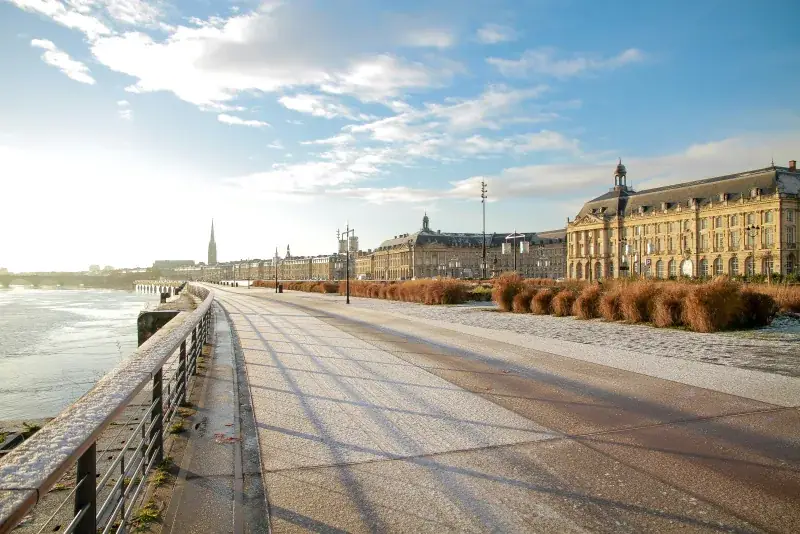
Bordeaux curves along a crescent bend of the Garonne so graceful that sailors named it the Port of the Moon — a shape the city still wears on its coat of arms. Capital of the world's most celebrated wine region, it is also one of Europe's great cities to wander: since 2007 nearly half of it has been inscribed as a UNESCO World Heritage ensemble, with more protected monuments than any French city except Paris. Its riverfront squares, honey-stone facades and hidden courtyards were built to be read like a story — which is exactly what a self-guided audio tour lets you do, landmark by landmark, at your own pace.
A golden age set in stone
Eighteenth-century wine and maritime trade paid for an Enlightenment makeover that left some 5,000 buildings of the era still standing. The showpiece is the Place de la Bourse (1730–1775), designed by royal architect Ange-Jacques Gabriel to dazzle merchants arriving by ship. Facing it since 2006, the Miroir d'eau — a 3,450 m² sheet of water just two centimetres deep — mirrors the palace facades and dissolves into mist every quarter-hour; it has become the most photographed spot in the city. A few streets away the colonnaded Grand-Théâtre anchors the elegant Golden Triangle, while the vast Place des Quinconces and its soaring Monument aux Girondins carry the city's revolutionary chapter — each stop with an audio guide that unpacks the drama behind the stone.
Place de la Bourse
Neoclassical riverside square of twin curved facades, once crowned by a royal statue melted down in revolution.
Miroir d'eau
Shallow granite reflecting pool that turns an eighteenth-century tax office into a mirror of sky.
Opéra National de Bordeaux - Grand-Théâtre
Neoclassical opera house of Corinthian columns and a mostly wooden frame, still standing unburned after two centuries.
Place des Quinconces
Tree-lined square centered on a towering column fountain guarded by rearing bronze horses.
Monument aux Girondins
Bronze fountain chariots of rearing seahorses beneath a towering column crowned by Liberty breaking her chains.
Medieval bells, modern temples of wine
Older Bordeaux survives in the Gothic Cathédrale Saint-André and the freestanding Tour Pey-Berland, whose climb earns the finest view over the rooftops. Duck under the Grosse Cloche, one of France's oldest belfries, then follow the long pedestrian spine of Rue Sainte-Catherine down toward the quays. Along the river, the Pont de Pierre stitches the two banks together, and downstream the gleaming, swirling Cité du Vin (2016) turns wine into an immersive museum experience, while the Bassins des Lumières projects monumental digital art inside a cavernous former submarine base.
Press play, and let Bordeaux narrate its own golden age as you drift from the quays of the old port to the wine merchants' Chartrons district — a story best heard with the river at your side.
Cathédrale Saint-André de Bordeaux
Gothic cathedral where a teenage duchess's wedding feast once reshaped medieval Europe.
Tour Pey Berland
Freestanding Gothic bell tower built apart from its cathedral to spare it the weight of the bells.
Grosse Cloche
Medieval belfry gate with twin round towers, a jail behind ten-centimetre oak doors, and a leopard weathervane.
Pont de Pierre
Brick nineteenth-century river crossing whose seventeen arches once carried a wired-for-demolition port to the brink of ruin.
Cité du Vin
Golden, curving wine museum rising over the docks, tracing wine's culture and craft across the world.
Bassins des Lumières
Cavernous concrete U-boat pens turned into immersive digital art projections across pools and towering walls.