
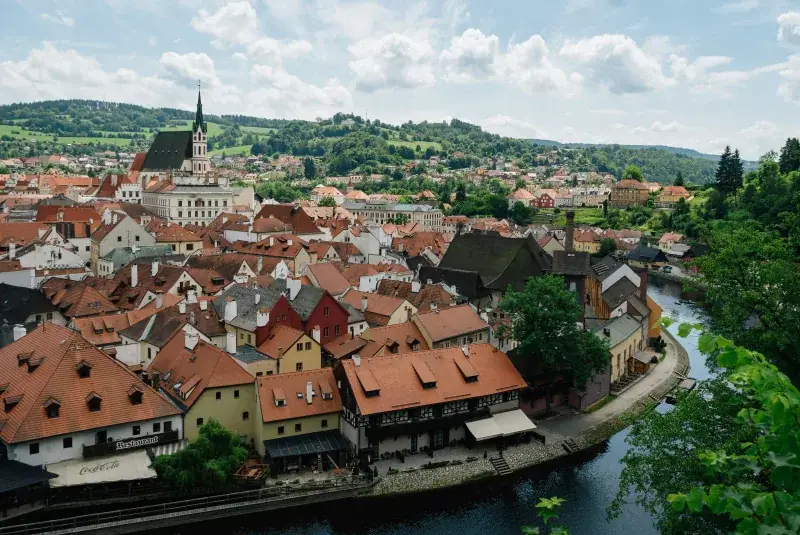
Curled inside a tight horseshoe bend of the Vltava River in South Bohemia, Český Krumlov looks almost too perfect to be real: a huddle of red rooftops, Renaissance gables and one gloriously painted castle tower, essentially unchanged for five centuries. The whole historic centre has been a UNESCO World Heritage Site since 1992, and its compact scale is a gift — nearly everything sits within a fifteen-minute walk, making this an ideal town to explore with self-guided audio guides, letting each courtyard, bridge and burgher house tell its story at your own pace.

A castle above the bend
The State Castle & Chateau is the second-largest castle complex in the Czech Republic, a hilltop procession of buildings and courtyards shaped by three great dynasties: the Rožmberks, whose five-petalled rose still marks the town; the Eggenbergs, who dressed it in Baroque splendour; and the Schwarzenbergs, who held it until after the Second World War. The audio guide walks you from the painted Castle Tower — 162 steps up to the definitive view over the river loop — across the extraordinary multi-tiered Cloak Bridge to the 1680s Baroque Theatre, one of the best preserved in the world, its original stage machinery and sets still intact. Bears really do live in the castle moat, a centuries-old tradition of the lords of Krumlov, and the formal Castle Garden above hides a revolving open-air auditorium that stages opera on summer evenings.
State Castle & Chateau Český Krumlov
Vast Renaissance and Baroque castle complex of painted towers, courtyards, and a moat still home to bears.
Český Krumlov Castle Tower
Cylindrical Renaissance tower with a painted facade, open arcaded gallery, and four historic bells over a Gothic base.
Cloak Bridge
Three-story covered stone bridge with a hidden corridor once used by nobles to reach the castle theatre unseen.
Castle Theater
Baroque court theater with original eighteenth-century rope-and-winch stage machinery still in working order.
A Moat with Bears
Historic castle moat where live bears have been kept for centuries as a family emblem come to life.
The Castle Garden
Baroque noble garden with a cascade fountain, Rococo summer house, and a theatre whose whole audience rotates.
Lanes, squares and the river
Down below, Gothic and Renaissance houses crowd crooked lanes that funnel into Náměstí Svornosti, the arcaded main square, while the Church of St. Vitus holds the tomb of the Rožmberk family beneath its soaring vaults. Follow Latrán, the old castle-servants' quarter, for the town's most atmospheric stretch of facades, and step into the Egon Schiele Art Centrum, which honours the Viennese painter's ties to his mother's hometown. The Vltava itself is a playground: locals and visitors drift through the centre on rafts and canoes, shooting the small weirs right beneath the castle rock.
Náměstí Svornosti
Baroque plague column ringed by a hexagonal stone fountain rebuilt around it a century after its carving.
Church of St. Vitus
Gothic hall church whose vanished guild altars once included one funded by the town's brewers.
Latrán
Cobbled lane of castle-servant houses once packed with taverns for dice, cards and beer past curfew.
Egon Schiele Art Centrum
Renaissance former town brewery now housing watercolors and drawings by a scandal-hounded Viennese painter.
When to go
Stay at least one night. Day-trip crowds arrive with the tour buses and vanish by evening — early mornings and dusk are when the lanes fall improbably quiet and the town feels medieval again. Time a June visit for the Five-Petalled Rose Festival, when Český Krumlov dresses itself in Renaissance costume.