
Five Centuries on the Straits of Florida
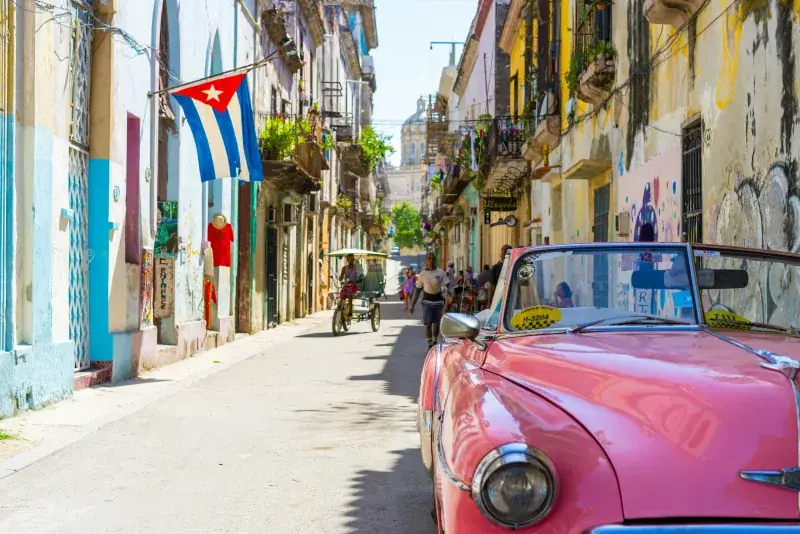
Havana is Cuba's capital and the largest city in the Caribbean — a port founded by the Spanish in 1519 that grew rich as the gateway between the New World's treasure fleets and Seville, and has been the island's capital since 1552. Five centuries later the city is gloriously layered: Baroque and Art Deco facades in fading pastels, 1950s American cars rumbling past colonnades, son and rumba drifting out of doorways. It rewards slow exploration, and a self-guided audio tour is the natural way to take it in — you set the pace along the cobblestones while the stories behind each weathered balcony and harbor fortress unfold in your ears.
Old Havana, Square by Square
The historic core, Habana Vieja, was inscribed on the UNESCO World Heritage list in 1982 together with its fortification system — more than a thousand buildings of historical importance in a district that, unusually, grew around four main squares rather than one. Plaza de Armas was the military heart, Plaza Vieja the marketplace, Plaza de San Francisco served the port, and Plaza de la Catedral the church — its cathedral of San Cristóbal is counted among the finest works of Cuban Baroque. Streets like Obispo and Mercaderes thread the squares together past palaces, rum bars, and tiny museums; each landmark along the way carries its own audio guide, so the walk becomes a chain of short, vivid histories.
Old Havana
Colonial walled quarter of cobbled plazas and restored baroque mansions, funded back into repair by its own tourist trade.
Plaza de Armas
Colonial military square paved partly in wood, ringed by palaces and a secondhand book market.
Old Town Square
Restored colonial plaza built around a marble fountain, once ringed by a fence to keep locals from drawing water.
Saint Francis of Assisi Plaza
Marble fountain of reclining lions on a cobblestone harborside square, once a freshwater stop for docked ships.
Plaza de la Catedral
Baroque square framed by an asymmetrical cathedral facade and a bronze statue of a flamenco dancer forever mid-step.
Cathedral of the Immaculate Conception of the Virgin Mary
Baroque cathedral with uneven bell towers, built of coral stone flecked with ancient sea fossils.
Sea Wall, Fortresses, and the Modern City
Every evening the city gravitates to the Malecón, the eight-kilometre seafront esplanade where musicians, fishermen, and couples gather to watch waves break over the wall at sunset. Across the harbor mouth rise El Morro's lighthouse castle and La Cabaña — the largest fortress Spain ever built in the Americas, where a cannon ceremony still fires at nine each night. Inland, the 92-metre dome of El Capitolio crowns the skyline beside the Gran Teatro, home of the Cuban National Ballet, while the Museo de la Revolución — set in the former Presidential Palace — and the Museum of Fine Arts tell the story of Cuba's turbulent, creative twentieth century.
Havana is a city you listen to as much as look at — let the audio guides supply the history while the streets supply the soundtrack.
Malecón of Havana
Seawall promenade where the sea meets a working shoreline of anglers and daily survival.
Castle of the Three Kings of Morro
Coral-stone harbor fortress with a lighthouse, its guns still trained on the channel below.
Fort Of San Carlos Of The Cabin
Colossal eighteenth-century bastion fortress whose nightly cannon shot once set an entire city's clocks.
National Capitol of Cuba
Neoclassical domed capitol with a gilded rotunda goddess and a diamond marking the island's center point.
Museo de la Revolución
Former presidential palace with bullet-scarred stairways and the overloaded rebel yacht that launched a revolution.
National Museum of Fine Arts - Cuban Art
Colonial-era gallery of Cuban painting, drawing, sculpture and prints spanning four centuries in a rationalist nineteen fifty-four palace.