
The jewel of the Spanish Main
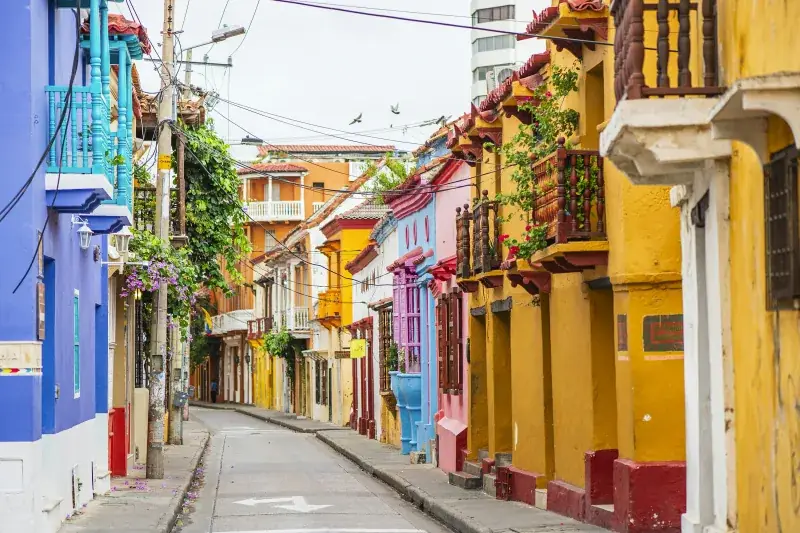
Founded by Pedro de Heredia in 1533, Cartagena de Indias grew rich as one of the great ports of the Spanish Empire — and paid for it in pirate raids. After Francis Drake sacked the town in 1586, Spain answered with some of the mightiest fortifications in the Americas, a stone crown so complete that UNESCO inscribed the Port, Fortifications and Group of Monuments as a World Heritage Site in 1984. Today the old city rewards slow exploring, headphones on: wander the lanes at your own pace while self-guided audio tours unpack the stories hiding behind bougainvillea-draped balconies and massive studded doors.
Inside the walled city
Step through the Torre del Reloj, the clock-tower gate that has welcomed arrivals for centuries, and the ciudad amurallada unfolds in a blaze of ochre, indigo and coral facades. Palenqueras in bright dresses balance fruit bowls past the Cathedral of Santa Catalina de Alejandría, and by evening the restaurant terraces of Plaza de Santo Domingo fill with music. Nearly four kilometres of ramparts still ring the centre — walk them at sunset toward the Baluarte de Santo Domingo, letting an audio guide replay the sieges these stones survived while the Caribbean turns gold.
Monumento Torre del Reloj
Baroque stone gate with Tuscan columns crowning the walled city's only historic entrance, topped by a working clock tower.
Catedral de Santa Catalina de Alejandría
Coral-stone cathedral built with columns redesigned mid-construction after the porous local rock proved too weak.
Plaza de Santo Domingo
Bronze reclining nude by a famed Colombian sculptor, its polished chest rubbed daily for luck outside a crooked colonial bell tower.
Fortress, faith and freedom
Across the lagoon rises the Castillo San Felipe de Barajas, the largest fortress the Spanish built in South America, where in 1741 Blas de Lezo's outnumbered defenders turned back a vast British fleet. In town, the Sanctuary of San Pedro Claver honours the Jesuit who spent his life ministering to enslaved Africans landed in this very port — a harder chapter told honestly at the Museum of Cartagena de Indias, seat of the former Inquisition. Just outside the walls, once working-class Getsemaní now pulses with street art, flag-strung alleys and champeta rhythms born in the city's barrios.
San Felipe de Barajas Fort
Hilltop stone fortress of tunnels and bastions built to repel pirates and a colonial-era British invasion fleet.
Santuario de San Pedro Claver
Colonial Jesuit church and cloister museum honoring a missionary who ministered to enslaved arrivals at the port.
Getsemani
Working-class harbor district where artisans forged bells, cannons, and an uprising against Spanish rule.
Beyond the ramparts
Climb to the hilltop Convent of La Popa for the finest panorama in the city, then trade history for turquoise: boats run out to the coral cays of the Rosario Islands and the white sand of Playa Blanca on Barú. Few cities pack empire, resistance and Caribbean ease into so few square kilometres — Cartagena repays every unhurried, story-guided step.
Convent of Santa Cruz de la Popa
Hilltop colonial monastery of gold-laced chapels and a legend of a demon cast off the cliff.
Rosario Islands
Coral-ringed archipelago of low cays whose shoreline scientists have tracked shrinking for over half a century.
Baru Playa Blanca
Powder-white coral sand beach on an island severed from the mainland by a colonial-era canal.