
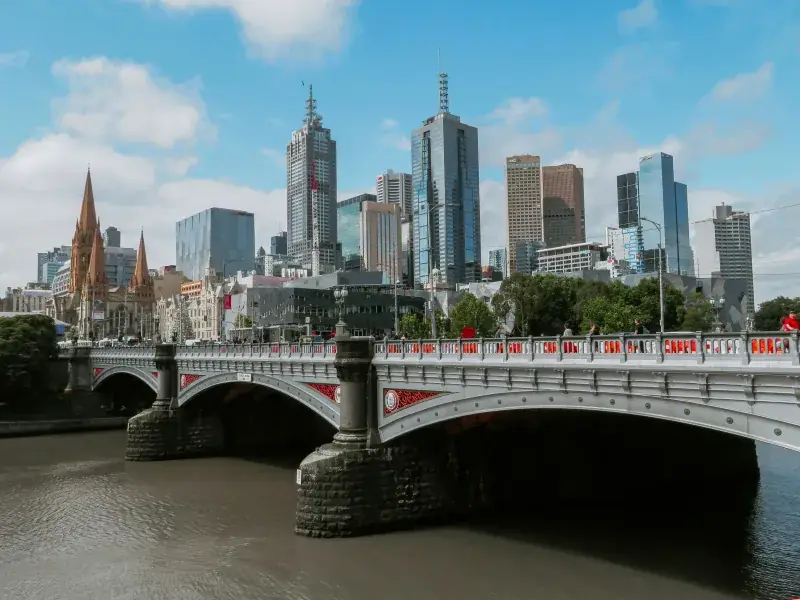
Melbourne rewards the curious. Australia's second city — and, most locals will insist, its cultural capital — keeps its best side down bluestone laneways, behind unmarked bar doors and inside gold-rush-era arcades. It is a city made for exploring with an audio guide in your ears: hop on a tram on the world's largest urban tram network, get off wherever a story begins, and let each landmark explain how a settlement founded in 1835 became one of the world's wealthiest metropolises within fifty years.
Gold-rush grandeur meets laneway rebellion
The Victorian gold rush of the 1850s dressed Melbourne in marvellous style, and the city centre still wears it. Stand beneath the domed clocktower of Flinders Street Station, the honey-coloured railway palace where generations have arranged to meet "under the clocks", then cross to the angular, deconstructed plaza of Federation Square — a century of Melbourne architecture facing itself across one intersection, and each side of the argument has an audio guide to make its case. From there the laneways take over: Hosier Lane's ever-changing street art, Degraves Street's espresso counters, and the hidden bars that made Melbourne famous for putting its treasures out of plain sight.
Flinders Street
Grand Edwardian railway terminus with a landmark dome and a row of clocks famed as the city's meeting point.
Federation Square
Fractal-patterned civic plaza of angular zinc, glass and sandstone shards over a rail deck.
Hosier Lane
Ever-changing laneway gallery of layered street art, murals repainted by artists day after day.
The sporting and green heart
Melbourne calls itself the sporting capital of Australia with some justification: it hosts the Australian Open, the Melbourne Cup and the Australian Grand Prix, and it invented Australian rules football. The game's cathedral is the Melbourne Cricket Ground — "the G" — a stadium whose story an audio guide can carry you through from the 1956 Olympics to a 100,000-strong Grand Final roar. South of the Yarra River, the mood softens among the lakes and rare plantings of the Royal Botanic Gardens and at the solemn Shrine of Remembrance on its ceremonial rise.
Melbourne Cricket Ground
Colossal stadium where a nation's roar has echoed through Test cricket, Olympic ceremonies and Grand Finals since eighteen fifty-three.
Royal Botanic Gardens Victoria - Melbourne Gardens
Sweeping riverside gardens of lawns, lakes and winding paths in a picturesque design.
Shrine of Remembrance
Classical stone war memorial with a hidden mirror system that lights a carved word each November.
Coffee, markets and the bay
Melburnians take their flat whites seriously, and nowhere shows the city's appetite better than Queen Victoria Market, the largest covered market in the Southern Hemisphere. Balance it with the free-entry collections of the National Gallery of Victoria, a sunset from the Melbourne Skydeck, and a tram ride to St Kilda for the beach, Luna Park's grinning gate and — a little further around the bay — Brighton's candy-coloured bathing boxes.
Melbourne ranked as the world's most liveable city for much of the 2010s — but its real charm is that it never feels like it's trying to win anything.
Pick a laneway, press play, and let the city talk.
Queen Victoria Market
Sprawling nineteenth-century produce market built directly over Melbourne's first cemetery, its thousands of graves still underfoot.
National Gallery of Victoria
Bluestone-clad art museum entered through a cascading water wall, with a Great Hall ceiling of hand-cut stained glass overhead.
Melbourne Skydeck
Glass cube projecting from a skyscraper's eighty-eighth floor, opaque then instantly transparent nearly three hundred metres up.
St. Kilda Beach
Bayside beach fronting a rocky breakwater that shelters an urban colony of little penguins.
Luna Park Melbourne
Seaside amusement park with a giant grinning mouth and the world's oldest wooden roller coaster.
Brighton Bathing Boxes
Row of ninety-plus rainbow-painted Victorian-era beach huts, privately owned and fiercely protected on a sandy shoreline.