
The City of Gold
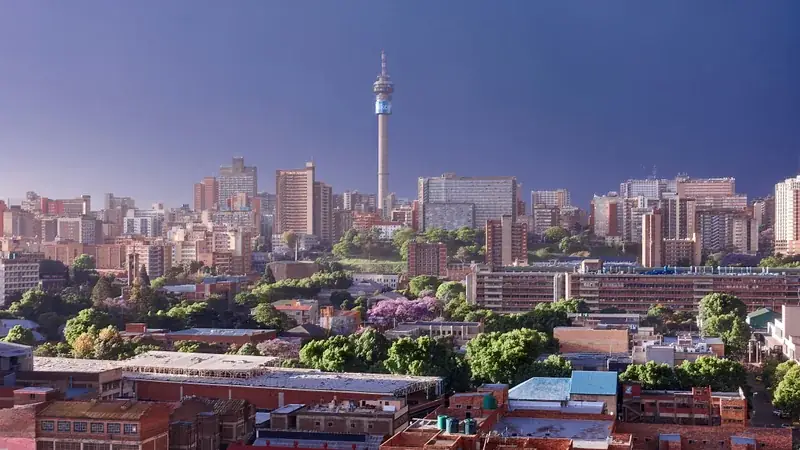
Johannesburg — eGoli, the City of Gold — sprang from bare veld in 1886, when prospector George Harrison struck the Witwatersrand gold reef and set off the greatest gold rush in history. Within a decade a tented mining camp had become Africa's boomtown; today it is South Africa's economic engine and one of the world's largest cities built on neither a river nor a coast, its skyline rising instead from a vast man-made urban forest. It is a city best understood through its stories, and self-guided audio tours let you hear them exactly where they happened — at the mine headgear, in the courtroom, on the street corner where history turned.
Where South Africa's story was written
No city carries the weight of the country's past — or its triumph — like Joburg. The Apartheid Museum traces the system from its imposition in 1948 through to Nelson Mandela's release, while at Constitution Hill the notorious Number Four prison that once held both Mandela and Gandhi now shares its ramparts with the Constitutional Court. Across the ridges in Soweto, an audio guide walks you along Vilakazi Street — the only street in the world that was home to two Nobel Peace Prize laureates — past Mandela's House and the Hector Pieterson Memorial, where the 1976 schoolchildren's uprising changed the nation's course.
Apartheid Museum
Museum recreating apartheid-era segregation through a randomly assigned entrance, before tracing the system's rise and fall.
Constitution Hill Human Rights Precinct
Prison complex turned constitutional court, built atop cells where political prisoners were held.
Soweto
Sprawling township of vibrant streets and murals, birthplace of the uprising that shook apartheid.
Vilakazi Street
Heritage street once home to two Nobel Peace Prize laureates, now lined with cafes and craft stalls.
Mandela's House
Modest matchbox home of bullet holes and scorch marks, kept as the family left it after apartheid-era raids.
Hector Pieterson Memorial
Memorial marking the spot where a schoolboy was shot dead during the nineteen seventy six student uprising.
From deep mines to deep time
Johannesburg wears its layers openly. Descend a real 19th-century mine shaft at Gold Reef City, then surface into the street art and coffee roasters of Maboneng, the "Place of Light", where a derelict industrial district reinvented itself as one of the city's liveliest quarters. And about 50 km northwest lies something older still: the Cradle of Humankind, a UNESCO World Heritage Site whose Sterkfontein Caves have yielded hominid fossils millions of years old, with the Maropeng visitor centre telling the story of where humanity began.
Gritty, warm, fast-talking and endlessly resilient, Johannesburg rewards the curious. Press play, and let the city tell you how it turned gold into a nation.
Gold Reef City Theme Park
Former gold-mine shaft turned underground tour and heritage theme park on the historic Witwatersrand reef.
Maboneng Precinct
Post-industrial arts and culture district of converted warehouses, murals, markets and creative studios in a former no-go inner-city zone.
Cradle of Humankind
Vast limestone cave system where fossil hunters have unearthed some of humanity's oldest known ancestors.
Sterkfontein Caves
Limestone cave system where nearly complete early human ancestor fossils were chiseled from solid rock over decades.
Maropeng: Official Visitor Centre for the Cradle of Humankind World Heritage site
Human-origins exhibition in a grass-covered mound, opening with an underground boat ride.