
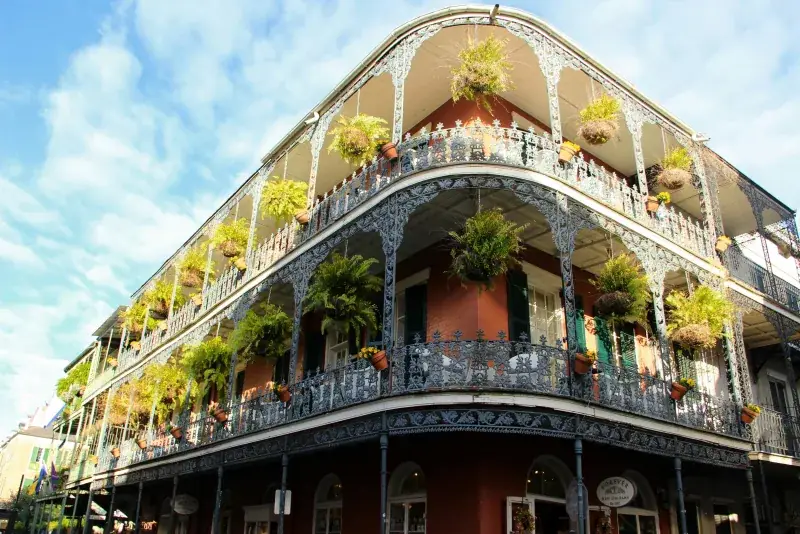

New Orleans doesn't feel quite like anywhere else in the United States — and it knows it. Founded by the French in 1718 on a crescent-shaped bend of the Mississippi River, handed to Spain, then sold to the young republic in the Louisiana Purchase of 1803, the city layered French, Spanish, African, and Caribbean cultures into something entirely its own: Creole cooking, jazz drifting out of open doorways, and streets that reward slow, curious wandering. That makes the Crescent City a natural fit for self-guided audio tours — pop in your earbuds, set your own pace, and let each balcony, tomb, and corner bar tell you how it got here.
The Vieux Carré and beyond
Start in the French Quarter, the original colonial grid the locals call the Vieux Carré, where wrought-iron galleries hang over Spanish-era facades rebuilt after the great fires of the 1700s. At its heart, Jackson Square opens onto the triple spires of St. Louis Cathedral — an audio guide here unpacks three centuries of colony, empire, and statehood in one panorama. Bourbon Street supplies the neon and the noise, but walk a few blocks downriver and Frenchmen Street is where the city actually goes to hear live music. In between, browse the stalls of the historic French Market and do what everyone eventually does: order beignets buried in powdered sugar with a café au lait.
French Quarter
Historic riverside neighborhood of lacy cast-iron balconies, colonial architecture, and centuries-old street life.
Jackson Square
Landscaped public square framed by matching red-brick row houses with the city's first cast-iron balconies.
St. Louis Cathedral
Twin-towered Spanish colonial cathedral rebuilt after fire, its beloved priest buried inside the sanctuary.
Music, mansions, and memory
Jazz was born in these neighborhoods, and you can still hear it played the old way at Preservation Hall, a deliberately unplugged room devoted to the tradition since 1961. For a different rhythm, ride the St. Charles Streetcar beneath the live oaks to the Garden District, where antebellum mansions line quiet, shaded blocks — each with a story an audio guide can tell as you stroll past the fences. The famous above-ground tombs of St. Louis Cemetery No. 1 reveal how a city below sea level buries its dead, while the National WWII Museum — one of the most acclaimed museums in America — anchors the Warehouse District.
Preservation Hall
Rustic French Quarter jazz room where elder musicians played nightly on worn benches since nineteen sixty-one.
Garden District
Antebellum garden neighborhood of columned mansions behind cast-iron fences cast from nineteenth-century foundry molds.
St. Louis Cemetery No. 1
Above-ground tombs behind an iron gate, where tourists still play a century-old wishing game.
Why go
Come for Mardi Gras if you like a crowd, but New Orleans is generous year-round: gumbo and po'boys, brass bands on street corners, ghost stories and river fog. It is a city built for walking with a storyteller in your ear — every block has a past, and most of them are happy to talk about it.