Istanbul's imperial heart
From Sirkeci station through Gülhane Park and Topkapi to Hagia Sophia, the Basilica Cistern and the Blue Mosque, ending in the Arasta Bazaar. Two easy hours: a gentle climb into the park, then flat, cafés at the end.

Istanbul, the only city spanning two continents, layers Byzantine and Ottoman wonders — from Hagia Sophia to the Grand Bazaar — along the Bosphorus.
From Sirkeci station through Gülhane Park and Topkapi to Hagia Sophia, the Basilica Cistern and the Blue Mosque, ending in the Arasta Bazaar. Two easy hours: a gentle climb into the park, then flat, cafés at the end.
From the Column of Constantine through the Grand Bazaar, Süleymaniye and the Spice Bazaar to Galata Tower: hammams, hans, mosques and market lanes. About 4.5 km, mostly downhill, with one steep climb at the end.
From Galata Tower along İstiklal Caddesi and Taksim to Dolmabahçe Palace and Ortaköy's waterside mosque: embassies, arcades and late-Ottoman palaces. A long, mostly flat walk down to the shore, with one optional climb.
Istanbul is the only major city on earth that stands on two continents. The Bosphorus Strait cuts it in half — Europe on one shore, Asia on the other — and for more than 2,500 years this crossing between the Black Sea and the Mediterranean has been fought over, rebuilt and renamed: first Byzantium, then Constantinople, capital of the Byzantine and then the Ottoman empire, and finally Istanbul. Few places carry so much story per square meter, which is why the city rewards exploring with self-guided audio tours: stand beneath a 1,500-year-old dome, press play, and hear what actually happened where you are standing — at your own pace, in your own order.

Sultanahmet, the old imperial heart on the European shore, packs an almost unreasonable density of wonders into a walkable square kilometer. Hagia Sophia — raised as a cathedral in 537 and converted to a mosque after the conquest of 1453 — still stuns with its floating dome and golden mosaics, while the Blue Mosque answers it across the park with cascading domes and six slender minarets. A few minutes away, Topkapi Palace was home to Ottoman sultans for some four centuries of treasure, ceremony and harem intrigue. And beneath the streets waits the Basilica Cistern, the "Sunken Palace": a forest of 336 columns built under Emperor Justinian in 532, where two ancient Medusa heads lie sideways and upside down at the base of the pillars. Each landmark has its own audio guide, so the mosaics, relics and inverted Medusa get their stories told while you look at them.
Byzantine cathedral turned mosque, crowned by a dome that seems suspended from heaven.
Ottoman imperial mosque with six minarets and twenty-one thousand blue Iznik tiles inside.
Former seat of the Ottoman Empire, now a museum of imperial courts and sacred Islamic relics.
Sixth-century cistern with 336 marble columns rising from dark water, and two ancient Medusa heads.
Commerce is Istanbul's other great monument. The Grand Bazaar, trading since the 1450s, sprawls through 61 covered streets and more than 4,000 shops of carpets, gold and ceramics; the fragrant Egyptian Bazaar by the Golden Horn has scented the air with spices for centuries. Climb the medieval Galata Tower for the classic panorama, find Sinan's serene Süleymaniye Mosque on its hilltop, or follow the waterfront to the gilded halls of Dolmabahçe Palace. Then do what locals do daily: board a ferry and cross to Kadıköy on the Asian side — a twenty-minute voyage between continents, tea in hand, gulls overhead.
Too Eastern to be European and too Western to be Asian — Istanbul refuses simple labels, and that in-betweenness is exactly its charm.
Sprawling covered Ottoman market with over four thousand shops across sixty-one vaulted streets.
Covered Ottoman bazaar of spice, sweet, and herb stalls built to fund an imperial mosque complex.
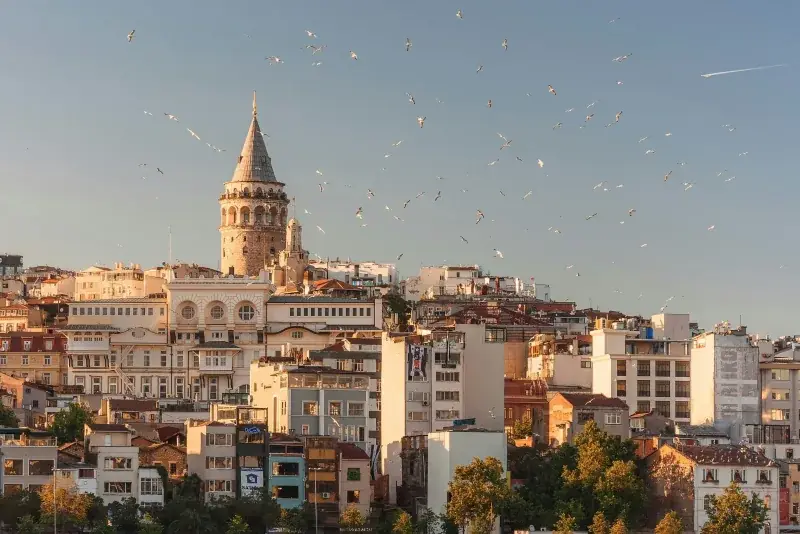
Medieval stone watchtower rising over the Golden Horn, with panoramic views across the Bosphorus.
Imperial Ottoman mosque with a soaring central dome, set on a hilltop above the Golden Horn.
Imperial waterfront palace blending Ottoman grandeur with European Baroque design.
Because nowhere else layers Roman engineering, Byzantine gold and Ottoman grandeur under one skyline, seasoned with simit sellers, tulip-shaped tea glasses and the call to prayer rolling across the water. Wander with headphones on, and the city's 2,500 years narrate themselves street by street.
Sacred mosque and mausoleum marking the tomb of a seventh-century companion of the Prophet.
Wide pedestrian plaza anchored by a bronze monument marking Turkey's founding as a secular republic.
Hillside park with three Ottoman-era wooden pavilions and spring tulip gardens above the Bosphorus.
Hilltop tea garden overlooking the Golden Horn, steeped in a French novelist's forbidden love.
Ornate waterfront mosque in a blend of Neoclassical and Ottoman styles, rising above the Bosphorus.
Bascule bridge over the Golden Horn, lined with fishermen above and fish restaurants below.
Grand Ottoman mosque on the site of a Byzantine church, housing the Conqueror's imperial tomb.
Multi-zone aquarium tracing a geographic sea voyage from the Black Sea to the Pacific Ocean.
Open-air park displaying miniature replicas of Turkey's most iconic landmarks and ancient monuments.
Sprawling hilltop park with wooded paths, pavilions and lakes on former Ottoman imperial grounds.
Public square built over the Byzantine Hippodrome's ancient track, lined with original obelisks.
Waterfront cruise port and cultural district along a Bosphorus shore reopened after two centuries.
Ancient islet tower at the Bosphorus narrows, a sentinel through Byzantine and Ottoman rule.
Museum of transport and industrial history in a restored Ottoman anchor foundry on the Golden Horn.
Ornate Ottoman summer palace on the Bosphorus, once host to Empress Eugénie, later a prison.
Museum complex housing the Alexander Sarcophagus and the world's oldest known peace treaty.
Ottoman-era boza shop serving a thick fermented wheat drink from its original tile-lined counter.
Waterfront square where a Baroque mosque, synagogue, and Greek church share a Bosphorus shoreline.
Covered arcade of iron-and-glass arches and traditional meyhane taverns, rich in bohemian history.
Panoramic cyclorama depicting the Ottoman conquest of Constantinople, with ten thousand figures.
Waterfront promenade on the Sea of Marmara with island views and a lively bohemian shore culture.
Bosphorus-edge Ottoman palace turned luxury hotel, with a history of sultans, fire, and intrigue.
Three-towered fortress raised in four months to blockade the Bosphorus at its narrowest point.
Imperial mosque at the Golden Horn, completed by two Ottoman queen mothers after sixty years.
Turkey's largest mosque, set on the Asian side's highest hill, with six symbolic minarets.
Byzantine church converted to mosque, home to exceptional fourteenth-century mosaics and frescoes.
Hilltop park with sweeping views over the Bosphorus, Golden Horn, and Sea of Marmara.
Underground Byzantine cistern with marble columns, now a cultural venue and concert space.
First Ottoman Baroque mosque, with a curved horseshoe courtyard beside the Grand Bazaar.
Turkey's first modern art museum, in a Renzo Piano waterfront building with Bosphorus views.
Wooded valley park beside Dolmabahçe's historic grounds, crossed overhead by a cable car gondola.
Millennia-old column of purple stone that once bore a sun-god statue of a Roman emperor.
Ottoman imperial barges and naval artifacts in a purpose-built hall by the Bosphorus.
Private art museum in a restored historic hotel, housing a celebrated Ottoman Orientalist collection.
Sixteenth-century mosque by Mimar Sinan, famed for its extraordinary Iznik ceramic tilework.
Ancient seat of the Ecumenical Patriarchate, on a quiet hilltop beside the Golden Horn.
Pedestrian avenue of nineteenth-century facades, bookshops, cafes, and a classic red tram.
Ottoman calligraphy collection in a Bosphorus villa, famed for landmark temporary exhibitions.
Island with a storied exile history, Ottoman-era villas, and Europe's largest wooden landmark.
Byzantine church-turned-mosque whose carved inscription to Justinian still circles the interior.
Palace of a powerful Ottoman grand vizier, housing Islamic art spanning fifteen centuries.
Ottoman palace garden turned public park, site of a landmark imperial reform edict.
Medieval fortress incorporating a Byzantine triumphal arch, infamous as an Ottoman state prison.
Baroque Ottoman hammam with domed chambers and carved marble, operating since seventeen forty-one.
Ottoman dervish lodge from 1491, now a museum of Mevlevi culture and the sema ceremony.
Waterfront promenade on an elegant Bosphorus bay, lined with cafés and a century of prestige.
Ottoman mosque on the Bosphorus shore, built by Sinan for Suleiman's beloved only daughter.
Vivid hand-painted steps winding up a hill through a centuries-old Jewish and Greek quarter.
Sixteenth-century Ottoman double bathhouse with star-lit domes and heated marble platforms.
Ottoman waterfront mosque where the patron's tomb opens through an iron grille into the prayer hall.
Ottoman-era market street built to fund an adjacent imperial mosque, with Byzantine mosaics beneath.
Ottoman caravanserai with three vast courtyards, once a hub for Persian silk and carpet merchants.
Literary museum where a Nobel laureate's fictional love story fills eighty-three display cases.
Prefabricated cast-iron Bulgarian Orthodox church, sole survivor of three iron churches ever built.
Ancient urban woodland with Ottoman aqueducts, historic stone dams, and sweeping walking trails.
Early Byzantine church predating Hagia Sophia, repurposed as an Ottoman arsenal, now a concert hall.
Sinan-designed Ottoman mosque with exquisite İznik tiles and fragments of the sacred Black Stone.
Ottoman mosque on reclaimed seafront land, modeled on Hagia Sophia, with the tomb of an admiral.
Triple-walled land fortification from the fifth century, once impenetrable for over a millennium.
Fourth-century Roman aqueduct with two tiers of stone arches, straddling a major city boulevard.
Late Ottoman mosque with a vast külliye — school, hospital, and caravanserai — on the Asian shore.
Byzantine floor mosaics in situ, once the courtyard floor of Constantinople's imperial palace.
Railway terminus blending Ottoman arches with European design, once the Orient Express's final stop.
Neo-Gothic terminal built on Bosphorus piles, former Baghdad Railway gateway under restoration.
Car-free island with pine forests and a Greek Orthodox seminary closed since 1971.
Narrow-lane seafood market with fresh catch from three seas, alongside honey, cheese, and olives.
Intimate domed mosque renowned for its flower-patterned blue-and-white hand-painted Ottoman tiles.
Historic Bosphorus-side neighborhood where synagogue, church, and mosque share the same street.
Narrow cobblestone lane wedged between Topkapı's outer wall and a row of restored Ottoman houses.
Sixteenth-century imperial mosque built by Suleiman the Magnificent as a memorial to his son.