
Russia's Imperial Window on Europe
Saint Petersburg was willed into being in 1703, when Peter the Great set out to build a European capital on the marshy delta of the Neva. For two centuries it was the seat of the Russian Empire, and it still looks the part: a UNESCO-listed historic centre of pastel Baroque palaces, gilded domes and granite embankments, threaded by the canals that earned it the nickname "Venice of the North." It is a city best absorbed slowly and on your own terms — headphones on, letting a self-guided audio tour narrate the tsars, revolutions and wartime siege written into almost every façade.
Palaces, domes and mosaics
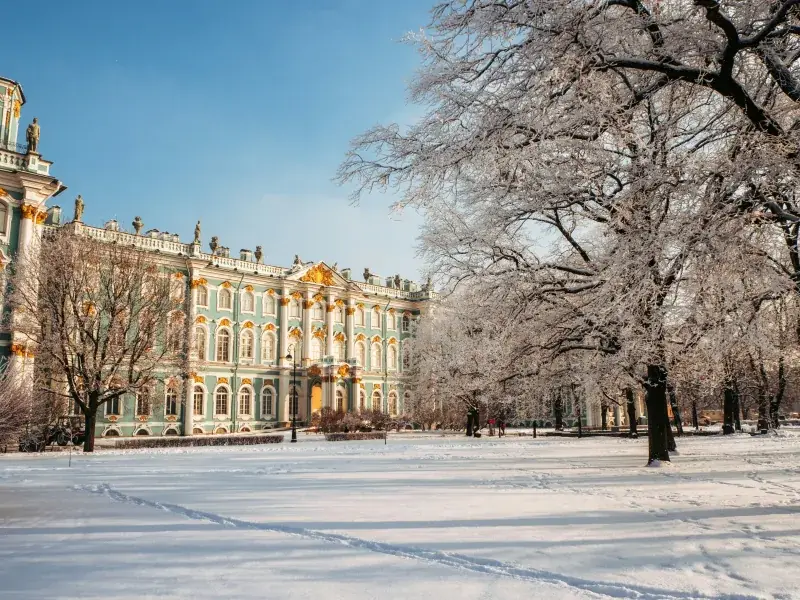
Start on Palace Square, where the green-and-white Winter Palace anchors the State Hermitage Museum — a collection of more than three million works, from Rembrandt to Matisse, spread through the former imperial residence. A short walk along the Griboyedov Canal brings you to the Savior on the Spilled Blood, its candy-striped onion domes rising over some 7,000 square metres of mosaics on the spot where Emperor Alexander II was assassinated. Climb the 300-step colonnade of St. Isaac's Cathedral for a rooftop panorama, then follow Nevsky Prospekt — the city's grand main avenue — past the sweeping colonnade of Kazan Cathedral. Each landmark carries its own audio guide, so the stories of court intrigue and revolution unfold right where they happened.
Palace Square
Vast imperial square framed by a Baroque palace, dominated by a six-hundred-ton granite column held up by gravity alone.
Winter Palace
Baroque residence of fifteen hundred rooms, once an imperial seat, now home to a vast art museum.
State Hermitage Museum
Vast imperial palace museum housing millions of artworks, from Rembrandt to Da Vinci, along the Neva River.
Savior on the Spilled Blood
Onion-domed cathedral built over the exact spot of an emperor's assassination, blanketed in seven thousand square meters of mosaic.
St. Isaac's Cathedral
Gold-domed neoclassical cathedral ringed by granite columns, forty years in the building.
Kazan Cathedral
Curved Empire-style colonnade cathedral built by a freed serf architect, now a monument to the eighteen-twelve war.
Across the Neva and out of town
On its own island in the Neva stands the Peter and Paul Fortress, the city's 1703 birthplace and the burial place of the Romanov dynasty. Beyond the centre, two imperial estates reward a day trip: Peterhof, the "Russian Versailles," where the Grand Cascade's gilded fountains run on gravity-fed springs alone, and the Catherine Palace at Tsarskoye Selo, home of the legendary reconstructed Amber Room.
Peter and Paul Fortress
Star-shaped citadel and former political prison with a cathedral topped by a gilded spire.
Peterhof Grand Palace
Baroque imperial residence rebuilt from wartime ruin, with gilded halls overlooking a cascade of golden fountains.
Catherine Palace
Baroque palace of gilded halls and a legendary amber chamber lost to war and rebuilt from memory.
White Nights and stage lights
Come between late May and mid-July and darkness never quite falls: during the White Nights the city celebrates through luminous midnight streets, and crowds gather on the embankments to watch the Neva drawbridges rise in the small hours. Year-round, Russia's cultural capital keeps its promise with ballet and opera at the Mariinsky Theatre and the world's finest collection of Russian art at the Russian Museum. However long you stay, an audio guide in your pocket turns this open-air museum of a city into one continuous, walkable story.