
Japan's Kitchen, Loud and Proud
Osaka is Japan's second metropolis and its self-appointed capital of appetite — a merchant city so devoted to eating that locals live by the motto kuidaore, "eat until you drop." Where Tokyo polishes and Kyoto whispers, Osaka grins, shouts across the counter, and hands you another skewer. It is Japan at its warmest and most unbuttoned, and the best way to take it in is with a self-guided audio tour in your ears, letting each landmark tell its own story while the city sizzles around you.
From Castle Town to Neon Canal
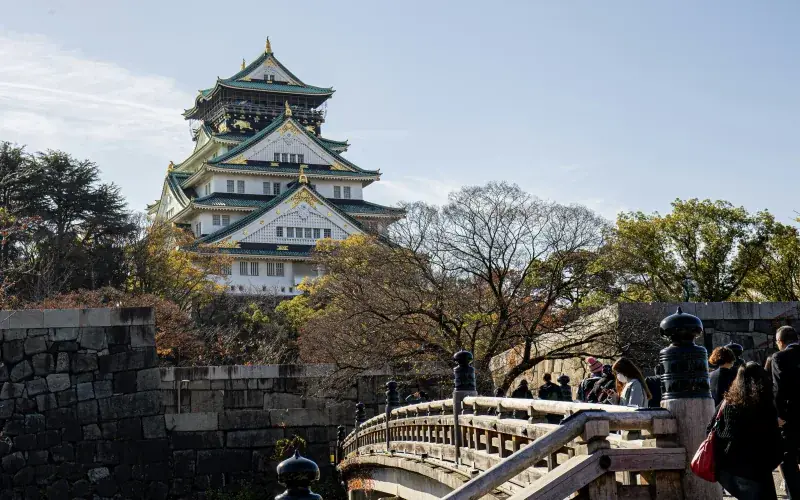
The city's fortunes were forged in the 1580s, when the warlord Toyotomi Hideyoshi raised Osaka Castle on the site of a fortified temple and made it the seat of his ambition to unify Japan. Besieged, burned, and rebuilt — the present main tower dates from 1931, funded by the citizens themselves — it now anchors a vast park of Tokugawa-era moats and stone walls, and its audio guide untangles four centuries of samurai intrigue as you circle the ramparts. From the castle, merchant Osaka spread along its rivers and canals, provisioning the whole country and earning the Edo-period title tenka no daidokoro — "the nation's kitchen."
That mercantile swagger survives most vividly in Dotonbori, where the Glico Running Man and a giant mechanized crab blaze above the canal and takoyaki griddles hiss late into the night. An audio guide here peels back the neon to reveal the district's origins as a 17th-century theater quarter — entertainment, then as now, was the family business.
Osaka Castle
Stone samurai fortress with moats and a museum tower rebuilt over a fallen warlord's stronghold.
Osaka Castle Park
Sprawling park of massive stone-walled ramparts surrounding a rebuilt feudal keep once the seat of a warlord dynasty.
Dotonbori
Neon-drenched canal-side entertainment district famed for a giant illuminated runner sign and riverside street food.
Two Downtowns, One Appetite
Osaka splits into two downtowns. Minami, around Namba, holds Dotonbori, the 600-meter Shinsaibashi-Suji arcade, and the fresh-seafood stalls of Kuromon Market, long nicknamed "Osaka's kitchen." Kita, around Umeda, answers with sleek towers — the Umeda Sky Building suspends an open-air observatory between its twin summits. Southward, the retro Tsutenkaku tower presides over the kushikatsu joints of Shinsekai, while 300-meter Abeno Harukas looks clear across the Kansai plain. Down at the harbor, whale sharks glide through the Kaiyukan aquarium and Universal Studios Japan packs in the crowds.
In Osaka, the greeting isn't "how are you?" — it's mōkarimakka, "are you making money?" This is a city that has always hustled, fed, and entertained.
Wander from castle moat to canal-side neon with audio stories queued up, stopping wherever the next smell of batter and sauce insists — that, Osakans will tell you, is exactly the point.
Shinsaibashi-Suji Shopping Street
Roofed pedestrian arcade of boutiques and eateries named for a bridge that no longer exists.
Kuromon Market
Century-old covered fish and food arcade of some one hundred fifty stalls, now packed with street-eating tourists.
Umeda Sky Building
Twin towers joined by a rooftop ring observatory that was lifted into place a hundred meters up.
Tsutenkaku
Rebuilt observation tower with a lucky mascot statue whose original vanished decades ago.
Abeno Harukas
Three-hundred-meter skyscraper and former tallest tower in Japan, with an observation deck and department store inside.
Osaka Aquarium Kaiyukan
Ring-shaped aquarium spiraling around a huge central tank of Pacific Rim life led by whale sharks.