
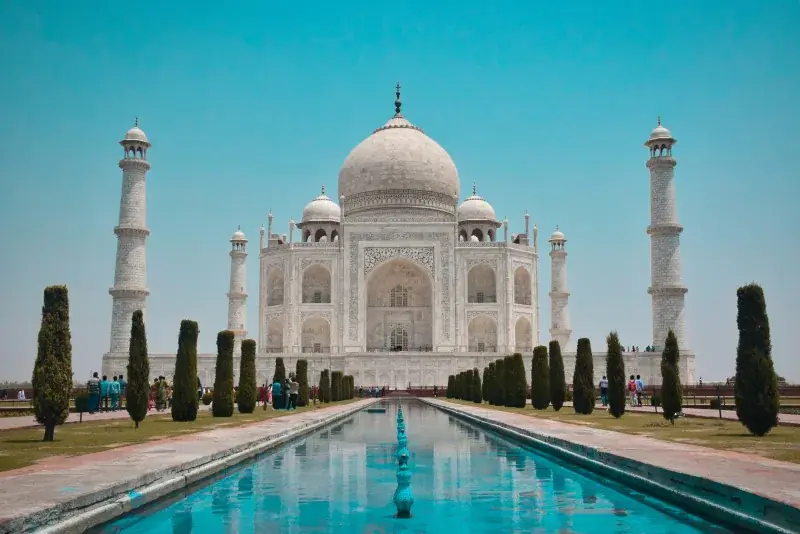

Agra sits on a bend of the Yamuna River in Uttar Pradesh, some 230 kilometres from Delhi, and for the better part of a century it was the beating heart of the Mughal Empire. Emperors Akbar, Jahangir and Shah Jahan ruled from here and left behind a density of masterpieces almost no other city can match — three UNESCO World Heritage Sites within an hour of one another. It is a city best taken monument by monument, story by story: press play on a self-guided audio tour and let the tales of emperors, empresses and master craftsmen unfold as you wander marble halls and sandstone courtyards at your own pace.
The Taj Mahal and the river that mirrors it
Everyone comes for the Taj Mahal, and it earns the pilgrimage. Commissioned by Shah Jahan in 1631 as a mausoleum for his wife Mumtaz Mahal and completed in 1648, its white-marble dome, four minarets and jewel-like pietra dura inlay draw millions of visitors a year. The audio guide walks you through the love story, the geometry and the calligraphy — details easy to miss in the crowd. For a quieter encounter, cross the river to Mehtab Bagh, the moonlit garden that frames the Taj perfectly at sunset.
A fortress full of palaces
Upstream stands Agra Fort, the red-sandstone citadel Akbar began in 1565. Within its 2.5-kilometre walls lie the Jahangir Palace, mirror-clad halls and the marble pavilions where an aging Shah Jahan, imprisoned by his own son, gazed across the Yamuna at the tomb he had built. Nearby, the delicate Itmad-ud-Daula — nicknamed the "Baby Taj" — and Akbar's grand tomb at Sikandra each carry their own chapter of the dynasty's story, told stone by stone in your ears.
Agra Fort
Walled Mughal fortress in red sandstone, once the seat of empire and the prison of Shah Jahan.
Itmad-ud-Daula
Marble Mughal mausoleum with pioneering pietra dura inlay, precursor to the Taj Mahal.
Tomb of Akbar
Mughal mausoleum of red sandstone and marble, blending Hindu, Islamic, Buddhist, and Jain motifs.
Akbar's abandoned capital
An hour away, Fatehpur Sikri is the Mughal capital Akbar built from red sandstone in 1571 and deserted within decades. Walk beneath the 54-metre Buland Darwaza, one of India's mightiest gateways, and through the courtyards of Jodha Bai's Palace, where Rajput and Persian styles intertwine.
Fatehpur Sikri
Intact Mughal capital of red sandstone, abandoned after fourteen years and preserved as a ghost city.
Buland Darwaz
Towering sandstone victory gate built by Emperor Akbar, and the world's tallest ceremonial gateway.
Jodha Bai's Palace
Red sandstone palace built for a Mughal emperor's Hindu queen, blending Rajput and Islamic design.
A living city
Beyond the monuments, Agra hums with life: marble inlay workshops descended from the Taj's own artisans, bazaars piled with leather goods and petha sweets, and living sanctuaries like the Mankameshwar Temple and Guru ka Taal gurudwara. Come between October and April, start your days early — and let the audio guides fill Agra's stones with the voices of its emperors.