
Heraklion is Crete's bustling capital and one of Europe's oldest continuously inhabited cities — a working Mediterranean port where Minoan myth, Venetian stone, and modern Greek street life stack up within a single walkable core. It is not a postcard island village but a vibrant small metropolis, and that is exactly its charm: every fountain, bastion, and market lane has a story to tell, and with a self-guided audio tour you uncover them at your own pace — earbuds in, harbour breeze at your back.
From the labyrinth to the Lion of St Mark
Five kilometres inland stands the Palace of Knossos, the Bronze Age heart of Minoan civilization — Europe's earliest advanced culture — and the mythical home of King Minos and the Minotaur's labyrinth. Excavated by Sir Arthur Evans from 1900, its part-reconstructed halls and frescoed courtyards come alive with an audio guide that untangles myth from archaeology as you walk. Back in town, the Heraklion Archaeological Museum keeps the originals: the Ladies in Blue fresco, exquisite Minoan goldwork, and the still-undeciphered Phaistos Disc.
The Venetians ruled here for over four centuries and called the city Candia. Their legacy is everywhere: the Koules fortress (1523–1540) still guards the old harbour with the Lion of St Mark carved above its gate, and the massive Venetian walls — among the longest city walls in Europe — withstood a 21-year Ottoman siege before finally falling in 1669. On the walls' Martinengo Bastion lies the tomb of Nikos Kazantzakis, author of Zorba the Greek, inscribed with his own epitaph:
I hope for nothing. I fear nothing. I am free.
Knossos Palace
Reconstructed Bronze Age palace linked by legend to the labyrinth of the Minotaur.
Heraklion Archaeological Museum
Minoan antiquities collection anchored by an undeciphered clay disc and painted snake goddesses.
Venetian Fortress of Koules
Squat Venetian sea fortress with walls nearly nine meters thick, guarding a harbor entrance since the fifteen forties.
Venetian Walls of Heraklion
Renaissance-era ramparts encircling the old town, crowned by a bastion overlooking a writer's grave.
Martinengo Bastion
Largest of seven Venetian bastions crowning the old city walls, now home to a writer's plain grave and sweeping views.
Life between the walls
Modern Heraklion pulses around Lions Square, where the 17th-century Morosini Fountain once delivered fresh water along a 15-kilometre aqueduct. Cafés spill across pedestrian lanes past the arcaded Venetian Loggia — now the city hall — and the great cathedral of Saint Minas, the largest church in Crete, inaugurated in 1896. Along 1866 Street, the central market stalls are piled high with thyme honey, mountain herbs, cheese, and raki: Cretan cuisine ranks among Greece's finest, and the tavernas ringing the old harbour prove it nightly. Each stop carries its own audio story, so the city reads like a book you walk through.
Lions Square
Venetian fountain of four stone lions, fed by a fifteen-kilometer gravity aqueduct built in sixteen twenty-eight.
Morosini Fountain
Venetian octagonal basin ringed by four stone lions once crowned by a giant statue of Poseidon.
Venetian Loggia
Palladian-style Venetian noblemen's clubhouse of arcaded stone, nearly demolished in nineteen oh four and rebuilt over decades.
Saint Minas Holy Cathedral
Grand cathedral built to honor a legendary horseman-saint said to have saved the city from a massacre.
Herakleion Central Market
Narrow bazaar lane of butchers and spice stalls, named for a Cretan uprising against Ottoman rule.
Beyond the city
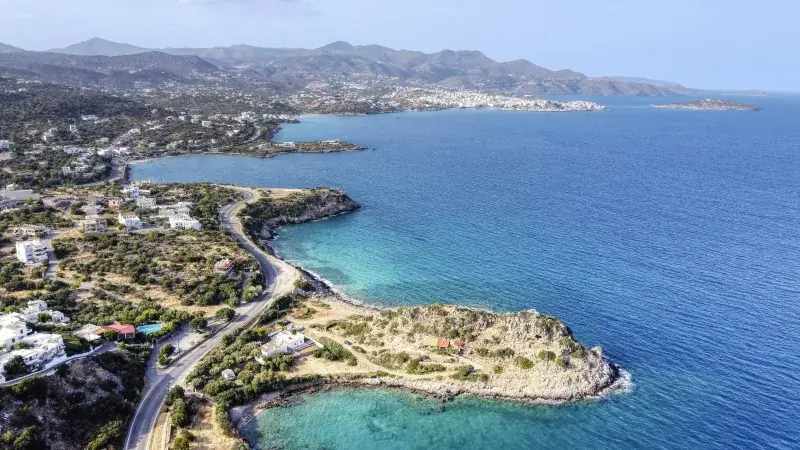
Heraklion is also Crete's natural base for wider wandering — the hilltop Minoan palace of Phaistos, the cave-pocked bay of Matala where 1960s wanderers once wintered, and sandy beaches just minutes from town. Start at the harbour, press play, and let the city talk.