
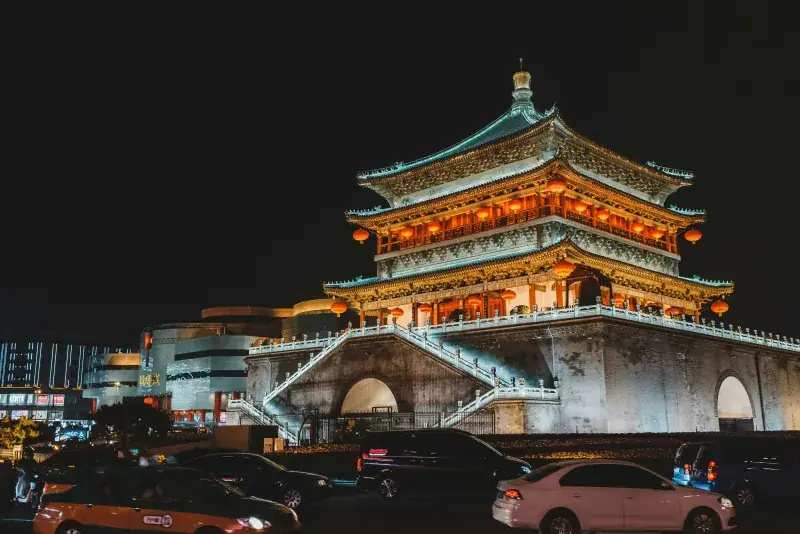

Xi'an is where you go to stand at the beginning of China's story. For over a millennium this was Chang'an — "Perpetual Peace" — imperial capital to a succession of dynasties from the Western Zhou to the Tang, and the eastern terminus of the Silk Road, where caravans set off for Persia and Rome. Modern Xi'an is a fast-moving city of some 13 million people, but its historic heart is still wrapped in a complete Ming-dynasty wall, and nearly every gate, tower and pagoda inside it has a story worth hearing. That is how this city rewards the self-guided traveller: wander at your own pace and let an audio guide unpack each landmark as you reach it.
An army that waited 2,200 years
In March 1974, farmers digging a well east of the city struck fragments of fired clay — and uncovered the Terracotta Army, thousands of life-sized soldiers buried to guard Qin Shi Huang, China's first emperor, in the afterlife. Pit 1 alone holds more than 6,000 figures, and famously no two faces are alike. The warriors are only the outer edge of a mausoleum complex sprawling across 56 square kilometres, about an hour's drive from the centre — and the audio guide's tales of the emperor's obsession with immortality make the ranks of silent soldiers all the more haunting.
Life on (and inside) the Ming walls
Back in town, the city wall — raised in 1370 and running roughly 12 kilometres around the old city — is one of the best-preserved fortifications in China. Rent a bicycle at the South Gate and ride the full circuit as the sun sets over the watchtowers. Inside, the Bell Tower and Drum Tower anchor the centre, and just behind them the lanes of the Muslim Quarter fill with smoke and noise each evening: hand-pulled biangbiang noodles, roujiamo stuffed flatbreads, steaming bowls of yangrou paomo. Here too stands the Great Mosque, a serene courtyard complex blending Chinese and Islamic architecture — a living legacy of the Silk Road's Hui community.
Fortifications of Xi'an
Brick-faced Ming rampart nearly fourteen kilometers around, its bricks stamped with the workshops that made them.
Bell Tower of Xi'an
Ming-dynasty timber tower at a four-way crossroads, ringed by bustling noodle and snack stalls.
鼓楼
Ming-dynasty timekeeping tower with an oxhide drum, silent for decades, rebuilt to sound again.
Xi'an Muslim Dasi Residential Quarter
Grey-brick courtyard lanes behind a historic mosque, home to a centuries-old Muslim community.
Great Mosque of Xi'an
Sino-Islamic temple complex of five courtyards, with a moon-watching tower and hills for spotting Ramadan's new moon.
Tang splendour, then and now
The Giant Wild Goose Pagoda, begun in 652, was built to house the Buddhist scriptures the monk Xuanzang carried home from India — the journey that later inspired Journey to the West. Pair it with the Tang treasures of the Shaanxi History Museum, then join the evening crowds along Datang Everbright City, a neon-lit re-imagining of Tang-dynasty streets. Further out lie the hot-spring pavilions of Huaqing Palace and the vertiginous trails of Mount Hua, one of China's five sacred peaks.
Come in spring or autumn for the kindest weather, arrive hungry, and let the stories in your ears turn stones and statues back into the capital of an empire.
Giant Wild Goose Pagoda
Brick pagoda raised by a fugitive monk to house the six hundred and fifty seven scriptures he smuggled home from India.
Shaanxi History Museum
Neo-Tang palace of brick and plaster, built for a small fraction of the ancient relics it now holds.
Datang Everbright City
Tang-themed pedestrian boulevard of bronze sculptures, lantern light, and nightly street performance.
Huaqing Palace
Excavated imperial hot-spring bathing pools tied to a legendary Tang-dynasty royal romance.
Huashan Mountain
Sheer granite peaks shaped like a blooming lotus, cradling a hermit's cave and a cliffside plank walk.