

The City That Contains the World
New York City is less one city than five stitched together — Manhattan, Brooklyn, Queens, the Bronx, and Staten Island — linked by bridges, ferries, and a subway that has been running since 1904. Around 8.6 million people live here, and an estimated 800 languages are spoken on its streets, making it the most linguistically diverse city on Earth. That density of stories is exactly why New York rewards exploring with a self-guided audio tour: you set the pace, and the narration fills in what the skyline alone won't tell you — who built it, who fought over it, and who wrote songs about it.
Icons with Backstories
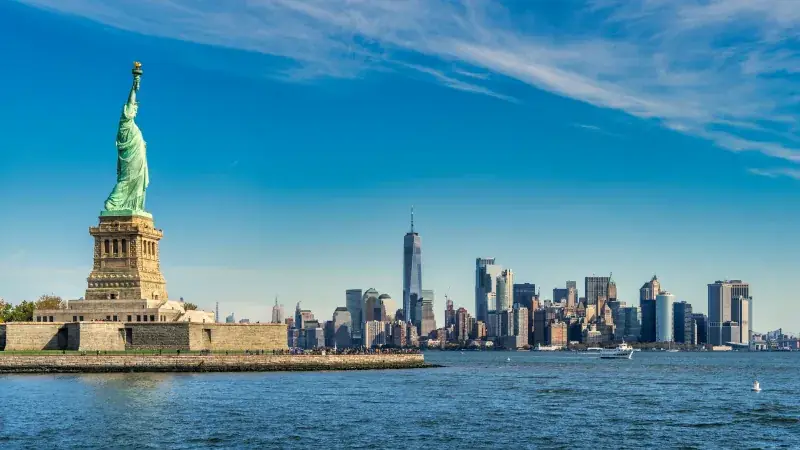
Every postcard landmark here has a plot twist worth hearing. The Statue of Liberty, dedicated in 1886 as a gift from France and sculpted by Bartholdi, greeted millions of immigrants sailing past toward Ellis Island — its audio guide traces how the statue's meaning kept evolving long after the torch was lit. Central Park, 843 acres of meadows, woodlands, and bridges designed by Olmsted and Vaux, was America's first landscaped public park; walking it with a guide in your ears turns an ordinary stroll into a masterclass in 19th-century ambition. Add the Empire State Building rising over Midtown and the electric chaos of Times Square, and you have a first day that practically narrates itself.
Statue of Liberty
Colossal copper statue on a harbor island, gifted by France and dedicated in 1886, now a national monument.
Central Park
Vast urban park with meadows, lakes, wooded paths, and a zoo, ringed on all sides by city towers.
Empire State Building
Art Deco skyscraper with observation decks on the 86th and 102nd floors, opened in 1931.
Times Square
Commercial crossroads ablaze with neon signs, Broadway theaters, and towering digital billboards.
The Neighborhoods Are the Real Museum
New York's character lives at street level. In Greenwich Village, winding lanes shelter the ghosts of folk singers and beat poets; SoHo's cast-iron facades frame the city's art-to-fashion story; Harlem carries the sound of the jazz age and the pulse of Black American culture. Cross the East River and Dumbo and Williamsburg show you Brooklyn's waterfront reinvention, with the Manhattan skyline as a backdrop. Downtown, the 9/11 Memorial offers the city's most solemn and moving hour. Each stop has its own audio guide, so a day of wandering becomes a chain of short, vivid stories rather than a checklist.
In 2026, New York takes center stage in America's 250th-anniversary celebrations — a fitting moment for the nation's first capital, and one more reason the city's history is worth listening to.
Come for the icons, stay for the block-by-block surprises — and let the stories play as you walk.
Greenwich Village
Bohemian enclave of leafy streets, jazz clubs, and decades of countercultural art and protest.
SoHo
Cast-iron district that went from garment factories to artists' lofts to luxury boutiques.
Harlem
Historic uptown neighborhood that sparked a golden age of Black music, art, and literature.
Dumbo
Cobblestoned waterfront between two landmark bridges, packed with converted industrial lofts.
Williamsburg
Creative neighborhood anchored by a converted industrial waterfront park and a dense arts and dining scene.
9/11 Memorial & Museum
Twin reflecting pools and underground museum marking the site of the September 11 attacks.