
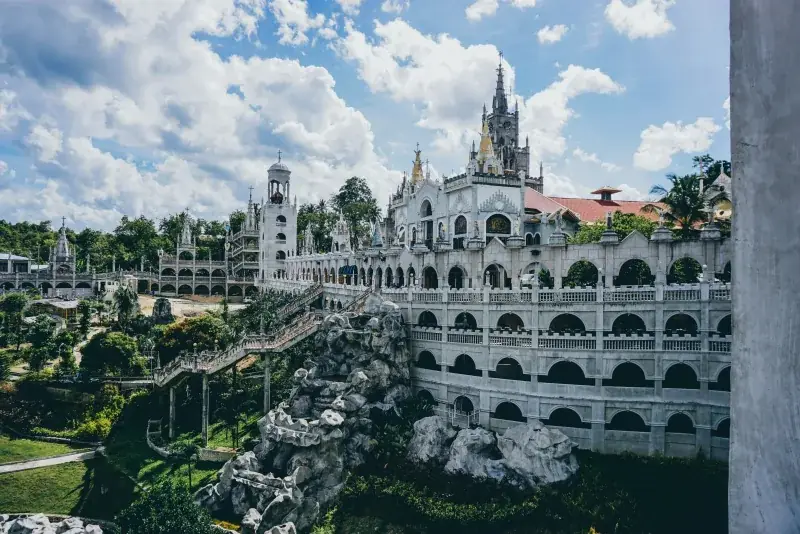

The oldest city in the Philippines
Cebu City is where the recorded history of the Philippines begins. Ferdinand Magellan's fleet arrived in 1521, and in 1565 Miguel López de Legazpi founded the Spanish settlement that grew into the country's oldest city — the Queen City of the South, today a fast-moving port metropolis of nearly a million people at the heart of the Visayas. Its colonial core is remarkably compact, which makes it a natural city to explore with self-guided audio guides: the founding-era landmarks cluster within a few walkable blocks, and each carries a story far bigger than its footprint.
Five centuries in a few blocks
In a small octagonal chapel downtown stands Magellan's Cross, marking the spot where Christianity first took root in Asia. Next door, the Basilica Minore del Santo Niño — the oldest Roman Catholic church in the country, rebuilt in stone in 1737 after fires claimed its earlier incarnations — guards the revered image of the Child Jesus that Magellan is said to have gifted Cebu's queen. A short walk toward the harbor brings you to Fort San Pedro, the smallest and oldest triangular bastion fort in the Philippines, its coral-stone walls now enclosing a quiet garden and museum. Let the audio guides replay the drama at each stop — the Battle of Mactan, the fires, the galleon trade — before you drift down Colon Street, the oldest street in the nation, or into the ancestral houses of the Parian district.
Magellan's Cross
Wooden cross planted by Spanish explorers in fifteen twenty-one, encased in tindalo wood inside an octagonal coral-stone pavilion.
Minor Basilica of the Holy Child of Cebu (Basilica Minore Del Sto. Niño de Cebu)
Colonial-era basilica built around a small carved Christ-child statue found unburned in a 1565 fire.
Fort San Pedro
Coral-stone triangular Spanish bastion fort that later served as barracks, hospital, city zoo, and garden.
Markets, mountains and lechon
Cebu is just as much about appetite and altitude. Carbon Market has fed the city for over a century; Taboan's stalls pile up dried danggit and mangoes; and the evening food park at Sugbo Mercado serves Cebu's famous lechon — roast pig that many Filipinos rank the best in the world. Then head for the hills: the winding road into the mountain barangays passes the flower terraces of Sirao Garden and the marble colonnades of the Temple of Leah, a Roman-style shrine a husband built for his wife in 2012, before reaching TOPS, the clifftop deck some 600 meters up with a 360-degree panorama of the city and its straits. Come in January and the whole city erupts in Sinulog, one of the country's grandest festivals — dancing in honor of the same Santo Niño that landed here five hundred years ago.
Carbon Market
Century-old open-air bazaar of produce, seafood and dry goods, born beside a coal depot.
Taboan Public Market
Bustling dried-fish market where basketfuls of sun-dried and smoked seafood perfume the air.
Sugbo Mercado
Open-air night market of grilled street food stalls born from a humble parking-lot pop-up.
Sirao Garden
Hillside flower garden of imported blooms and windmills, born from a retirement plot turned viral photo spot.
Temple of Leah
Seven-story Greco-Roman hillside monument built by a widower to house his late wife's vast collections.
TOPS Cebu
Hilltop viewing terraces of stone arches and hexagonal flooring, offering three-hundred-sixty-degree views of city, mountains and sea.