
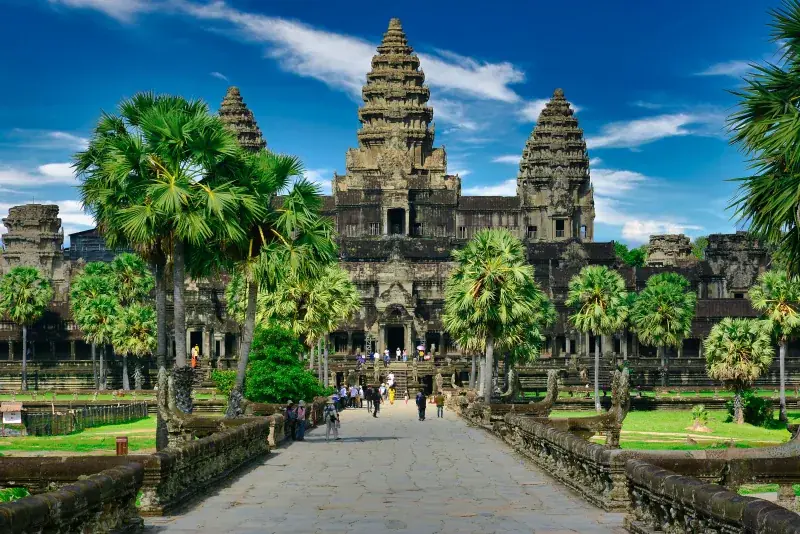
Siem Reap is the gateway to Angkor, the lost capital of the Khmer Empire — and one of the great archaeological destinations on Earth. This laid-back town on the Siem Reap River in northwestern Cambodia, close to the shores of Tonle Sap, Southeast Asia's largest freshwater lake, wakes before dawn as streams of tuk-tuks head north toward the sandstone towers of Angkor Wat. The ruins are silent narrators — bas-relief galleries, enigmatic face towers, courtyards half-swallowed by jungle — and they give up their stories best when you wander at your own pace with a self-guided audio guide telling you what the stones cannot.

A city built on an empire
The Angkor Archaeological Park, a UNESCO World Heritage Site, spreads across roughly 400 square kilometres and holds more than a thousand temples and shrines raised between the 9th and 13th centuries. Angkor Wat — the largest religious monument in the world — is only the beginning. Inside the walled royal city of Angkor Thom, entered through gates crowned with colossal stone faces, the Bayon smiles in every direction from its forest of towers, and the Terrace of the Elephants still traces the parade ground of god-kings. At Ta Prohm, silk-cotton trees and strangler figs grip the galleries in slow-motion embrace — the famous "Tomb Raider" temple deliberately left to the jungle. Farther afield, Banteay Srei's rose-pink sandstone carries some of the most intricate carving in all Khmer art. Each landmark has an audio guide that unpacks its history as you stand before it, so a day among the ruins becomes a story rather than a checklist.
The name "Siem Reap" is traditionally translated as "the defeat of Siam" — a reminder that this easygoing riverside town sits atop centuries of contested history.
Angkor Thum
Walled fortress city of laterite ramparts and moat, guarded by giant carved stone faces at each gate.
Bayon Temple
Two hundred sixteen serene stone faces crown fifty-four towers of a twelfth-century Buddhist state temple.
Terrace of the Elephants
Stone grandstand carved with wrestlers, polo players and life-size elephant processions, once a king's audience platform.
Ta Prohm Temple
Twelfth-century Buddhist monastery left half swallowed by silk-cotton and strangler fig roots.
Banteay Srei Temple
Pink sandstone Hindu shrine famed for exquisitely deep-cut carvings of smiling female guardians.
Life along the river
Back in town, French-colonial and Chinese-style shophouses cluster around the covered Old Market and the Old French Quarter. Pub Street throbs with neon after dark, while quieter Wat Bo and Kandal Village trade in galleries, artisan coffee and design shops. Try fish amok and num banh chok noodles, catch a classical Apsara dance performance, or spend an evening at Phare, the celebrated Cambodian circus whose performers retell the country's stories through acrobatics.
Old Market
Covered riverside market of live fish, frogs and eels from Tonle Sap Lake, alongside silks and stone carvings.
Pub Street
Pedestrian nightlife strip of neon bars and street food, rebuilt from a rutted dirt lane into paved, drained road.
Phare, The Cambodian Circus
Big-top circus troupe of Cambodian genocide-survivor descendants blending acrobatics with live storytelling.
When to go and how to explore
The cool dry season from November to February is the sweetest time to visit; March to May is hotter but quieter. Most travellers give Siem Reap three to four days: sunrise over Angkor Wat, sunset from the hilltop shrine of Phnom Bakheng, and a boat trip to the stilted floating villages of Tonle Sap in between. With an audio guide queued up for each temple, you set the rhythm — linger in an empty gallery, skip the crowds, and let the Khmer Empire speak for itself.