
Sapporo is the capital of Hokkaido and Japan's fifth-largest city, yet it is barely 150 years old. In 1857 the site held a handful of settlers; in 1869 the Meiji government's Development Commission (Kaitakushi) made it the headquarters of its push to open the northern frontier, laying out a rectangular street grid unusual in Japan and hiring American advisers such as Horace Capron and William S. Clark. The result is a city that feels unlike Kyoto or Tokyo: wide boulevards, red-brick and clapboard Meiji buildings, a university campus of poplars and ginkgo, and forested hills close enough to reach by tram and ropeway.
It is also a city best understood through its stories, and that is how our self-guided audio guides approach it. Each landmark below has its own narration, so you can stand under the TV Tower, at a shrine gate or beside a ski jump and hear how a frontier outpost became the host of Asia's first Winter Olympics, the birthplace of miso ramen and the home of a snow festival that draws more than two million visitors every February.
Odori Park and the Meiji grid
The city's spine is Odori Park, a 1.5-kilometre strip of lawns and fountains that divides the grid into north and south. In February it fills with the giant sculptures of the Sapporo Snow Festival, an event that began in 1950 when local students built six snow figures here. At its eastern end rises the Sapporo TV Tower (1957), whose observation deck looks straight down the length of the park. A few blocks north stand the two icons of the Kaitakushi era: the wooden Sapporo Clock Tower, built for the Agricultural College and still keeping time, and the Former Hokkaido Government Office, the 1888 American neo-baroque "Red Brick Building". The audio guides here trace how a planned frontier capital was drawn onto marshland.
Odori Park
Century-old firebreak turned promenade, transformed into a snow-sculpture city every February.
Sapporo TV Tower
Red lattice steel tower engineered to flex rather than snap when the ground shakes.
Sapporo Clock Tower
Meiji-era wooden drill hall crowned by a still-ringing Boston clock, Japan's oldest surviving clock tower.
Former Hokkaido Government Office Building Red Brick Building
American-style red brick capitol with an octagonal tower, its two and a half million bricks surviving a devastating 1909 fire.
Hokkaido University and Dr. Clark
North of the station the campus of Hokkaido University grew out of Sapporo Agricultural College, where William S. Clark spent a single year as founding vice-president in 1876 and left the city its motto, "Boys, be ambitious". The campus is a public park in its own right, with the golden Hokkaido University Ginkgo Avenue in late October, the poplar avenue, a botanic garden and the university museum. Clark's statue, arm outstretched over the city, stands on Sapporo Hitsujigaoka Observation Hill on the southern edge of town, among grazing sheep.
Hokkaido University
Sprawling campus born from an eighteen-seventies frontier college, with a poplar avenue and a bust of its founding professor.
Hokkaido University Ginkgo Avenue
Golden tunnel of ginkgo trees lining a campus street, survivors of wartime timber cutting.
Sapporo Hitsujigaoka Observation Hill
Sweeping hilltop pasture with grazing sheep and a raised-arm statue overlooking the city plain.
Beer, ramen and the markets
Sapporo Breweries was founded in 1876 as another Kaitakushi venture, and the ivy-covered Sapporo Beer Museum tells that story in the original red-brick brewery, with the beer garden next door serving jingisukan, the local grilled-lamb dish. For food the city has its own vocabulary: miso ramen was invented here, and the narrow Ganso Ramen Yokocho alley in Susukino is where to try it. Nijo Market, a century old, sells crab, sea urchin and salmon roe over rice, while the sprawling Jyogaishijo (Jyogai Market) by the wholesale market does the same at breakfast hour. On the west side, Shiroi Koibito Park turns a cookie factory into a fairy-tale confection of its own.
Sapporo Beer Museum
Red brick former sugar factory turned malt house, tracing Japan's first home grown lager back to eighteen seventy-six.
Ganso Ramen Yokocho Sapporo
Narrow alley of side-by-side ramen counters rebuilt from a nineteen-fifties noodle row.
Nijo Market
Open-air fish market of crab, sea urchin and salmon stalls rebuilt by local fishmongers after an early twentieth-century fire.
Jyogaishijo (Jyogai Market)
Curbside outer market of about sixty stalls reselling same-day catch straight from the neighboring wholesale auction.
Shiroi Koibito Park
Chocolate theme park with a rose garden, Tudor-style hall, and factory windows overlooking cookie production.
Susukino after dark
South of Odori, Susukino is Hokkaido's largest entertainment district, thousands of restaurants and bars beneath a canopy of neon, anchored by the famous Nikka Whisky Sign at its main crossing. Since 1983 it has been the Snow Festival's ice-sculpture site. The covered Tanukikoji Shopping Street runs for seven blocks just to the north, and the Giant Ferris Wheel nORIA Sapporo Susukino turns on a rooftop above the crowds.
Nikka Whisky Sign
Illuminated corner billboard of a bearded whisky blender, redrawn five times since nineteen sixty-nine but never replaced.
Tanukikoji Shopping Street
Covered arcade of nearly two hundred shops where a raccoon-dog shrine sits steps from game centres and pachinko parlours.
Giant Ferris Wheel nORIA Sapporo Susukino
Rooftop wheel above a nightlife complex, offering karaoke and ghost-story rides in heated gondolas.
Mountains, shrines and the Olympic legacy
Sapporo sits in the alluvial fan of the Toyohira River, ringed by hills. A tram and ropeway climb Mt. Moiwa (531 m), whose summit view over the city and Ishikari Bay is ranked among Japan's three great night views. In the western hills, Hokkaido Jingu, the island's chief Shinto shrine founded in 1869, sits within Maruyama Park, where some 1,400 cherry trees bloom in early May. Nearby, the Mt. Okura Ski Jump Stadium still hosts competitions on the hill built for the 1972 Games; you can ride a lift to the top of the inrun and visit the Sapporo Olympic Museum at its base.
Mt. Moiwa
Glass-walled summit restaurant serving seasonal Hokkaido tasting menus above a top-three night view.
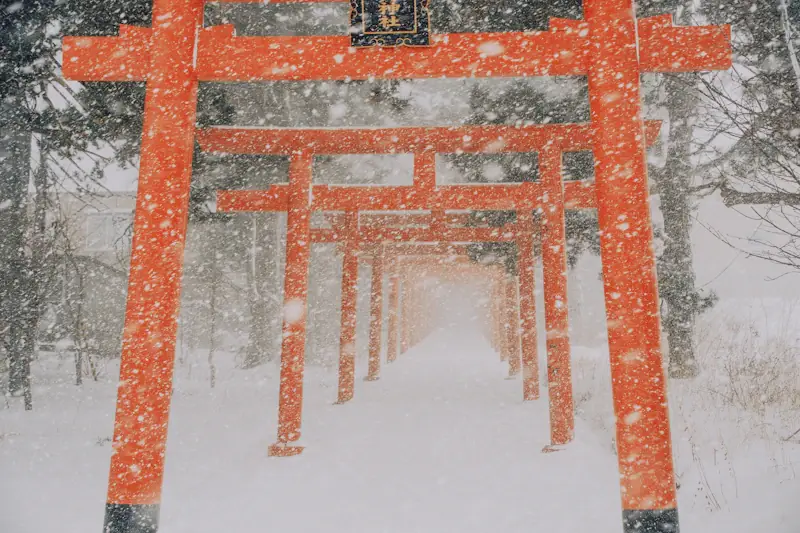
Hokkaido Jingu
Forested Shinto shrine founded to guard a frontier settlement, ringed by fourteen hundred cherry trees.
Maruyama Park
Sprawling city-edge park of virgin forest, a shrine, a zoo and Sapporo's favorite cherry-blossom grounds.
Mt. Okura Ski Jump Stadium (Ōkurayama-Schanze)
Ski jump hill and Olympic venue with a chairlift ride to a mountaintop observation deck over the city.
Sapporo Olympic Museum
Winter sports museum at a working Olympic ski jump, with simulators letting visitors feel the launch.
Art parks and onsen day trips
Sculptor Isamu Noguchi designed Moerenuma Park on a former landfill in the northeast: a glass pyramid, a man-made mountain and geometric play hills that read as a single work of land art. Southeast of the centre, Hill of the Buddha is Tadao Ando's lavender-covered mound hiding a giant stone Buddha. Beyond the city limits, Jozankei Onsen offers hot springs and autumn colour in a gorge an hour's bus ride away, and the herring-era warehouses along the Otaru Canal make the classic day trip by train.
Moerenuma Park
Reclaimed landfill reborn as a single sprawling sculpture designed by artist Isamu Noguchi.
Hill of the Buddha
Giant stone Buddha buried inside a lavender-ringed hill, its head glimpsed through a circular oculus after a dim, forty-meter tunnel walk.
Jozankei Onsen
Riverside hot-spring town where wooden hand-bath spouts shaped like water goblins invite visitors to make a wish.
Otaru Canal
Curved waterway reclaimed from the bay, lined with stone warehouses and lit by sixty-three gas lamps.
Getting around
Sapporo's grid makes navigation easy: addresses are given as blocks north/south and east/west of the Odori-Sosei intersection. Three subway lines, a tram loop around the southwest and the underground Chi-Ka-Ho walkway from the station to Susukino keep you moving even under the roughly five metres of snow the city receives each winter. Summer, with its dry, mild days, is the other peak season.