
Picasso's Hometown on the Costa del Sol
For decades most travellers saw Málaga only from an airport shuttle, racing past on their way to a resort. Their loss: this is one of Europe's oldest cities, with some 3,000 years of Phoenician, Roman and Moorish history stacked into a walkable seafront centre — and today it hums with more museums per square kilometre than almost anywhere else in Spain. It's an ideal city to wander with self-guided audio tours in your ears, letting each stone tell its story while you set the pace between fortress, cathedral and beach.
Three Millennia on One Hillside
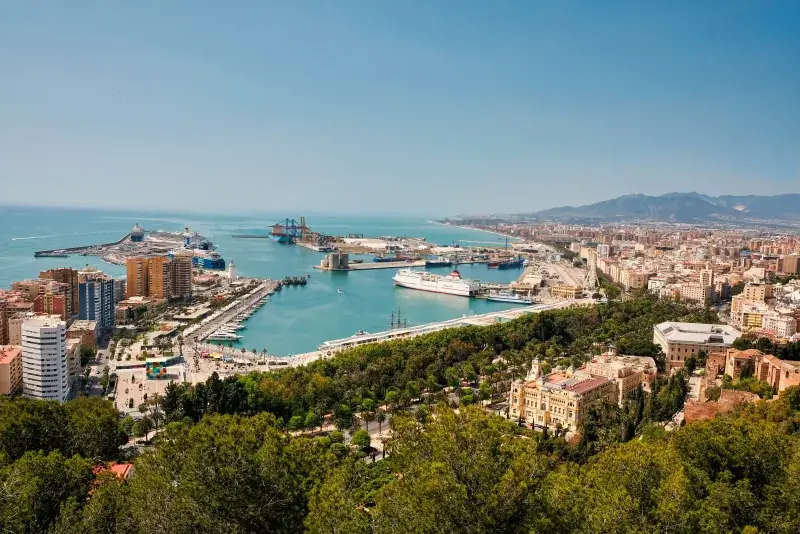
Nowhere layers history quite like the slope beneath Mount Gibralfaro. At street level sits the Roman Theatre, built in the 1st century BC and hidden underground until its rediscovery in 1951. Directly above it rise the horseshoe arches and fountain courtyards of the Alcazaba, the 11th-century Moorish fortress-palace, and higher still the ramparts of the Castillo de Gibralfaro, with sweeping views over the port and the Mediterranean — each stop has an audio guide that unpacks what your eyes are seeing. A few streets away stands the cathedral locals call La Manquita, "the one-armed lady", after the south tower that was never finished.
Málaga Roman Theatre
Sunken Roman stage and stone tiers beside a glass-pyramid view of ancient fish-sauce salting vats.
Alcazaba
Moorish hilltop fortress built from recycled Roman stone, with sweeping bay and old-town views.
Castillo de Gibralfaro
Nasrid hilltop fortress of rammed-earth and masonry walls linked to a citadel by a fortified corridor.
Santa Iglesia Catedral Basílica de la Encarnación de Málaga
Baroque facade with one soaring bell tower and one left permanently unfinished, nicknamed the one-armed lady.
An Art City Reborn
Málaga is where Pablo Picasso was born in 1881, on leafy Plaza de la Merced, and the Museo Picasso Málaga shows more than 200 of his works inside a 16th-century palace. The city has doubled down on that legacy: a colourful glass cube on the waterfront houses the Centre Pompidou Málaga, the Paris museum's first outpost abroad, while the once-gritty Soho district has become an open-air gallery of large-scale street art.
Museo Picasso Málaga
Renaissance-Mudejar palace museum holding over two hundred Picasso works above ancient Roman and Phoenician ruins.
Centre Pompidou Málaga
Multicoloured glass cube on the waterfront housing a modern art collection and a hands-on play space for young children.
Soho
Riverside arts quarter of murals and galleries, once a rough dockland tamed after a catastrophic flood.
Markets, Espetos and Sweet Wine
The city's everyday pleasures are just as rewarding. Browse the iron-and-glass Mercado de Atarazanas, built on the site of a Moorish shipyard, then stroll marble-paved Calle Larios — pedestrianised in 2003 and now the city's elegant main promenade — down to the palm-lined Muelle Uno quayside. At Playa de la Malagueta, beach shacks grill espetos, sardines skewered over open coals, best washed down with the region's sweet Moscatel wine. With the vertiginous Caminito del Rey gorge walk about an hour away, Málaga rewards far more than a stopover — give it a few days and let the audio guides fill in three millennia of stories.
Mercado de Atarazanas
Nineteenth-century iron market wrapped around a fourteenth-century Moorish shipyard gate and a vast stained-glass wall.
Calle Marqués de Larios
Grand shopping boulevard of arcaded facades, watched over by a marquis's bronze statue that was once thrown into the sea.
Muelle Uno
Revamped harbor promenade lined with yacht berths, palm trees, and a colorful glass museum cube.
Playa de la Malagueta (Málaga)
Coarse dark-sand city beach where nineteenth-century doctors once prescribed seawater as medicine.
Caminito del Rey . North Access
Cliffside boardwalk bolted to a gorge wall, starting gate for a river canyon path patrolled by griffon vultures.