
Montreal is where Europe's rhythms meet North America's scale: the largest primarily French-speaking city in the Americas, spread across an island in the St. Lawrence River and wrapped around the leafy summit that gave it its name. Founded in 1642 as the missionary settlement of Ville-Marie, it has layered nearly four centuries of stories into a remarkably walkable core — which is exactly why it rewards exploring with self-guided audio tours, moving at your own pace from cobblestone lane to mountain lookout while each landmark tells its own story in your ears.
Four centuries in a few square blocks
Old Montreal is the city's founding ground, a district where the memory of de Maisonneuve and Jeanne Mance still lingers along cobblestoned streets now lined with design shops, galleries and candle-lit bistros. At its heart rises the Notre-Dame Basilica, a Gothic Revival landmark completed in 1829 whose deep-blue vault glitters with golden stars — an interior so theatrical it draws millions of visitors a year. A few steps away, buskers and terrasses fill sloping Place Jacques-Cartier, and the Old Port's riverside promenade hums with cyclists by day and strolling couples after dark. With an audio guide, these streets become a narrated time machine — fur traders, missionaries and merchants resurfacing corner by corner.
Notre-Dame Basilica of Montreal
Gothic Revival church with a gold-starred blue vault and wood carvings raised without a single nail.
Place Jacques-Cartier
Sloping cobblestone square lined with cafes, leading downhill to a nineteenth-century admiral's column.
Vieux-Port de Montréal
Riverside park of docks and promenades, where a mothballed grain silo still looms over the water.
The mountain in the middle
Montrealers simply call it the mountain. Mount Royal Park, laid out by Frederick Law Olmsted — co-designer of New York's Central Park — and inaugurated in 1876, rises to 233 metres above the downtown towers. The reward at the top is the Kondiaronk Belvedere, a sweeping stone terrace where the skyline, the river and the distant hills line up for your camera. On the mountain's far slope, the immense dome of Saint Joseph's Oratory crowns one of the world's great pilgrimage churches.
Mount Royal Park
Sprawling hilltop park of winding carriage roads, forested slopes, and sweeping skyline views.
Kondiaronk Belvedere
Stone terrace atop a mountain, offering sweeping city and river views beside a Depression-era Beaux-Arts chalet.
Saint Joseph's Oratory of Mount Royal
Twin-shelled concrete dome poured in nine winter days, modeled on Florence's cathedral roof.
A city that likes to celebrate
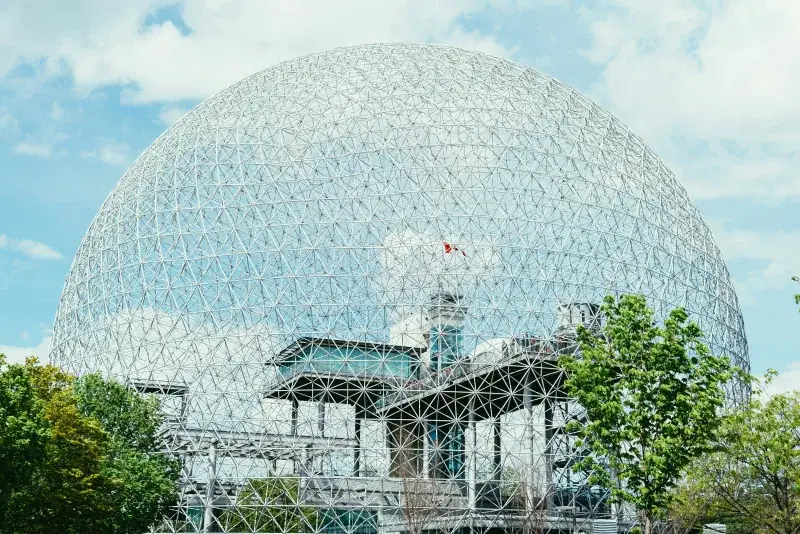
This is the town that hosted Expo 67 and the 1976 Summer Olympics — the Olympic Stadium's leaning tower still defines the eastern skyline, next to the Biodome's indoor ecosystems and a botanical garden ranked among the world's finest. Summer brings the Montreal International Jazz Festival, the largest on the planet, while a UNESCO City of Design keeps reinventing itself in murals, markets and festivals. Come hungry, too: Jean-Talon Market, wood-fired bagels and smoked-meat delis are attractions in their own right. Then press play, and let the city do the talking.
Olympic Stadium
Ribbed concrete stadium crowned by the world's largest inclined tower.
Montreal Biodome
Former Olympic velodrome reborn as walk-through rainforest, forest, marine and polar habitats.
Jardin botanique de Montréal
Seventy-five-hectare living museum of themed gardens, ten exhibition greenhouses, and thirty thousand plant species.