
Brussels is the bilingual heart of Belgium and the de facto capital of the European Union — and yet its best-loved icon is a half-metre bronze boy cheerfully relieving himself into a fountain. That blend of grandeur and self-mocking humour, what locals call belgitude, is the city's true character. Brussels rewards slow, curious exploration, and self-guided audio tours are made for it: wander the cobbled lanes at your own pace while the stories behind each façade play in your ears.
From gilded guildhalls to an iron crystal
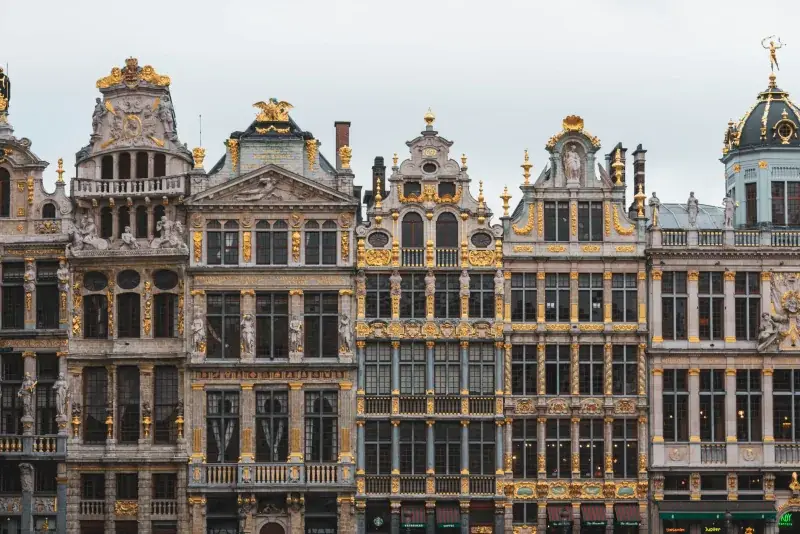
Every visit begins at the Grand Place, a UNESCO World Heritage square ringed by gilded Baroque guildhalls. Bombarded to rubble by French artillery in 1695, it was rebuilt in barely four years around its one medieval survivor — the Gothic Town Hall, whose 96-metre tower still carries a golden Saint Michael. The audio guide unpacks four centuries of drama hidden in the ornament; in August of even-numbered years the cobbles themselves vanish beneath a flower carpet of nearly a million blooms. A few streets away stands Manneken Pis, cast in bronze around 1619 and dressed on festive days from a wardrobe of roughly a thousand costumes. Then head north to the Atomium — nine steel spheres forming an iron crystal magnified 165 billion times, built for the 1958 World's Fair — and take in the panorama from 102 metres up.
Grand Place
Baroque guildhalls of gilded gables ring a grand medieval market square beneath a soaring town hall spire.
Brussels Town Hall
Gothic city hall with an intentionally off-center tower, topped by a gilded statue of the city's patron saint.
Manneken Pis
Small bronze fountain of a boy mid-stream, dressed in rotating costumes from a wardrobe of about a thousand outfits.
Atomium
Giant stainless-steel model of an iron crystal, magnified billions of times, with a lift and tube escalators to a panoramic top sphere.
Surrealism, Art Nouveau and comic strips
Brussels gave the world René Magritte, and the museum devoted to his bowler-hatted enigmas sits beside the Royal Museums of Fine Arts on the art-crowned slope of Mont des Arts. The city was also a cradle of Art Nouveau, where Victor Horta bent iron and glass into flowing new forms in the 1890s, and it proudly calls itself the capital of the comic strip — murals of beloved characters brighten whole streets, with a museum to match. Each stop has its own audio story, so the walk between them becomes part of the tour.
Magritte Museum
Townhouse museum holding the world's largest collection of a surrealist painter's work, including his most iconic images.
Belgium Royal Museums of Fine Arts
Grand art complex housing Bruegel, Rubens and David masterpieces across six connected museums.
Mont des Arts
Terraced garden and grand staircase built over a razed medieval hillside, framing sweeping views of the city skyline.
Comics Art Museum | Brussels
Art Nouveau warehouse of iron and glass by Victor Horta, now a museum tracing the comic strip's evolution.
Waffles, frites and belgitude
No city rewards aimless wandering quite like Brussels — provided you pause often for waffles, frites, pralines and a properly poured Belgian beer.
Browse the elegant glass-roofed Royal Gallery of Saint Hubert, hear the organ echo in the twin-towered cathedral of St Michael and St Gudula, and finish under the triumphal arch of Parc du Cinquantenaire. Press play, and let Brussels tell you its own story.
Royal Gallery of Saint Hubert
Glazed nineteenth-century shopping arcade of iron and glass, lined with chocolatiers, cafes and a historic theater.
St Michael & St Gudula Cathedral
Twin-towered Gothic cathedral hosting royal weddings, named for a saint and her lantern legend.
Parc du Cinquantenaire
Sprawling park centered on a triple arch crowned with a bronze horse-drawn chariot.